Korean skincare has earned its reputation not by being the most aggressive, but by being the most thoughtful. The science behind why Korean skincare gentle formulas outperform harsh alternatives comes down to one principle: your skin heals and thrives when its natural defenses stay intact. If you have ever tried a product that left your face tight, red, or flaky and called it “working,” this article will reframe everything. You will understand the biology behind barrier health, what makes Korean beauty gentle products different at the formulation level, and how to build a routine that actually delivers long-term results.
Table of Contents
- Key takeaways
- Why Korean skincare gentle formulas protect your skin barrier
- What makes Korean beauty gentle products different
- Clinical evidence supporting gentle Korean skincare benefits
- Building a gentle Korean skincare routine that works
- Common myths about gentle Korean skincare
- My perspective on gentle Korean skincare
- Explore gentle Korean skincare at Lunarashopping
- FAQ
Key takeaways
| Point | Details |
|---|---|
| Barrier health comes first | Disrupting your skin’s acid mantle leads to dryness, sensitivity, and slower repair over time. |
| Fewer ingredients, better results | Korean formulas use 10 to 20 ingredients versus 30 to 50 in standard products, reducing irritation risk. |
| pH balance drives efficacy | Products matched to your skin’s natural pH of 4.7 to 5.5 work better and cause less long-term damage. |
| Centella asiatica is clinically validated | CICA formulations show zero irritation in patch testing and measurable improvements in hydration and wrinkle depth. |
| Simplicity is the strategy | A cleanser, moisturizer, and SPF base outperforms a complicated multi-step routine for most skin types. |
Why Korean skincare gentle formulas protect your skin barrier
Your skin barrier is not just the outermost layer of your face. It is a precisely calibrated system that keeps moisture in and irritants out. At the center of this system is the acid mantle, a thin film of natural oils, amino acids, and sweat that sits on the surface of your skin. Its pH sits between 4.7 and 5.5, and that range is not arbitrary. It is the exact environment your skin’s protective enzymes need to function.
When you use a cleanser with a pH above 7 or 8, you are not just washing your face. You are temporarily dismantling this system. Soap-based cleansers above pH 8 can raise your skin’s surface pH by up to two full units for several hours after washing. That disruption removes free fatty acids from the barrier, slows enzyme activity, and leaves your skin unable to repair itself efficiently.
Here is what barrier disruption actually looks like in practice:
- Tightness and dryness after cleansing, often mistaken for “clean” skin
- Increased sensitivity to products you previously tolerated
- Redness and flaking that cycles without resolving
- Breakouts triggered by a compromised barrier allowing bacteria deeper access
- Accelerated signs of aging because a weakened barrier cannot retain moisture effectively
The acid mantle also has three distinct pH zones across the stratum corneum, each with specific biological roles. This layered architecture means even moderate disruption at the surface can affect deeper barrier repair processes. Hard water ions compound this problem by forming deposits that strip acid mantle components, making your tap water itself a potential barrier disruptor.
Korean skincare philosophy addresses this directly. Rather than treating barrier disruption as an acceptable side effect of “active” skincare, the Korean approach treats barrier preservation as the goal. Gentle formulas are not a compromise. They are the mechanism.
Pro Tip: If your skin feels tight after cleansing, that is a sign your cleanser’s pH is too high. Switch to a low pH cleanser formulated at pH 5.0 to 5.5 and notice the difference within a week.
What makes Korean beauty gentle products different
The difference between Korean beauty gentle products and conventional Western formulations is not just marketing. It shows up in the ingredient list, the pH calibration, and the formulation philosophy.
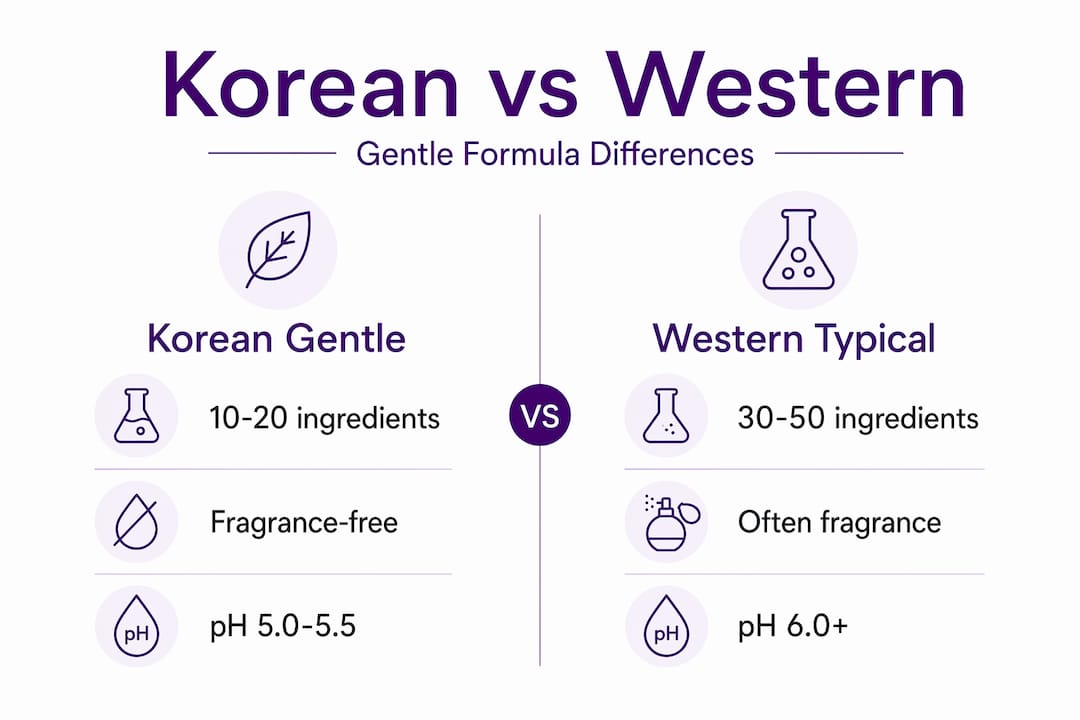
Korean sensitive-skin products typically contain 10 to 20 ingredients, compared to 30 to 50 in standard formulas. That reduction is intentional. Fewer ingredients mean fewer potential irritants, fewer interactions between compounds, and a clearer understanding of what is actually doing the work.
The fragrance-free commitment
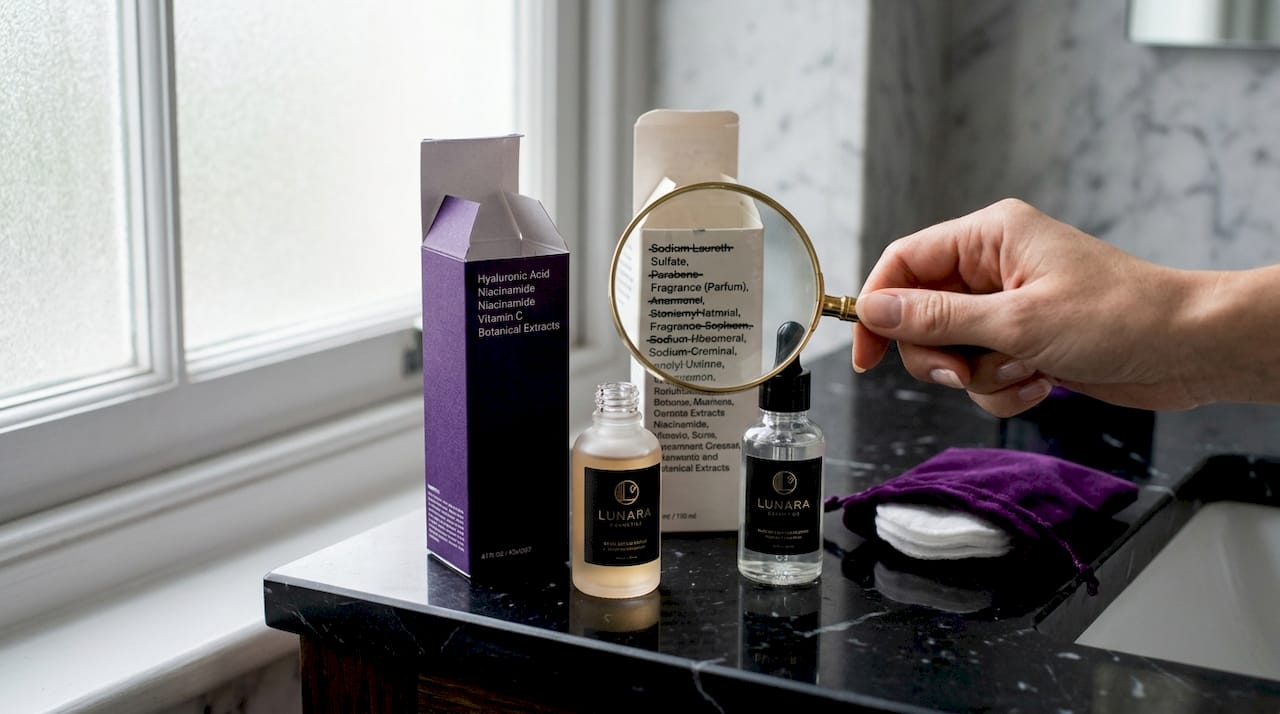
Fragrance is one of the most common causes of contact dermatitis in skincare. Many Korean formulations skip it entirely, particularly those positioned for sensitive or reactive skin. This is not a trend. It reflects a formulation standard that prioritizes skin compatibility over sensory experience.
The same logic applies to drying alcohols like denatured alcohol (alcohol denat.), which appear in many Western toners and serums to create a fast-drying, lightweight feel. Korean formulas tend to replace these with fatty alcohols like cetyl or cetearyl alcohol, which are actually hydrating, or with water-based humectants that do not compromise the barrier.
pH calibration as a design principle
| Feature | Korean gentle formulas | Typical Western formulas |
|---|---|---|
| Average pH range | 5.0 to 5.5 | 6.0 to 8.0+ |
| Fragrance inclusion | Minimal to none | Common |
| Ingredient count | 10 to 20 | 30 to 50 |
| Barrier-supportive actives | Centella, ceramides, niacinamide | Varies widely |
| Alcohol type used | Fatty alcohols (hydrating) | Drying alcohols common |
Centella asiatica as the benchmark ingredient
Centella asiatica, widely known as CICA, has become the signature ingredient of Korean barrier-repair skincare. Its popularity is not based on trend cycles. It is based on clinical data. A controlled human study found that a CICA-derived formulation produced a 24-hour patch test irritation index of 0.00, meaning zero irritation response. The same formulation reduced wrinkle depth by 7.8 to 18.8%, increased hydration by 7.9%, and reduced pore area by 17.9%.
Those are measurable, meaningful results from an ingredient that causes no irritation. That combination is exactly what defines the best gentle Korean skincare: effective without being aggressive.
Pro Tip: When scanning a Korean product’s ingredient list, look for Centella asiatica extract, madecassoside, or asiaticoside near the top. The higher these appear on the list, the more concentrated the barrier-repair benefit.
Clinical evidence supporting gentle Korean skincare benefits
The case for gentle formulas is not just philosophical. It is backed by clinical research that shows barrier-supporting products deliver measurable improvements in skin health.
A randomized split-face trial involving 40 participants found that pairing acne therapy with a bioactive moisturizer produced significantly greater hydration (p=0.001) and reduced dryness (p=0.021) compared to a traditional moisturizer. The active treatment did not change. Only the barrier support did. This tells you something important: the gentleness of your supporting products directly affects how well your active treatments perform and how well your skin tolerates them.
“Barrier-supporting moisturizers improve tolerability even when active acne treatments remain unchanged.” — Clinical finding from bioactive moisturizer research
Dermatologists consistently reinforce this approach. Simplified routines built around a cleanser, moisturizer, and SPF form the foundation that dermatologists recommend most. Layering hydrating products carefully, rather than stacking multiple actives, reduces sensitization risk and allows each product to function at its intended efficacy level.
The pH dimension matters here too. Ingredient efficacy depends on pH in ways that many consumers do not realize. A vitamin C serum at the wrong pH will not oxidize into your skin properly. A BHA exfoliant outside its effective pH range will not penetrate the pore lining. Korean formulations that calibrate pH carefully are not just gentler. They are more effective because the chemistry is correct.
Key clinical takeaways on gentle skincare:
- Barrier-supporting products improve hydration and reduce irritation even alongside strong actives
- pH-matched formulations increase active ingredient absorption and reduce tolerance issues
- Simplified routines reduce cumulative irritation from ingredient interactions
- CICA formulations show clinically validated safety and anti-aging benefits in human trials
Building a gentle Korean skincare routine that works
You do not need a 10-step routine to get results. What you need is a routine built on the right principles. Here is how to structure one that respects your barrier and delivers consistent improvement.
-
Start with a pH-balanced cleanser. Your cleanser sets the tone for everything that follows. If it disrupts your acid mantle, every product you apply afterward is working against a compromised foundation. Look for cleansers labeled pH 5.0 to 5.5, and consider a moisturizing cleansing foam that cleanses without stripping.
-
Apply a hydrating toner or essence. This step adds the first layer of moisture back to your skin post-cleansing. A niacinamide-based toner can also address uneven tone and pore appearance without irritating the barrier.
-
Seal with a moisturizer suited to your skin type. A hyaluronic acid cream provides both humectant and occlusive benefits, drawing moisture into the skin and holding it there.
-
Finish with SPF every morning. UV exposure is the single largest driver of premature aging and barrier degradation. Dermatologists recommend approximately two finger lengths of SPF applied to the face and neck, reapplied every two hours when outdoors.
-
Introduce new products one at a time. Adding multiple new products simultaneously makes it impossible to identify what is causing a reaction if one occurs. Wait at least one week between new additions.
Pro Tip: Patch test every new product on your inner forearm for 24 hours before applying it to your face. This is especially important for Korean skincare for sensitive skin, where even well-formulated products can trigger reactions in highly reactive individuals.
Evidence-based guidance consistently favors this additive approach. Adding one or two hydrating or soothing layers based on your skin’s actual response is more effective than following a prescribed multi-step routine that may not suit your skin type.
Common myths about gentle Korean skincare
Not everything marketed as Korean skincare is gentle, and not every belief about the category is accurate. Clearing up the most common misconceptions helps you make smarter choices.
-
Myth: More steps mean better skin. The 12-step routine myth has done real damage. Layering too many products increases the risk of ingredient interactions, sensitization, and barrier overload. A focused three to four step routine outperforms a complicated one for most people.
-
Myth: All Korean skincare is gentle. Some Korean products contain strong exfoliating acids, high-concentration retinoids, or fragrance. The gentle formulation philosophy is a significant part of the category, but it does not apply universally. Read ingredient lists, not just country of origin.
-
Myth: Gentle means ineffective. The clinical evidence on CICA, hyaluronic acid, and bioactive moisturizers proves otherwise. Gentle formulas produce measurable results. They just do it without triggering inflammation or barrier damage in the process.
-
Myth: You need actives to see change. Hydration, barrier repair, and consistent SPF use produce visible improvements in texture, tone, and radiance without a single exfoliating acid or retinoid. Actives have their place, but they are not the starting point.
-
Age and skin condition matter. Mature skin, compromised skin, or skin undergoing medical treatment may need different product choices. When in doubt, consult a dermatologist before adjusting your routine significantly.
My perspective on gentle Korean skincare
I have watched countless people burn through harsh actives chasing fast results, only to end up with a sensitized, reactive skin barrier that took months to rebuild. What I have learned from years of working with Korean skincare is that the gentle approach is not the cautious path. It is the smart one.
The skin barrier is not an obstacle to work around. It is the asset you are trying to protect and strengthen. Every time you strip it with an alkaline cleanser or overload it with incompatible actives, you are taking one step forward and two steps back. The Korean philosophy of respecting the barrier first and adding actives carefully is not timid. It is precise.
What I find most compelling is how Korean formulations combine traditional botanical knowledge with modern clinical validation. Centella asiatica has been used in Asian medicine for centuries, and now it has a clinical safety record that backs up every claim. That combination of tradition and science is rare in beauty.
My honest advice: stop chasing the routine you saw on social media and start listening to your skin. If it is tight, irritated, or reactive, simplify. If it is stable and comfortable, build slowly. Trust the response over the trend.
— Lunara
Explore gentle Korean skincare at Lunarashopping
If this article has shifted how you think about your routine, the next step is finding products that actually reflect these principles.
At Lunarashopping, every product in our Korean skincare collection is selected with barrier health and formulation quality in mind. The INNISFREE Green Tea Seed Hyaluronic Face Cream is one of our most popular gentle moisturizers, delivering layered hydration with green tea antioxidants and hyaluronic acid in a fragrance-conscious formula. For targeted eye care, the COSRX Advanced Snail Peptide Eye Cream offers soothing peptides and snail secretion filtrate to support the delicate periorbital area. And if you want to add a weekly hydration boost, the SUNGBOON Deep Collagen Hyalu-B5 Hydrating Mask layers collagen and hyaluronic acid for a noticeably plumper, smoother finish. Browse the full collection at Lunarashopping and build your gentle routine with confidence.
FAQ
What makes Korean skincare formulas gentler than Western ones?
Korean gentle formulas typically use 10 to 20 ingredients versus 30 to 50 in standard products, avoid fragrance and drying alcohols, and calibrate pH to match the skin’s natural acid mantle at 4.7 to 5.5. This reduces irritation risk and supports barrier function rather than disrupting it.
Is gentle Korean skincare effective for acne-prone skin?
Yes. Clinical research shows that barrier-supporting moisturizers used alongside acne treatments significantly improve hydration and reduce dryness without compromising the treatment’s effectiveness. Gentle formulas help your skin tolerate active treatments better.
How many steps should a gentle Korean skincare routine include?
Dermatologists and evidence-based guidelines recommend starting with three steps: a pH-balanced cleanser, a moisturizer, and SPF. You can add one or two targeted products based on your skin’s response, but more steps do not automatically mean better results.
Can people with sensitive skin use Korean beauty products safely?
Korean skincare for sensitive skin is one of the strongest segments of the category. Look for products labeled fragrance-free, with pH 5.0 to 5.5, and containing barrier-repair ingredients like Centella asiatica, ceramides, or niacinamide. Always patch test before full application.
Does pH really affect how well skincare products work?
Yes. pH controls active ingredient behavior in ways that directly affect both efficacy and tolerability. A product with the right active but the wrong pH will underperform and may cause unnecessary irritation. Korean formulations that calibrate pH carefully deliver better results for this reason.
Recommended
- GLAMFOX Ginseng Black Rice Low pH Cleanser (7.77oz) – Lunara Cosmetics
- FARMSTAY Ginseng & Niacinamide Facial Toner (5.07 fl.oz) – Lunara Cosmetics
- PRETTYSKIN Daily 5‑in‑1 Collagen Powerful Moisturizer (4.37oz) – Lunara Cosmetics
- SUNGBOON Deep Collagen Hyalu-B5 Hydrating Mask (1 sheet) – Lunara Cosmetics