Yes, cruelty-free K-beauty is real, widely available to U.S. shoppers, and verifiable before you buy. The key is knowing which signals to trust and which to question.
Your 3-point shelf check:
- Look for a Leaping Bunny or PETA Beauty Without Bunnies logo on the packaging or brand website.
- Confirm the brand does not sell in mainland China, where post-market animal testing can still apply.
- Check the parent company’s testing policy, not just the sub-brand’s claim.
For the safest shopping experience, stick to authorized U.S. retailers that specialize in Korean skincare and can confirm brand sourcing. Skincare staples like cleansers and serums are the easiest category to verify.
Key Takeaways
Verified cruelty-free K-beauty is accessible to U.S. shoppers, but it requires a three-step check: third-party certification, China-market status, and parent-company policy.
| Point | Details |
|---|---|
| Third-party certs are the strongest signal | Leaping Bunny audits supply chains; PETA’s database is pledge-based but searchable and free. |
| China sales require direct confirmation | Brands selling in mainland China may face post-market testing; always ask for exemption documentation. |
| Self-declared is not the same as verified | “Not tested on animals” without a supplier audit leaves gaps in the cruelty-free claim. |
| Skincare is easier to verify than makeup | Cleansers and serums have simpler supply chains; makeup colorants need deeper supplier-level checks. |
| Lunarashopping stocks vetted K-beauty brands | The Morning Face Care Routine Set and full face care collection offer a curated, U.S.-accessible starting point. |
Table of Contents
- What does “cruelty-free” actually mean, and how is it different from “vegan”?
- How to verify a K-beauty brand’s cruelty-free status before you buy
- Verified cruelty-free K-beauty brands available to U.S. shoppers
- Which brands should you watch or avoid?
- Where can you buy cruelty-free K-beauty in the United States?
- How to choose cruelty-free K-beauty products: a practical product-page checklist
- How we verified the claims in this article
- Why this guide exists, from Lunara
- Vetted cruelty-free K-beauty, ready to shop at Lunarashopping
- Sources
What does “cruelty-free” actually mean, and how is it different from “vegan”?
“Cruelty-free” means no animal testing was conducted at any stage of product development or the supply chain, including by ingredient suppliers and third-party manufacturers. The label says nothing about what is in the formula.
“Vegan,” by contrast, means the product contains no animal-derived ingredients, such as beeswax, lanolin, or carmine. A product can be vegan but tested on animals, and a product can be cruelty-free but contain animal-derived ingredients like honey or collagen. Vegan covers ingredient content only, not testing practices, which is why the two certifications are issued separately and by different bodies.
Here is how the most common label language typically breaks down:
| Label | What It Usually Means | Third-Party Verified? |
|---|---|---|
| “Not tested on animals” | Self-declared; no supplier audit required | No |
| “Never tested on animals” | Stronger self-declaration; still no audit | No |
| Leaping Bunny certified | Supply-chain audit by independent certifier | Yes |
| PETA Beauty Without Bunnies | Brand signed a pledge; PETA lists them | Partial |
| Vegan certified (Vegan.org) | No animal ingredients; testing not covered | Yes (ingredients only) |
Pro Tip: The phrase “we do not test on animals” is a self-declaration. Without a third-party audit covering suppliers, it leaves a meaningful gap. A Leaping Bunny logo closes that gap; a pledge alone does not.
How to verify a K-beauty brand’s cruelty-free status before you buy
Verification works best as a layered process. No single step is enough on its own, but combining three checks gives you a reliable answer.
Step 1: Check for third-party certification logos. Leaping Bunny is widely regarded as the gold standard because it audits the entire supply chain, including ingredient suppliers, and requires brands to renew annually. PETA’s Beauty Without Bunnies database is searchable and free, though it relies on a brand pledge rather than a full supply-chain audit. Both are useful starting points.
Step 2: Check whether the brand sells in mainland China. Animal testing is banned in South Korea, but that protection does not follow a product across borders. Brands that sell in mainland China can be subject to post-market animal testing under Chinese regulations, even if the brand’s home country prohibits it. Ethical Bunny’s K-beauty guide makes clear that selling in China does not automatically disqualify a brand, but it does require direct confirmation that the brand’s specific products are exempt (for example, through cross-border e-commerce channels that carry different rules). When in doubt, contact the brand.
Step 3: Check the parent company’s policy. A sub-brand can claim cruelty-free status while its parent company tests on animals for other product lines. The parent company’s policy can affect supplier relationships and ingredient sourcing across the portfolio.
Step 4: Read the brand’s policy page and search certification databases. Search the brand name in both the Leaping Bunny database and PETA’s company search. If the brand is not listed, that absence is itself informative.
Step 5: Email the brand directly. A one-sentence email works well: “Can you confirm that your products are not tested on animals at any stage of production, including by ingredient suppliers, and that you do not sell in markets that require animal testing?” Cruelty-Free Kitty contacted over 100 K-beauty brands using direct outreach and classified each as cruelty-free, not cruelty-free, or grey area based on the responses received.
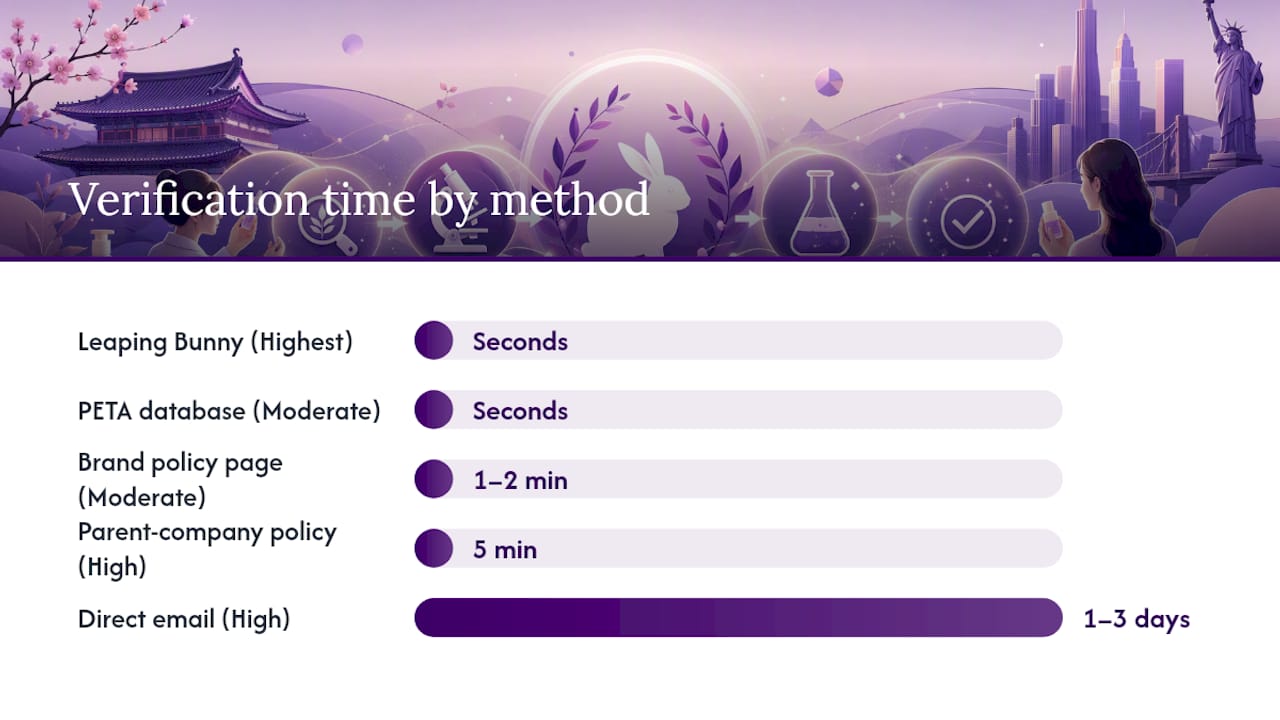
| Verification Method | Reliability | Time Required |
|---|---|---|
| Leaping Bunny certification | Highest (supply-chain audit) | Seconds (database search) |
| PETA Beauty Without Bunnies | Moderate (pledge-based) | Seconds (database search) |
| Brand policy page | Moderate (self-declared) | 1–2 minutes |
| Direct email to brand | High when detailed response given | 1–3 days |
| Parent-company policy check | High for portfolio-wide clarity | 5 minutes |
Pro Tip: If a brand responds with “we comply with all applicable laws” or “we do not test unless required by law,” treat that as a grey-area signal. That phrasing leaves room for testing in markets where it is legally mandated. Ask specifically whether they sell in mainland China and whether their suppliers are audited.
Verified cruelty-free K-beauty brands available to U.S. shoppers
The brands below have been assessed using publicly available certification data, brand policy pages, and third-party database listings. Verification status reflects information available at the time of writing; always confirm directly before purchasing.
COSRX is one of the most widely stocked Korean skincare brands in the U.S. and is self-declared cruelty-free. The brand states it does not test on animals and does not sell in mainland China through channels that require testing. COSRX products are available through Lunarashopping, including the COSRX Lip Plump AHA BHA Vitamin C Lip Plumper. Verify current status via the PETA database before purchasing.
Beauty of Joseon is a self-declared cruelty-free brand with a strong following among U.S. skincare enthusiasts. The brand’s policy states no animal testing at any stage. It is available through multiple authorized U.S. retailers and is a staple in the cruelty-free Korean skincare community.
Krave Beauty is founded by Liah Yoo and is one of the more transparent K-beauty brands on the market. Krave publishes detailed ingredient sourcing information and maintains a clear cruelty-free policy. It is self-declared and widely listed on cruelty-free databases. Available through U.S. authorized retailers.
SKIN1004 is a self-declared cruelty-free brand known for its centella asiatica formulas. The brand states it does not conduct or commission animal testing. Available through U.S. e-commerce channels; confirm current China-market status directly with the brand.
Innisfree presents a more complex picture. The brand’s U.S. story page positions it with a conscious, cruelty-free identity for certain markets. However, Innisfree is owned by Amorepacific, a large conglomerate that has historically sold products in mainland China. Shoppers should verify the current parent-company policy and which specific product lines are sold in which markets before purchasing. The Innisfree Dewy Treatment Lip Balm is available at Lunarashopping; confirm cruelty-free status for your specific product directly with the brand.
Purito is a self-declared cruelty-free brand with a focus on gentle, minimal formulations. It is listed on several cruelty-free databases and does not appear to sell in mainland China through channels requiring animal testing. Available through authorized U.S. retailers.
For makeup categories, verification is more involved. Colorants and pigments often come from separate suppliers, and those suppliers may operate under different testing standards. Skincare staples like cleansers, serums, and toners are generally easier to verify because the supply chains tend to be simpler and better documented.
Which brands should you watch or avoid?
Certain patterns reliably signal that a brand’s cruelty-free claim deserves extra scrutiny. Recognizing them protects you from unintentionally supporting animal testing.
| Red Flag | What It Signals | Recommended Action |
|---|---|---|
| Sells in mainland China (physical retail) | Post-market testing may apply | Contact brand; ask about exemption status |
| Parent company tests on animals | Supplier overlap risk | Check parent-company policy separately |
| Vague policy language (“unless required by law”) | Testing in regulated markets possible | Treat as grey area; seek certified alternatives |
| No response to direct verification email | Transparency gap | Do not assume cruelty-free; seek alternatives |
| No listing in Leaping Bunny or PETA database | Unverified self-declaration only | Rely on direct outreach and policy review |
Brands in the grey area are not necessarily testing on animals, but they have not provided enough evidence to confirm they are not. The most common reason a brand lands in grey-area status is selling in mainland China without clear documentation of an exemption, or having a parent company with a mixed testing policy.
If a brand you love is on your personal watchlist, the practical steps are: email the brand with a specific question about China sales and supplier audits, check whether their status has changed in the Leaping Bunny or PETA databases, and consider a verified alternative in the meantime.
Where can you buy cruelty-free K-beauty in the United States?
Authorized, specialist retailers are the safest channel. They source directly from brands or licensed distributors, which reduces the risk of gray-market imports, counterfeit products, or outdated stock.
Reliable U.S. retail channels:
- Specialist K-beauty e-tailers like Lunarashopping stock vetted brands and can confirm sourcing. Lunarashopping carries brands including COSRX, Innisfree, and Beauty of Joseon, and provides product-level detail to help you shop with confidence. Browse the full face care selection for a curated starting point.
- Brand-direct websites are reliable for authenticity but require you to verify cruelty-free status independently using the steps above.
- Leaping Bunny and PETA certified retail partners have agreed to stock only verified cruelty-free products in designated sections; check each certifier’s retailer list.
- Reputable brick-and-mortar beauty retailers that carry authorized K-beauty lines are generally safe for authenticity, though cruelty-free verification still falls to you.
Marketplace checklist (for third-party sellers on Amazon, eBay, or similar platforms):
- Confirm the seller is the brand itself or an authorized distributor.
- Check product packaging photos for batch codes and ingredient lists.
- Compare the ingredient list against the brand’s official website.
- Avoid listings with suspiciously low prices, which often indicate gray-market or counterfeit stock.
For a deeper look at shopping Korean skincare online safely, Lunarashopping’s buyer’s guide covers authenticity checks and seller vetting in detail.
U.S. buyer protections to use: Purchase with a credit card that offers purchase protection, confirm the retailer’s return policy before checkout, and keep your order confirmation in case a product arrives damaged or misrepresented.
How to choose cruelty-free K-beauty products: a practical product-page checklist
Start at the brand level, then move to the product level. A cruelty-free brand claim covers the company’s testing policy; a product-page check confirms what is actually in the formula and how it was made.
| Checklist Item | What to Look For | Priority |
|---|---|---|
| Certification logo | Leaping Bunny or PETA logo on packaging or brand site | First |
| Parent-company policy | Confirm parent brand does not test | First |
| China market status | No physical retail in mainland China, or documented exemption | First |
| Ingredient list | No animal-derived ingredients if vegan claim is also made | Second |
| Fragrance and allergen flags | Check for common sensitizers if you have reactive skin | Second |
| Batch code and packaging photos | Confirm authenticity and match to official product | Third |
| Brand policy link | Direct URL to cruelty-free statement on brand’s own site | Third |
Skincare categories like cleansers, hydrating serums, and sheet masks are the easiest to verify because they typically have shorter supply chains and fewer specialty ingredients. Makeup products, particularly those with synthetic colorants or mineral pigments sourced from multiple suppliers, require more thorough supplier-level verification. If you are checking a Korean sunscreen, pay attention to UV-filter sourcing, as some chemical filters are manufactured by suppliers that operate in markets with different testing standards.
For shoppers with sensitive or reactive skin, fragrance-free formulas narrow the field further but are generally well-represented in cruelty-free K-beauty. Brands like Purito and SKIN1004 both offer fragrance-free options within their self-declared cruelty-free lines.
How we verified the claims in this article
Transparency matters, especially on a topic where brand language can be ambiguous. Here is how the information in this guide was gathered and assessed.
- Databases checked: Leaping Bunny’s certified brand list and PETA’s Beauty Without Bunnies searchable database, both accessed for this article.
- Brand policy pages reviewed: Official brand websites for each featured brand were reviewed for cruelty-free policy language and China-market disclosures.
- Third-party guides consulted: Cruelty-Free Kitty’s K-beauty brand guide and Ethical Bunny’s K-beauty guide were used as reference frameworks for classification methodology.
- Ambiguous responses handled: Brands with vague policy language or no third-party listing are noted as grey area or self-declared, not as verified cruelty-free.
- Verification date: Brand status information reflects publicly available data as of early 2026. Brand policies change; always confirm directly before purchasing.
- Publisher: This article is authored by Lunara, editorial team at Lunarashopping, a U.S.-based Korean skincare retailer. Lunarashopping stocks several of the brands featured here and has a direct interest in accurate, trustworthy product information.
Why this guide exists, from Lunara
At Lunarashopping, we do not think shoppers should have to dig through five tabs to confirm whether a product aligns with their values. Cruelty-free sourcing is a priority in how we select the brands we carry, and that means going beyond a brand’s self-declaration. We look at parent-company policies, market distribution, and third-party certification status before adding a brand to our catalog.
This guide exists because the information is genuinely scattered, and the stakes are real. When a brand’s language is ambiguous, we treat it as ambiguous, not as verified. We will keep updating this resource as brand policies and regulatory frameworks evolve.
Vetted cruelty-free K-beauty, ready to shop at Lunarashopping
Lunarashopping gives U.S. shoppers direct access to Korean skincare brands with sourcing you can trace. Rather than sorting through marketplace listings from unknown sellers, you get a curated selection from brands like COSRX, Innisfree, and Beauty of Joseon, stocked by a retailer that has already done the first layer of vetting.
The Morning Face Care Routine Set is a practical starting point if you want a complete cruelty-free K-beauty routine without building it piece by piece. For broader browsing, the full face care collection covers cleansers, serums, moisturizers, and more. Every order ships with a clear return policy and authenticity backed by authorized sourcing. Use the Custom Skincare Kit Builder to put together a routine matched to your skin type and concerns, with cruelty-free options front and center.
Sources
Use these resources directly when verifying any brand not covered in this article.
- The Official Cruelty Free K-Beauty Guide - Ethical Bunny
- The Ultimate Guide to Cruelty-Free K-Beauty Brands (60+ Brands Verified) | Cruelty-Free Kitty
- Leaping Bunny
- PETA cruelty-free company search
- Vegan
When using these resources, search the brand name and the parent company name separately. A brand may appear cruelty-free in one database while its parent company is listed as not cruelty-free in another, and that discrepancy is itself a signal worth investigating.