
Most Korean sunscreens are not FDA-approved for retail sale in the U.S. in their original Korean-market formulations. Some Korean brands do sell U.S.-compliant versions, but those products are often reformulated with different active ingredients to meet FDA requirements.
Here is what that means for you right now:
- Only FDA-compliant formulations can be legally sold in U.S. stores. The FDA classifies sunscreens as over-the-counter (OTC) drugs, not cosmetics, which means every product sold at retail must carry a Drug Facts panel listing only FDA-permitted active ingredients.
- The 2026 bemotrizinol approval matters, but it is not a complete reset. The FDA added bemotrizinol (also known internationally as Tinosorb S and PARSOL Shield) to its OTC monograph effective August 9, 2026, the first new sunscreen filter approved in over 20 years. That narrows the gap between U.S. and Korean formulas, but many other filters used in Korean products remain unapproved.
- Your fastest compliance check: flip the bottle and look for a Drug Facts panel with an Active Ingredients section. No Drug Facts label on a product sold in a U.S. store is a red flag.
Key Takeaways
The single most important fact for U.S. shoppers: FDA compliance is determined by the Drug Facts panel, not the brand’s country of origin, and bemotrizinol’s 2026 approval narrows but does not close the gap between U.S. and Korean sunscreen formulas.
| Point | Details |
|---|---|
| FDA OTC drug classification | Sunscreens sold in U.S. retail must carry a Drug Facts panel; Korean-market imports often do not. |
| Bemotrizinol approved August 9, 2026 | First new U.S. sunscreen filter in 20+ years; U.S. labels will list it as “bemotrizinol,” not Tinosorb S. |
| Many Korean filters still unapproved | Tinosorb M, Uvinul A Plus, and others remain off the FDA list, so most Korean formulas still need reformulation. |
| Reformulated U.S. versions can test differently | Consumer Reports found Korean-market formulas sometimes outperformed U.S. versions in lab UV protection tests. |
| Lunarashopping for compliant Korean SPF | Lunarashopping’s curated U.S.-market listings display Active Ingredients clearly, simplifying compliance checks. |
This article is general information, not a substitute for advice from a qualified doctor. Consult a qualified healthcare professional about your own circumstances before acting on anything here.
Table of Contents
- Why do Korean and U.S. sunscreens use different ingredients?
- What does the 2026 bemotrizinol approval actually change?
- How can you tell if a Korean-branded sunscreen sold in the U.S. is compliant?
- Is it safe or legal to use imported Korean sunscreens in the U.S.?
- Want the Korean sunscreen feel with U.S.-compliant protection?
- Quick recap: what U.S. buyers should remember
- The part most coverage gets wrong about Korean sunscreen and the FDA
- Lunarashopping carries curated Korean skincare built for U.S. shoppers
- Sources
Why do Korean and U.S. sunscreens use different ingredients?
The answer comes down to one regulatory distinction. In the U.S., sunscreens are regulated as OTC drugs under the FDA’s monograph system, which sets a defined list of permitted active ingredients, required labeling language, and testing standards. Any new UV filter must go through a lengthy review process before it can appear on a U.S. label. In South Korea, sunscreens are classified as cosmetics, which allows regulators to approve newer filters much faster and lets brands market products using PA ratings and international filter names like Tinosorb S.
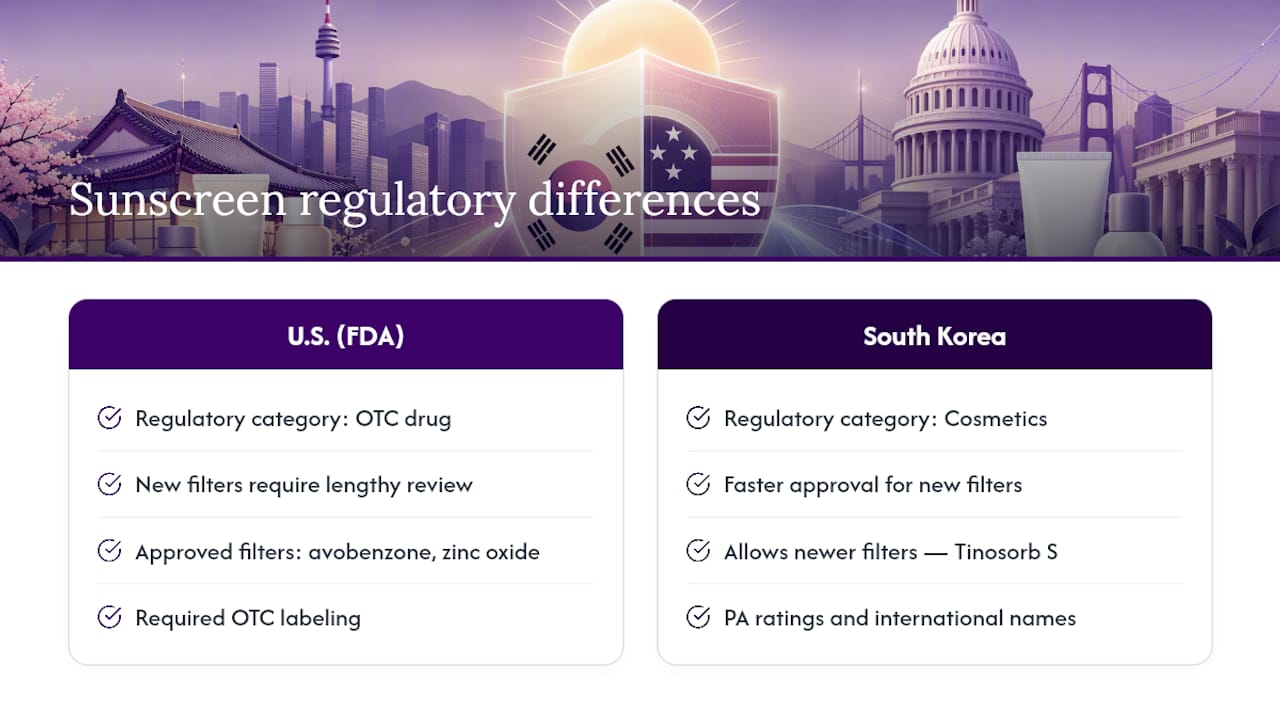
Board-certified dermatologist Dr. Jane Yoo describes this as the root of the confusion U.S. shoppers experience: the OTC drug pathway creates a higher barrier for new filters, which is why Korean formulas have historically included more advanced UV blockers than their U.S. counterparts.
The practical consequences are real. When a Korean brand wants to sell in U.S. stores, it typically reformulates, swapping out unapproved filters for FDA-permitted ones like avobenzone or zinc oxide. That reformulation often changes the product’s texture, finish, and measured protection level.
Consumer Reports laboratory testing found that original Korean-market formulas sometimes provided stronger UV protection than the same brands’ U.S. versions, a direct result of those regulatory-driven ingredient swaps.
Key finding: Consumer Reports’ head-to-head tests showed that reformulated U.S. versions of Korean sunscreens can underperform their Korean-market counterparts on lab measures of UV protection, because complying with FDA rules requires replacing more effective filters with approved alternatives.
What this means for your skin: the product you buy in a U.S. store under a Korean brand name may protect you differently than the version sold in Seoul, even if the packaging looks nearly identical. Checking the formulation differences between Korean SPF products before you buy is worth a few minutes of your time.
What does the 2026 bemotrizinol approval actually change?
The FDA approved bemotrizinol as a permitted sunscreen active ingredient, with the final order taking effect August 9, 2026. It is the first new UV filter added to the U.S. OTC monograph in more than 20 years. Bemotrizinol is a broad-spectrum organic filter with strong photostability, meaning it does not degrade quickly under UV exposure, qualities considered as safety and efficacy advantages.
The ingredient goes by three names depending on where you encounter it:
- Bemotrizinol (INCI name, used on U.S. Drug Facts labels)
- Tinosorb S (trade name used in European and Korean markets)
- PARSOL Shield (trade name used by DSM-Firmenich, the company that filed the FDA application)
Tinosorb S, bemotrizinol, and PARSOL Shield are the same molecule marketed under different names. If you see any of those three on a label, you are looking at the same filter.
What the approval does not do is equally important. Many Korean formulas pair bemotrizinol with other next-generation filters such as Uvinul A Plus, Uvinul T150, Tinosorb M, and Uvasorb HEB, none of which are currently on the FDA-approved list. A Korean-market product containing bemotrizinol alongside any of those unapproved filters still cannot be legally sold in U.S. retail as-is. Reformulation is still required.
There is also a commercial timing factor. DSM-Firmenich, which markets bemotrizinol as PARSOL Shield, holds an 18-month marketing exclusivity window tied to commercialization. Supply and licensing constraints mean bemotrizinol-containing U.S. products will roll out gradually, not all at once.
Pro Tip: When you shop for a sunscreen labeled with Tinosorb S or PARSOL Shield in the U.S., confirm that the Drug Facts panel lists “bemotrizinol” as the active ingredient. Marketing copy on the front of the bottle may use the trade name, but the back panel is where legal compliance lives.
How can you tell if a Korean-branded sunscreen sold in the U.S. is compliant?
Use this checklist before you buy, whether you are shopping online or in a store:
- Find the Drug Facts panel. Every sunscreen legally sold in U.S. retail must have one. No Drug Facts label means the product is not FDA-compliant for U.S. retail sale.
- Read the Active Ingredients section. Cross-reference every listed ingredient against the FDA’s permitted sunscreen actives. Approved options include avobenzone, zinc oxide, titanium dioxide, octinoxate, octisalate, and now bemotrizinol.
- Confirm a “broad spectrum” claim. This tells you the product has passed FDA testing for both UVA and UVB protection.
- Check the SPF value and water-resistance language. U.S. labels must state SPF as a number and use specific language for water resistance (“water resistant 40 minutes” or “water resistant 80 minutes”). PA ratings like PA++++ are Korean-market designations and do not substitute for FDA-required language.
- Look at where the product is marketed. A product with Korean-only text and no Drug Facts is likely a Korean-market import, not a U.S.-compliant retail item.
Red flags to watch for:
- Labels printed only in Korean with no English Drug Facts
- Active ingredient names like Tinosorb M, Uvinul A Plus, or Uvasorb HEB, which are not FDA-approved
- SPF claims without a “broad spectrum” designation
Pro Tip: When browsing Korean SPF products on Lunarashopping, check the product page’s Active Ingredients section directly. Lunarashopping’s curated U.S.-market listings display this information clearly, so you can confirm compliance before adding anything to your cart. The buyer’s guide for Korean skincare on the site walks you through what to look for.
Is it safe or legal to use imported Korean sunscreens in the U.S.?
The legal and safety questions here have different answers, and conflating them leads to real confusion.
On the legal side, the distinction is straightforward:
- Personal-use importation of small quantities is common and generally not intercepted by customs, but those products remain outside U.S. retail legality.
- Retail sale of non-compliant sunscreens in U.S. stores is not permitted. Retailers and customs can stop non-compliant shipments intended for commercial sale.
On the safety side, the picture is more nuanced. Many UV filters used in Korean-market sunscreens have extensive international safety data and are approved in the EU, Australia, and Japan. The safety record of filters like Tinosorb S is well-documented. The issue is not that these ingredients are dangerous; it is that they have not completed the FDA’s specific approval process for the U.S. market.
Practical risks to keep in mind when using imported Korean sunscreens:
- SPF claims on imported products are not verified against FDA testing standards, so measured protection may differ from the label.
- Water-resistance labeling may not follow U.S. conventions, making it harder to know when to reapply.
- Counterfeit products sold through unverified channels can carry inaccurate SPF claims or unlisted ingredients.
Want the Korean sunscreen feel with U.S.-compliant protection?
The good news is that you do not have to choose between a lightweight, non-comedogenic Korean texture and FDA compliance. Several Korean brands now sell U.S.-market versions with Drug Facts panels, using approved filters while preserving the finish that made their Korean-market products popular.
The approach that works best for most U.S. shoppers:
- Buy U.S.-market labeled versions of Korean brands from trusted U.S. retailers. The Drug Facts panel confirms compliance.
- Check the Active Ingredients list for approved filters. Zinc oxide and titanium dioxide are common in U.S. versions of Korean brands and still deliver broad-spectrum protection.
- Watch for bemotrizinol-containing U.S. launches as they become available. Given the 18-month exclusivity window and reformulation lead times, rollout will be gradual through 2026 and into 2027.
One vetted example available through Lunarashopping is the Beauty of Joseon Relief Sun: Rice + Probiotics SPF 50+. This product is a strong choice for U.S. shoppers who want a Korean-textured sunscreen with a lightweight, non-comedogenic finish. It delivers SPF 50+ broad-spectrum protection, absorbs cleanly without a heavy white cast, and suits oily and combination skin types well. Check the product page for the current U.S.-market formulation’s Active Ingredients panel before purchasing, as formulations can be updated.
For readers who want a deeper look at how Korean sunscreen textures and filter types compare, Lunarashopping’s 2026 skin-fit guide to Korean sunscreen types breaks down the options by skin type and finish.
Quick recap: what U.S. buyers should remember
The 2026 bemotrizinol approval is the most significant update to U.S. sunscreen regulation in over two decades, but it does not automatically make Korean-market formulations U.S.-compliant.
| Point | Details |
|---|---|
| FDA classifies sunscreens as OTC drugs | Every sunscreen sold in U.S. retail must carry a Drug Facts panel with approved active ingredients. |
| Bemotrizinol approved August 9, 2026 | First new U.S. sunscreen filter in 20+ years; look for “bemotrizinol” on the Active Ingredients panel. |
| Many Korean filters remain unapproved | Uvinul A Plus, Uvinul T150, Tinosorb M, and Uvasorb HEB are not yet on the FDA-permitted list. |
| Reformulated U.S. versions may test differently | Consumer Reports found Korean-market formulas sometimes outperformed their U.S. counterparts in lab tests. |
| Lunarashopping curates U.S.-market listings | Product pages show Active Ingredients clearly, making compliance verification straightforward for U.S. shoppers. |
The part most coverage gets wrong about Korean sunscreen and the FDA
The 2026 bemotrizinol approval generated a wave of headlines suggesting the U.S. sunscreen market was about to catch up with Korea overnight. That framing overstates what one ingredient approval can do.
The real story is more specific. Bemotrizinol is a genuinely excellent broad-spectrum filter with strong photostability, and its approval matters. But Korean sunscreen formulas that perform exceptionally well in lab tests typically combine three, four, or more next-generation filters working together. Approving one of them does not replicate that synergy. The filters that remain unapproved, including Tinosorb M and Uvinul A Plus, are not minor additions; they are core components of many high-performing Korean formulas.
What U.S. shoppers should actually prioritize is simpler than the headlines suggest: verify the Drug Facts panel, confirm broad-spectrum coverage, and buy from a retailer whose product pages make that information easy to find. Chasing the Korean-market version of a product for slightly higher lab scores is not worth the compliance and labeling uncertainty that comes with it, especially when U.S.-market versions from trusted Korean brands are genuinely good.
Lunarashopping carries curated Korean skincare built for U.S. shoppers
Sorting through Korean SPF products to find ones that are genuinely FDA-compliant takes time most shoppers do not have. Lunarashopping does that work for you. Every product in the face care collection is selected with U.S.-market compliance in mind, and each product page displays Active Ingredients clearly so you can verify before you buy.
Whether you want a lightweight daily sunscreen, a non-comedogenic formula for oily skin, or a full morning routine that pairs cleanser, moisturizer, and SPF, Lunarashopping’s morning face care routine set and complete face care collection give you a curated starting point. Browse the collection and check the Active Ingredients panel on any product page to confirm it fits your skin and your standards.
Sources
- Do Korean sunscreens offer better protection? CR puts them to the test
- The U.S. Food and Drug Administration’s recent approval of its first new sunscreen ingredient in decades is like a flashing green light for South Korea
- FDA approves bemotrizinol, opening door to Korean sunscreen in the U.S.