If you’ve ever stood in front of a K-beauty shelf wondering whether a “lotion” and an “emulsion” are the same product, you’re not alone. Understanding why Korean emulsions differ from moisturizers goes deeper than texture. It’s about formulation science, a layering philosophy that Western skincare rarely applies, and a fundamentally different theory of how skin gets and stays hydrated. This article breaks down exactly what sets these two product types apart, when each one earns its place in your routine, and how to use both for genuinely better skin.
Table of Contents
- Key Takeaways
- How Korean emulsions differ from moisturizers at a formulation level
- The layering philosophy behind Korean skincare
- Choosing between emulsions and creams by season and skin type
- Korean emulsions vs. Western moisturizers
- Practical tips for using emulsions and moisturizers effectively
- My honest take on the emulsion vs. cream debate
- Build your Korean skincare routine with Lunarashopping
- FAQ
Key Takeaways
| Point | Details |
|---|---|
| Emulsions are water-first formulas | Korean emulsions are predominantly water-based with low oil content, absorbing quickly without residue. |
| Creams provide occlusive protection | Richer moisturizers form a longer-lasting barrier, best suited for dry skin and cold climates. |
| Layering multiplies hydration depth | Applying a lightweight emulsion under a cream delivers more effective hydration than one thick product alone. |
| Skin type and season drive the choice | Oily skin and humid summers favor emulsions; dry skin and winter conditions call for richer creams. |
| Formulation science explains the difference | The emulsifier’s oil-to-water ratio and HLB value determine whether a product feels light or rich on skin. |
How Korean emulsions differ from moisturizers at a formulation level
Most people assume a Korean emulsion is simply a lighter moisturizer. That assumption misses the real story. The difference is rooted in chemistry, specifically in the oil-to-water ratio and the emulsifier system that holds the formula together.
A skin emulsion, in technical terms, is a stabilized blend of water and oil where one phase is dispersed throughout the other. Korean emulsions are oil-in-water (O/W) formulas. The water phase dominates, typically making up 75 to 85% of the product, while oils are dispersed in tiny droplets throughout. The result is a milky, liquid texture that absorbs within seconds and leaves virtually no film on skin.
Traditional moisturizers, especially creams, work differently. A standard moisturizing cream carries roughly 20 to 30% oil, and rich night creams can push that ratio to 40%. That higher oil content translates directly to a denser texture, slower absorption, and a protective occlusive film that locks in moisture for hours.
What makes this more than just a texture difference is the emulsifier. Emulsifiers are ingredients that hold oil and water together in a stable blend. Their HLB value (Hydrophilic-Lipophilic Balance) determines whether the product becomes light or rich. Korean emulsions use high-HLB emulsifiers (typically in the 8 to 18 range), which produce light, fast-spreading oil-in-water textures. Rich creams use lower HLB systems that favor water-in-oil textures with more staying power.
Here is what this means practically for your skin:
- Korean emulsions spread easily, absorb fast, and feel like cool, thin silk on the skin. No tackiness, no shine.
- Rich moisturizing creams take longer to absorb, leave a soft film, and provide sustained barrier protection.
- The unique stability provided by emulsifier choice is why emulsions and creams differ despite sometimes sharing the same individual ingredients.
Pro Tip: Check the first five ingredients on any product label. If water is first and oil-derived ingredients appear further down the list, you are likely holding an emulsion. If oils, butters, or waxes appear near the top, it is a richer cream.
The layering philosophy behind Korean skincare
Korean skincare does not treat moisturization as a single step. It treats hydration as something you build, layer by layer. This approach is central to understanding why emulsions exist as a distinct product category in K-beauty, rather than being an afterthought or a watered-down cream.
The standard layered routine in Korean skincare follows this general sequence:
- Cleanser removes surface debris and prepares a clean base.
- Toner restores pH and delivers initial hydration.
- Essence or serum targets specific concerns with concentrated actives.
- Emulsion adds a lightweight hydration layer that primes the skin for richer products.
- Cream seals everything in with an occlusive or semi-occlusive barrier.
The emulsion occupies a specific, strategic position in this sequence. It is thicker than a toner but lighter than a cream. Layering lighter emulsions under richer creams builds hydration more effectively than applying one thick product alone because each thin layer absorbs fully before the next is applied.
This also explains why many K-beauty users with oily or combination skin use emulsions as their final moisturizing step and skip a separate cream entirely. The emulsion delivers sufficient hydration without adding weight or clogging pores. For those with dry skin, the emulsion creates a primed, hydrated base that allows the subsequent cream to work more efficiently, rather than sitting on the surface.
Pro Tip: Apply your emulsion to slightly damp skin, right after your toner or essence. The residual water on the skin surface helps the emulsion spread more evenly and absorb more deeply.
Choosing between emulsions and creams by season and skin type
No single moisturizer works perfectly for every climate or skin type, and this is where K-beauty’s flexible approach genuinely outperforms a one-product strategy. The decision between an emulsion and a richer cream should shift with your environment and your skin’s current condition.
In humid, warm weather, your skin already retains moisture more easily, and heavier creams can feel suffocating. Emulsions in humid climates deliver breathable hydration that won’t congest pores, making them the preferred choice through spring and summer. Gels and emulsions in these conditions absorb in 15 to 30 seconds and create minimal occlusivity, which is exactly what skin needs when the air itself provides some moisture.
Cold, dry air pulls moisture from your skin constantly. In these conditions, a thicker cream that maintains occlusivity for 12+ hours is a measurably better choice, particularly overnight when your skin enters its repair phase and loses water more rapidly.
The table below shows how different formulas map to climate and skin type:
| Formula type | Best climate | Best skin type | Key benefit |
|---|---|---|---|
| Korean emulsion | Humid, warm | Oily, combination | Fast absorption, no pore congestion |
| Lightweight gel | Hot, wet | Oily, acne-prone | Cooling, minimal film |
| Standard cream | Mild, transitional | Normal, combination | Balanced protection and hydration |
| Rich cream | Cold, dry | Dry, mature | Long-lasting barrier and deep nourishment |
Skin type adds another layer of nuance to this decision:
- Oily skin benefits most from emulsions because they hydrate without contributing excess oil or creating a heavy skin feel.
- Dry skin gets the best results by layering an emulsion beneath a rich cream, allowing each layer to absorb and stack hydration.
- Sensitive skin often tolerates emulsions better because their lighter formulas typically contain fewer occlusive ingredients that can trigger reactions.
- Combination skin can apply an emulsion all over and add a small amount of richer cream only on dry patches.
Korean emulsions vs. Western moisturizers
The contrast between Korean emulsions and typical Western moisturizers goes beyond texture. It reflects a different theory of how skin hydration should work.
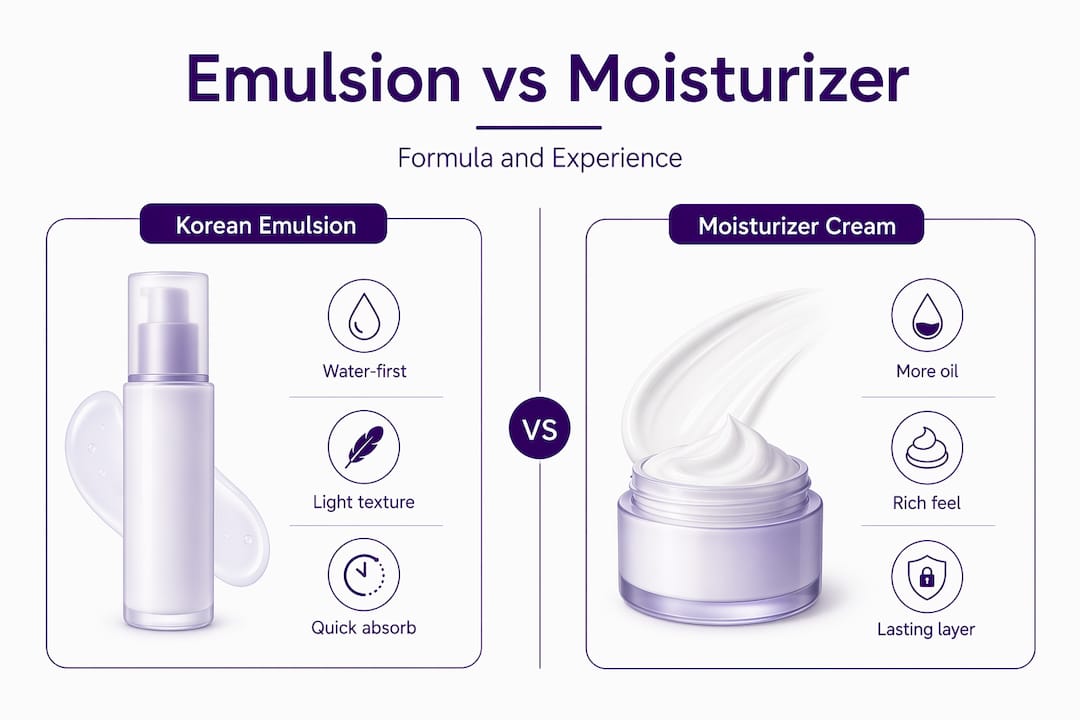
Western skincare has historically leaned toward single-step moisturizing. One rich, multitasking cream is applied after cleansing, and that is considered sufficient. These formulas are often water-in-oil based, which means a higher oil content upfront, longer wear, and a more occlusive finish. They are effective for their intended purpose, especially in drier climates. But Western moisturizers often focus heavily on occlusion as the primary mechanism of action, sealing the surface rather than delivering layered hydration.
Korean skincare, by contrast, treats moisturization as a multi-step process. Korean emulsions are designed as functional hydration layers that maximize penetration and hydration depth when used in a sequence. The formula is built for layering, not standalone use.
Key formulation differences worth knowing:
- Korean emulsions use high-HLB emulsifier systems that favor oil-in-water ratios, producing faster absorption and a lighter skin feel.
- Western creams often rely on water-in-oil ratios or balanced HLB systems that create richer, longer-lasting films.
- K-beauty formulas frequently include fermented ingredients, hyaluronic acid, and botanical extracts optimized to penetrate light, watery textures.
- The gentle formulation approach in Korean skincare means emulsions are often better tolerated on sensitive or reactive skin compared to heavier Western creams.
This distinction matters when you’re deciding which system to adopt. Korean skincare vs. Western moisturizers is less about which is better and more about which philosophy matches your skin, climate, and routine preferences.
Practical tips for using emulsions and moisturizers effectively
Knowing the difference is one thing. Applying that knowledge to your daily routine is where results actually happen. Here is how to make both product types work for you:
- Read ingredient labels carefully. An emulsion will list water as the first ingredient, with humectants like glycerin and hyaluronic acid near the top and oils well below. A cream will have a richer opening with butters, waxes, or fatty acids appearing earlier.
- Apply in order of weight. Always apply your emulsion before any cream. Lighter textures need to penetrate cleanly; applying a cream first creates a barrier that blocks absorption of anything applied afterward.
- Transition seasonally. In spring, swap your heavy winter cream for an emulsion-only finish or an emulsion layered with a lighter cream. In fall, add your richer moisturizer back beneath a cream to compensate for dropping humidity.
- Do not skip the emulsion on days your skin feels oily. Oily skin is often dehydrated skin overproducing sebum in response to lack of water. A lightweight emulsion can balance this without adding to surface oil.
- Avoid heavy creams in high humidity. Congested, shiny skin in summer is frequently the result of using a formula too occlusive for the climate, not a sign that you need more product.
Pro Tip: If you’re transitioning from a single-cream Western routine to a Korean layered routine, start with just an emulsion as your only moisturizing step for one week before adding a cream. Your skin will tell you clearly whether it needs more.
My honest take on the emulsion vs. cream debate
I’ve seen people dismiss emulsions as unnecessary or call them a watered-down cream that doesn’t do enough. I find that perspective misses what makes them genuinely different. In my experience, switching from a one-step cream to a layered emulsion-plus-cream approach changed the texture and feel of my skin in a way that no single product had managed alone.
The biggest shift I noticed was in humid weather. I used to wake up with congested, heavy-feeling skin in summer until I replaced my thick moisturizer with a lightweight emulsion. The improvement was immediate. My skin felt balanced rather than suffocated, hydrated rather than coated.
What I’ve also learned is that people often skip emulsions because they assume more product means more benefit. That logic breaks down in skincare. Two well-matched light layers deliver more usable hydration than one thick layer that partially sits on the surface. The multi-step moisturizing approach is not about adding steps for the sake of it. It is about matching each layer to what your skin can actually absorb and use.
My advice: try a single Korean emulsion for two weeks before deciding it is not enough. Most people are genuinely surprised.
— Lunara
Build your Korean skincare routine with Lunarashopping
Ready to put this into practice? At Lunarashopping, you’ll find a curated selection of trusted Korean skincare products designed to take the guesswork out of your routine.
Whether you’re starting with your first emulsion or refining a full multi-step routine, you can explore the full range of Korean moisturizers and creams to find textures matched to your skin type and season. For a hands-on starting point, the FARMSTAY Black Snail & Peptide 9 Perfect Emulsion is an excellent example of a well-formulated K-beauty emulsion that demonstrates exactly what a lightweight hydration layer feels like in practice. Not sure where to begin? Use the custom skincare kit builder to get a personalized routine recommendation built around your skin type, concerns, and climate.
FAQ
What is a skin emulsion in Korean skincare?
A skin emulsion is a water-dominant, oil-in-water formula that absorbs quickly and delivers lightweight hydration. In Korean skincare, it functions as a dedicated hydration layer applied before a richer cream.
Do I need both an emulsion and a moisturizer?
Not always. Oily skin types often do fine with an emulsion as their sole moisturizing step. Dry or mature skin benefits most from layering an emulsion under a richer cream for deeper, longer-lasting hydration.
How are emulsions different from creams in terms of oil content?
A lightweight emulsion carries roughly 15 to 20% oil, while a standard cream holds 20 to 30%. That ratio drives the texture, absorption speed, and how long each formula protects your skin barrier.
Why do Korean emulsions absorb faster than Western moisturizers?
Korean emulsions use high-HLB emulsifier systems that favor oil-in-water structures, meaning water carries the formula into skin quickly and leaves almost no surface residue. Western creams typically rely on denser emulsifier systems built for longer wear and stronger occlusion.
When should I switch from an emulsion to a richer cream?
When temperatures drop and humidity falls, your skin loses moisture faster and benefits from the extended protection that a richer, more occlusive cream provides. Thicker creams are preferable in dry winters because their higher oil content maintains the skin barrier for 12 or more hours between applications.