Korean skincare has long been celebrated for layered routines, glass-skin results, and beautifully scented formulas. So it may surprise you that the why Korean skincare fragrance-free trend has become one of the most discussed shifts in K-beauty today. The industry known for floral essences and botanical-rich toners is quietly, decisively moving toward fragrance-free formulations. This is not a passing moment. It reflects a deeper change in how Korean beauty brands understand skin health, barrier function, and what sensitive skin consumers actually need from their daily routine.
Table of Contents
- Key takeaways
- Why the Korean skincare fragrance-free trend matters for your skin
- K-beauty’s philosophy shift toward barrier-first skincare
- How to identify truly fragrance-free K-beauty products
- Practical benefits of a fragrance-free Korean skincare routine
- Common misconceptions about fragrance in K-beauty
- My perspective on the fragrance-free shift in K-beauty
- Explore fragrance-free Korean skincare at Lunarashopping
- FAQ
Key takeaways
| Point | Details |
|---|---|
| Fragrance triggers sensitivity | Fragrance is a leading cause of contact dermatitis and cosmetic sensitization, affecting up to 8% of the population. |
| K-beauty philosophy has shifted | Modern Korean skincare prioritizes skin barrier repair and gentle formulations over sensory experience. |
| Labels can be misleading | “Fragrance-free” does not always guarantee zero fragrance chemicals; always check the full ingredient list. |
| Leave-on products matter most | Moisturizers, serums, and sunscreens carry the highest fragrance exposure risk and should be prioritized for fragrance-free swaps. |
| Consumer demand is accelerating change | Growing sensitive skin awareness is driving Korean brands to formulate and market more fragrance-free options globally. |
Why the Korean skincare fragrance-free trend matters for your skin
To understand what is driving this shift, you first need to understand what “fragrance” actually means on a skincare label. In cosmetic formulation, fragrance refers to any synthetic or natural aromatic compound added to a product for scent, including blends of dozens of individual chemicals. Many of these compounds are well-documented skin sensitizers.
Fragrance allergy affects up to 8% of the general population and between 8 and 12% of patients presenting with contact dermatitis. Women and people with atopic dermatitis face even higher risk. That is not a small number when you consider how many steps a typical skincare routine involves.
Here is where the confusion often starts. There is an important difference between “unscented” and “fragrance-free” that most consumers do not realize:
- Fragrance-free means no aromatic compounds were added specifically for scent. However, raw ingredients themselves may still carry a natural odor.
- Unscented often means masking fragrances were added to neutralize the smell of other ingredients, meaning it can contain more fragrance chemicals than a product with an obvious scent.
- Essential oil-based scents are frequently marketed as natural alternatives but essential oils like linalool and limonene are among the most common fragrance allergens identified in patch testing.
The mechanism behind fragrance irritation is worth understanding. When a sensitizing fragrance chemical penetrates the skin barrier repeatedly, allergic contact dermatitis can develop over time. The reaction is not always immediate. You may use a product for months before your immune system triggers a noticeable response. This delayed sensitization is one reason people often do not connect their skin flare-ups to a product they have used for years.
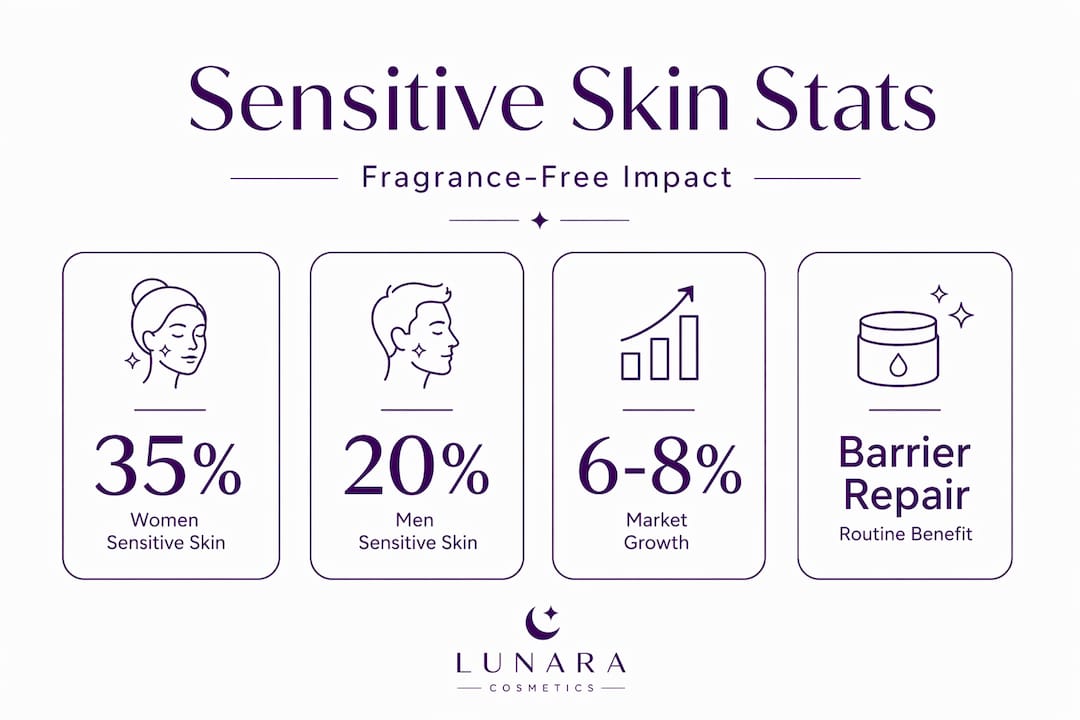
For people with sensitive or reactive skin, 35% of women and 20% of men in the U.S. identify their skin as sensitive. That scale alone is enough to explain why the fragrance-free category is expanding.
K-beauty’s philosophy shift toward barrier-first skincare
Korean beauty has always been grounded in a prevention-first mindset. The iconic multi-step routine was never about layering products for luxury. It was built around hydration, antioxidant protection, and maintaining a healthy skin barrier over time. That foundation makes the move toward fragrance-free formulations a natural progression rather than a departure from K-beauty’s roots.
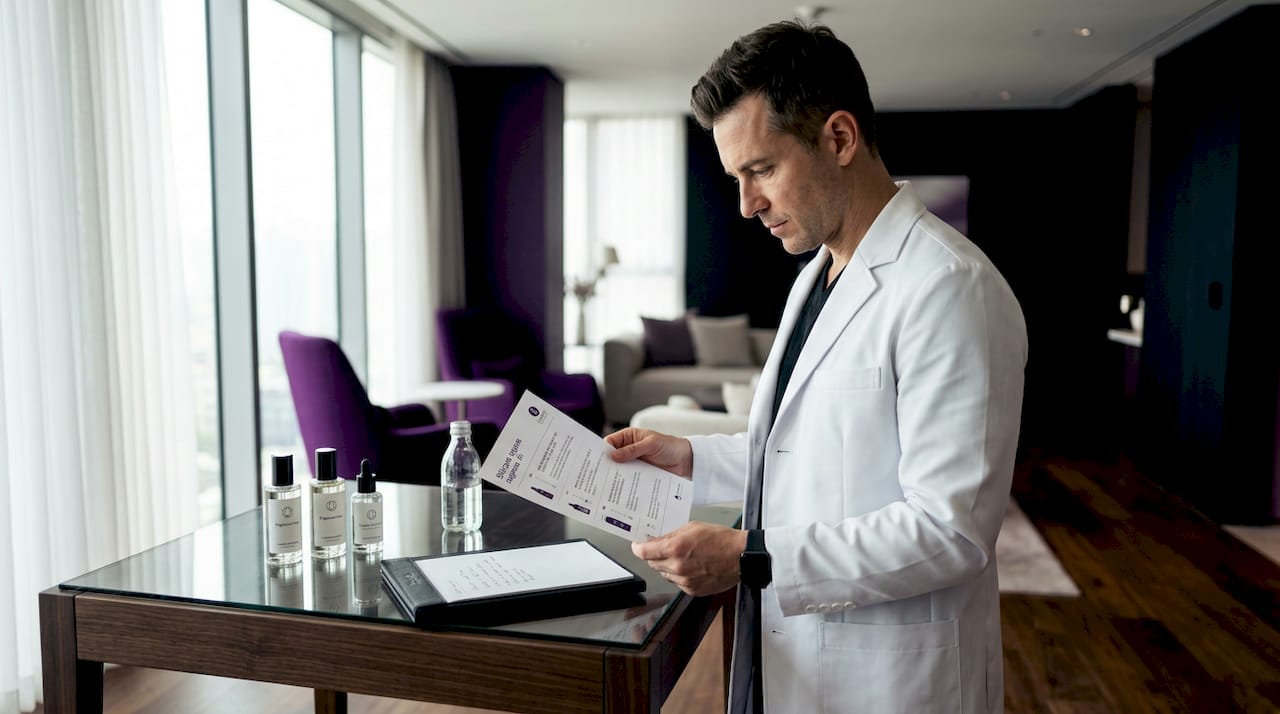
Experts framing K-beauty as barrier repair and prevention rather than correction reflect an evolving philosophy that explicitly deprioritizes anything that could compromise skin integrity. Fragrance is exactly that kind of ingredient. It adds aesthetic value but contributes nothing to hydration, repair, or protection.
The modern K-beauty consumer, both in Korea and globally, is increasingly well-informed about ingredient labels. Korean skincare culture has developed a strong community of ingredient-conscious consumers who research formulations the way others research nutrition labels. This has pushed brands to respond with cleaner formulations that earn trust through transparency.
The types of ingredients now prioritized in fragrance-free K-beauty tell the full story. Ceramides, beta-glucan, panthenol, niacinamide, and centella asiatica extract are the building blocks of today’s barrier-supportive Korean formulas. None of these require fragrance to function effectively. Pairing them with fragrance simply adds sensitization risk without any skin benefit.
“The goal is skin that functions well and looks good because of that function, not despite it. Fragrance in skincare is decoration for your nose that your skin barrier never asked for.”
Pro Tip: When evaluating a new K-beauty product, search the ingredient list for terms like “parfum,” “fragrance,” “aroma,” or specific botanical oils like lavender oil or citrus extract. These signal fragrance presence even when the front label says nothing about scent.
The fragrance-free market in the U.S. is growing at a 6 to 8% compound annual growth rate, and South Korea is a significant supplier in that space. Korean brands are not just responding to domestic demand. They are actively formulating for the global sensitive skin consumer, and that means fragrance-free is becoming a product design standard, not just a niche option.
How to identify truly fragrance-free K-beauty products
The Korean beauty market uses “fragrance-free” and “unscented” terminology somewhat interchangeably, which creates real confusion at the point of purchase. Understanding how to read labels accurately gives you a clear advantage when building a fragrance-free skincare routine.
| Term | What it means | What to watch for |
|---|---|---|
| Fragrance-free | No scent compounds added intentionally | Raw ingredient odors may still exist; check INCI list |
| Unscented | Masking fragrances used to neutralize odor | May contain more fragrance chemicals than scented products |
| Natural fragrance | Scent derived from botanical sources | Essential oils are still common allergens |
| Hypoallergenic | Lower likelihood of causing reactions | Not regulated; no standard definition exists |
| Dermatologist-tested | Tested by a dermatologist | Does not mean fragrance-free or allergen-free |
Fragrance-free labeling lacks strict regulation across most markets, including Korea. A product can technically carry a “fragrance-free” claim while still containing essential oils or botanical extracts that function as fragrance but are listed under their botanical names. Linalool, geraniol, citronellol, and eugenol are common examples. These appear as individual ingredient names rather than the word “fragrance,” so they pass through the label unchallenged.
The International Nomenclature of Cosmetic Ingredients (INCI) list is your most reliable tool. Korean products sold internationally are required to display full INCI ingredient lists, and learning to scan for fragrance compounds takes only a few minutes of practice.
Pro Tip: Use a free ingredient checker app or website to paste the ingredient list from a K-beauty product you are considering. Most will flag known fragrance allergens automatically, saving you significant research time.
It also helps to know that Korean skincare labels use both Korean and English INCI names on products sold domestically, but products exported to the U.S. and Europe must comply with local labeling standards. If you are purchasing from a Korean-language site, look up the product’s exported version to confirm the ingredient disclosure is complete.
Practical benefits of a fragrance-free Korean skincare routine
Knowing why fragrance causes problems is useful. Knowing how to actually build a fragrance-free routine is what changes your skin. The benefits of fragrance-free skincare are most noticeable when you apply the principle consistently across multiple routine steps rather than swapping just one product.
Here is a priority order for making fragrance-free swaps that will have the greatest impact on sensitive skin:
- Moisturizer. Your moisturizer is a leave-on product used twice daily, meaning any fragrance it contains contacts your skin for the full day or night. This is the single most important swap.
- Sunscreen. SPF products sit on skin all day and are often reapplied. Fragrance here creates significant cumulative exposure, particularly in people with reactive skin.
- Serum or treatment. Active serums also stay on skin and are often applied to areas where the skin barrier is already compromised, making fragrance penetration more likely.
- Toner or essence. These are often layered and applied to freshly cleansed, slightly permeable skin. Fragrance-free versions reduce irritation risk during this vulnerable moment.
- Cleanser. Rinse-off products have lower exposure time, so they are lower priority. That said, switching to a gentle, fragrance-free cleanser still reduces the total fragrance load your skin encounters daily.
Consistent fragrance avoidance across routine steps is the key to reducing cumulative irritation. A single fragrance-free moisturizer while using a heavily fragranced toner every morning does not eliminate re-challenge risk. The benefit compounds when you reduce total fragrance exposure across the full routine.
Pro Tip: If you are new to fragrance-free skincare, start by replacing your moisturizer and SPF first. Track your skin’s response over 4 to 6 weeks before making additional swaps. Changes take time to show up, and isolating variables helps you understand what is actually working.
A well-maintained skin barrier is less reactive overall, holds hydration more effectively, and responds better to active ingredients like niacinamide or retinol. Fragrance-free products support that process by removing an unnecessary stressor from the equation.
Common misconceptions about fragrance in K-beauty
Several persistent myths make it harder for consumers to make informed choices in the K-beauty fragrance-free space. Clarifying them protects both your skin and your spending.
- Myth: Most K-beauty products are fragrance-free. Not true. Fragrance remains a common ingredient in Korean skincare, particularly in sheet masks, essences, and body care products. The fragrance-free trend is growing, but fragranced products still represent the majority of the market.
- Myth: Natural fragrance is always safer than synthetic. Natural botanical extracts can cause reactions equivalent to synthetic fragrance compounds. Natural fragrances like linalool and limonene are among the most patch-tested allergens in dermatology.
- Myth: Fragrance-free products have no smell. Raw ingredients like fermented extracts, certain peptides, or fatty acids carry their own natural scent. A fragrance-free product may smell unusual or medicinal. That is not a flaw. It is a sign that no masking agents were added.
- Myth: If you have used a product for years without reaction, it is safe. Sensitization is cumulative. You can develop a fragrance allergy after years of exposure without any prior reaction.
- Why the trend is accelerating now: Growing ingredient literacy among consumers, increased access to Korean skincare globally, and skin barrier-first positioning by brands are all converging. The market is responding to consumers who read labels and demand transparency.
My perspective on the fragrance-free shift in K-beauty
I’ve spent years working closely with Korean skincare products and observing how both brands and consumers think about formulation. What strikes me most about the fragrance-free shift is that it is not driven by fear. It is driven by knowledge.
I’ve seen firsthand how sensitive skin consumers go through months of frustration, cycling through products and assuming their skin is just “difficult,” before they realize fragrance has been the common thread. Removing it from leave-on products often produces more visible improvement than switching to expensive actives.
What I find genuinely encouraging is how K-beauty is responding with formulation integrity rather than just marketing language. The best fragrance-free Korean products I’ve encountered do not feel like a compromise. They deliver real hydration, improved skin texture, and better barrier function without the aesthetic distraction of scent.
My honest advice: do not wait until your skin is visibly reactive to care about fragrance. The damage from repeated low-level sensitization often shows up as accelerated sensitivity years later. Being thoughtful now about where fragrance appears in your routine is one of the most practical long-term investments you can make in your skin health.
— Lunara
Explore fragrance-free Korean skincare at Lunarashopping
At Lunarashopping, we curate Korean skincare products with sensitive skin specifically in mind. Our selection includes fragrance-free options across moisturizers, cleansers, serums, and SPF products from trusted Korean brands that prioritize barrier-supportive formulations.
If you want a complete fragrance-free routine without the guesswork, the INNISFREE Green Tea Hyaluronic Skincare Set is a strong place to start. It focuses on deep hydration and skin barrier support without added fragrance. For a fully personalized approach, our Custom Skincare Kit Builder lets you select products by concern, skin type, and fragrance preference so your routine is built around your actual needs.
FAQ
What is causing the Korean skincare fragrance-free trend?
The trend is driven by growing consumer awareness of fragrance as a common skin sensitizer, increased ingredient literacy, and K-beauty’s broader shift toward barrier-first, gentle formulations that prioritize long-term skin health over scent appeal.
Is fragrance-free skincare actually better for sensitive skin?
For sensitive and reactive skin types, fragrance-free products significantly reduce the risk of allergic contact dermatitis and cumulative sensitization. Fragrance is one of the leading causes of cosmetic-related skin reactions, making fragrance-free formulas a clinically sound choice.
Can a fragrance-free K-beauty product still cause irritation?
Yes. Fragrance-free does not mean allergen-free. Botanical extracts, essential oils listed by their individual names, and certain preservatives can still cause reactions. Always review the full INCI ingredient list rather than relying on front-label claims.
Which K-beauty products should I switch to fragrance-free first?
Start with leave-on products, particularly moisturizers and sunscreens, since these create the most sustained skin contact. Replacing these two steps delivers the greatest reduction in fragrance exposure across your daily routine.
Does fragrance-free mean the product will have no scent?
Not necessarily. Raw skincare ingredients often have natural odors that remain in fragrance-free formulations. The absence of added fragrance or masking agents means the product may smell different from what you expect, but that is a sign of a cleaner formulation, not a quality issue.