Yes, a barrier-first Korean skincare routine centered on ceramides, panthenol, and gentle hydration can repair a damaged skin barrier, but only with consistency. Start by pausing acids and retinoids, switch to a gentle cleanser and a ceramide-rich moisturizer, and wear sunscreen every day. Dermatologist David Kim has noted that K-beauty’s core strength is favoring gentle formulas over aggressive actives, which is exactly what a compromised barrier needs.
TL;DR:
- Products with ceramides, cholesterol, and fatty acids placed near the top of the ingredient list support skin barrier rebuilding effectively.
- Consistent use of gentle, fragrance-free formulas with minimal alcohol and proper pH balance is crucial for barrier repair.
- Layering should follow a sequence from thin to thick, with hydration and moisturization repeated morning and night for at least four weeks.
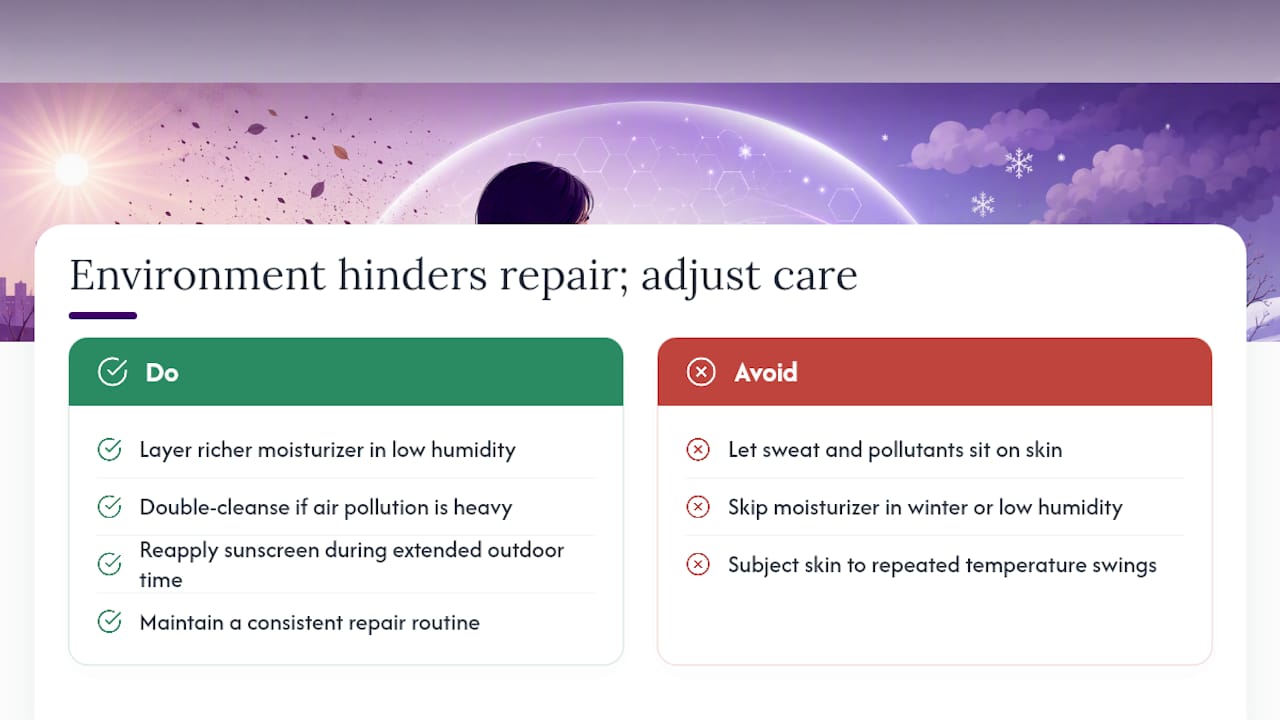
- Environmental factors like low humidity, pollution, and temperature swings can hinder recovery, requiring tailored adjustments to routine and skincare habits.
- Reintroduce active ingredients slowly, testing one at a time every three to five days, and seek dermatologist advice if severe or spreading inflammation occurs.
Table of Contents
- What to Look for in Korean Barrier-Repair Products
- A Simple Barrier-Repair Korean Routine, Step by Step
- Key Korean Ingredients for Barrier Repair and How They Work
- What to Expect: Timeline, Troubleshooting, and When to See a Dermatologist
- Lunara’s Approach: Editorial Guidance and the Acne & Barrier Repair Bundle
- The Telltale Signs Your Skin Barrier Is Damaged
- Common Causes of Barrier Damage in Korean Skincare Routines
- How Climate and Pollution Affect Barrier Recovery
- Getting the Layering Order Right
- How Korean and Western Barrier Repair Approaches Differ
- The Uncomfortable Truth About Barrier Repair
- How Lunarashopping Can Help You Shop for Barrier Repair
- Sources
What to Look for in Korean Barrier-Repair Products
Marketing language on Korean skincare packaging can make almost anything sound barrier-friendly. Ingredient lists tell the real story. Products built for repair, not just hydration marketing, tend to share a specific set of components and formulation habits.
Look for these on the ingredient panel, ideally near the top of the list:
- Ceramides, cholesterol, and fatty acids — the trio that makes up the skin’s natural lipid matrix
- Panthenol (pro-vitamin B5) — soothes and supports moisture retention
- Hyaluronic acid — pulls water into the surface layers without weighing skin down
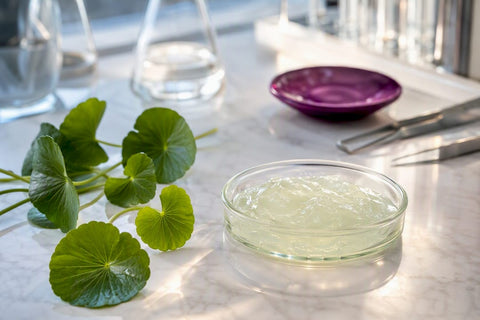
- Centella asiatica (also listed as madecassoside or asiaticoside) — calms visible redness and irritation
Formulation matters as much as ingredients. Fragrance-free formulas, minimal alcohol content, and pH-balanced cleansers (closer to skin’s natural 4.5 to 5.5 range) all reduce the odds of re-triggering sensitivity. Emollient, slightly tacky textures usually signal a richer lipid content than a fast-absorbing gel, which matters when the goal is rebuilding rather than just refreshing.
Packaging deserves a second look, too. Tubes and airless pumps limit air and finger contact, which keeps active ingredients stable and reduces contamination risk in jars you dip into daily.
Red flags are just as easy to spot once you know what to check. Strong exfoliating acids, two or more potent actives stacked together, drying alcohols high on the ingredient list, and heavy added fragrance all work against a barrier that’s already compromised.
Pro Tip: Check the first five ingredients only. If you see denatured alcohol or fragrance in that top group, skip it during your repair phase, no matter how good the marketing sounds.
A Simple Barrier-Repair Korean Routine, Step by Step
Barrier recovery routines succeed because they remove decisions, not because they add products. Simplification is the entire strategy, and Korean barrier recovery guidance consistently frames recovery this way: fewer steps, gentler formulas, and more restraint.
Morning routine:
- Cleanse with a low-foam, pH-balanced cleanser or plain water if skin feels raw. This step exists to remove overnight buildup without stripping oil.
- Hydrate with a lightweight essence or toner containing hyaluronic acid or panthenol, applied to damp skin.
- Moisturize with a ceramide-based cream, focusing on any areas with visible flaking.
- Apply sunscreen, since sunscreen remains essential even during active barrier repair and damaged skin burns and reacts more easily.
Evening routine:
- Cleanse the same way.
- Layer the same hydrating and moisturizing steps, adding a slightly richer cream or sleeping mask if skin feels tight by nightfall.
If you’re reintroducing actives after a repair phase, buffer instead of diving back in cold. Apply moisturizer first, then a thin layer of your retinoid over top. Clinic guidance on reintroducing retinoids recommends this buffering method specifically to cut down on irritation while still letting skin adjust. Test one new active every three to five days, not several at once, and watch for stinging or redness before adding the next.
Oily and acne-prone skin still needs this approach, just with lighter textures like gel creams instead of balms. Rosacea-prone skin should stretch the timeline between introducing new products and lean even harder on centella-based formulas for calming redness.
Key Korean Ingredients for Barrier Repair and How They Work
Ceramides, cholesterol, and fatty acids matter because they mimic what your skin barrier is actually made of. The outermost layer of skin, the stratum corneum, holds its shape through a lipid matrix built from roughly these three components in specific ratios. When that matrix breaks down from over-exfoliation, harsh weather, or aggressive actives, replacing those exact lipids is what rebuilds structure rather than just masking dryness.
Supporting players fill different jobs:
- Panthenol speeds surface healing and reduces transepidermal water loss
- Hyaluronic acid holds water at the skin’s surface layers
- Beta-glucan soothes irritation while supporting the skin’s own repair signals
- Centella asiatica calms redness and has a long history in Korean skincare for sensitive, reactive skin
One product review noted that a ceramide-focused moisturizer was linked to a 92 percent improvement in barrier strength among participants in a cited product study, a useful data point for how much a targeted lipid formula can move the needle.
PDRN, short for polydeoxyribonucleotide, shows up increasingly in Korean skincare marketing as a regenerative, clinic-derived repair ingredient. Treat it as an interesting option to explore once your barrier has stabilized, not a starting point. During active repair, stick with the foundational trio and skip layering multiple experimental actives at once.
What to Expect: Timeline, Troubleshooting, and When to See a Dermatologist
Surface improvement, less flaking, less tightness, usually shows up within two to four weeks of consistent barrier-first care. Deeper lipid matrix rebuilding takes longer, often six to twelve weeks or more depending on how much damage occurred and how consistently you stick with the routine.
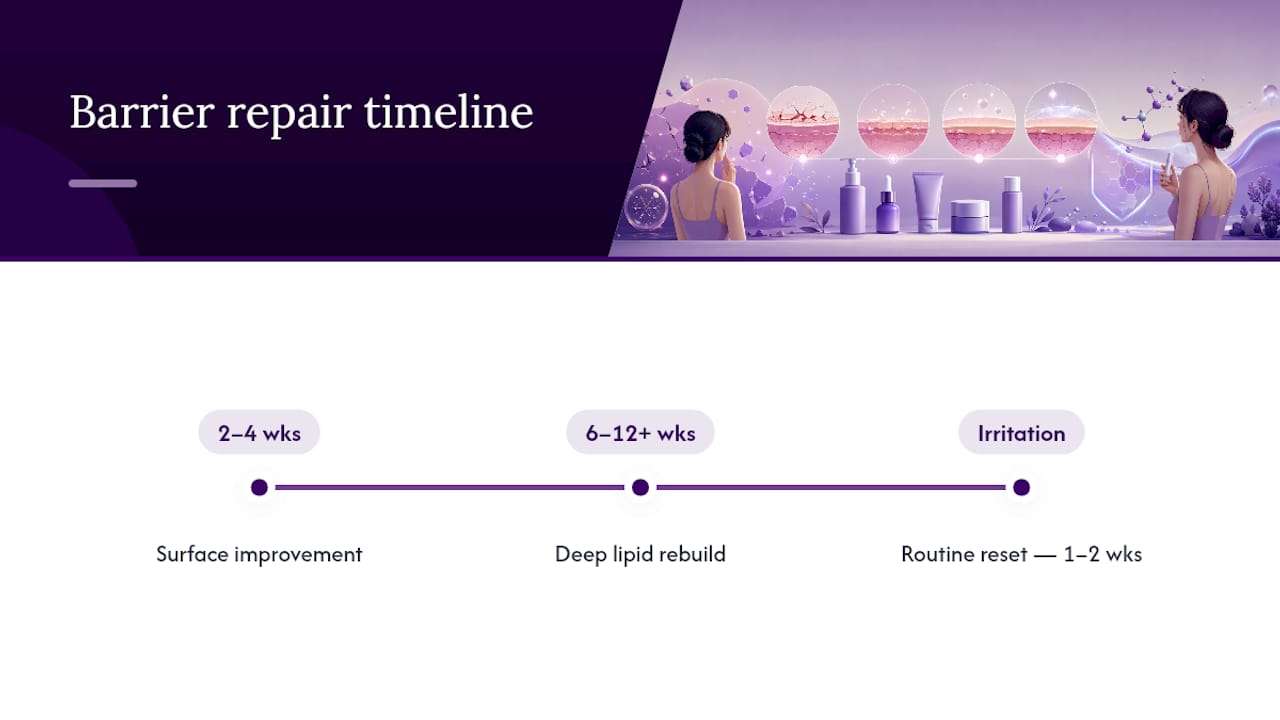
If irritation returns after reintroducing an active, stop that product immediately and go back to your minimal routine for another one to two weeks before trying again, more slowly this time. Don’t add anything new during that reset window.
Some symptoms need more than a skincare adjustment. See a dermatologist if you notice severe or spreading inflammation, oozing or crusting that suggests infection, or eczema-like patches that don’t respond to gentle care within a few weeks.
Pro Tip: Pick one moisturizer and stick with it for at least four weeks before judging results. Product-hopping resets your skin’s adjustment period every time you switch, which is often the actual reason recovery stalls.
Lunara’s Approach: Editorial Guidance and the Acne & Barrier Repair Bundle
An effective skincare routine prioritizes barrier health, and gentle formulas often outperform aggressive ones when skin is compromised. That philosophy shapes how we curate every collection, and it’s the same reasoning behind guides like our barrier-first approach for dry skin and why gentle Korean formulas work so well.
A barrier repair kit often pairs a gentle cleanser, a hydrating essence, and a ceramide-rich moisturizer, built around the idea that acne-prone skin and a compromised barrier usually need the same starting point: less stripping, more rebuilding. Rather than asking you to guess which products pair well together, the bundle removes that decision entirely.
The Telltale Signs Your Skin Barrier Is Damaged
A damaged barrier rarely announces itself with one obvious symptom. It shows up as a cluster of small, frustrating signals that build over days or weeks.
Tightness after cleansing is usually the first sign, that pulled, dry feeling even minutes after washing your face. Stinging or burning when you apply products that never used to bother you, plain moisturizer included, points to a barrier that’s lost its ability to keep irritants out. Visible flaking, especially around the nose, cheeks, and jawline, means the outer layer is shedding faster than it can rebuild.
Perhaps the most confusing sign is inconsistency. Skin that reacts to a product one day but not the next, or that looks fine in the morning and inflamed by evening, is often responding to a barrier that can no longer regulate what gets in and how much water gets out. Korean skincare guidance frames this specific pattern as chronic sensitivity, and treats it as a signal to strip the routine down rather than add more targeted treatments.
If you’re noticing two or more of these signs together, that’s a stronger signal than any one symptom alone. A single dry patch might just mean weather. Tightness, stinging, and flaking showing up at the same time usually means the barrier itself needs attention, not just the symptom in front of you.
Common Causes of Barrier Damage in Korean Skincare Routines
The 10-step routine that made K-beauty famous can also be the thing that damages a barrier, ironically enough. Layering multiple exfoliating steps, a chemical exfoliant toner followed by an acid essence followed by a resurfacing serum, stacks actives in ways that overwhelm skin before anyone notices a problem.
Double cleansing, a genuinely useful practice for removing sunscreen and makeup, becomes a liability when the second cleanser is also a foaming, high-pH formula used morning and night regardless of actual need. Over-sheeting, applying too many masks too frequently in pursuit of glass skin, adds hydration in the short term but can disrupt the barrier when combined with other actives in the same week.
Trend-chasing plays a role too. Ingredients like glycolic acid toners, high-percentage vitamin C serums, and strong retinol products get added to routines because they’re popular, not because skin actually needs them at that moment. Combining several of these “hero” products at once, rather than testing them individually, is one of the most common ways a barrier gets pushed past its limit.
None of this means the K-beauty routine itself is flawed. It means the multi-step structure rewards restraint, and punishes the instinct to add “just one more” active whenever a new product looks promising.
How Climate and Pollution Affect Barrier Recovery
Environmental stress works against barrier repair even when your product choices are right. Low humidity pulls water out of skin faster than a compromised barrier can replace it, which is why winter months often coincide with worse flaking and tightness regardless of routine.
High humidity isn’t automatically better. It can trap sweat and pollutants against skin, particularly in urban environments where fine particulate matter settles on the surface throughout the day. That combination, moisture plus airborne particles, creates conditions where a weakened barrier absorbs more irritants than it would in cleaner, drier air.
Temperature swings matter too. Moving between heated indoor air and cold outdoor air repeatedly through the day stresses the same lipid matrix that ceramides and fatty acids are trying to rebuild. This is part of why consistency matters more than intensity during repair: a barrier under environmental stress needs steady support, not sporadic treatment.
Practical adjustments help close that gap. Layering a slightly richer moisturizer during low-humidity months, double cleansing more thoroughly if you live somewhere with heavy air pollution, and reapplying sunscreen if you’re outdoors for extended periods all reduce the environmental load your barrier has to fight against while it rebuilds.
Getting the Layering Order Right
Layering order in Korean skincare follows one consistent rule during barrier repair: thinnest to thickest, wettest to driest. That sequence lets each product absorb properly before the next one goes on top, rather than competing for space on the surface.
Cleanser comes first, followed by any hydrating toner or essence applied to slightly damp skin, since damp skin absorbs water-based ingredients more efficiently. A hyaluronic acid serum, if you use one, goes next while skin is still slightly moist. Ceramide-based moisturizer follows to seal that hydration in, and sunscreen goes last in the morning, always as the final step before makeup, since it needs to sit undisturbed on the surface to work.
Timing matters as much as order. During repair, keep your routine identical morning and night except for sunscreen, since your skin doesn’t need different formulas at different times of day when the priority is simply reducing stress and rebuilding lipids. Once the barrier stabilizes and you’re ready to reintroduce treatments, that’s the point to start varying morning and evening steps again, adding an active at night while keeping mornings hydration-focused.
How Korean and Western Barrier Repair Approaches Differ
Western dermatology and Korean skincare tend to reach for different tools first when a barrier is compromised. Western approaches often lean on occlusive ointments, petrolatum-based balms, and prescription-strength formulas as a fast fix for severe dryness or eczema-like symptoms. These work well for acute flare-ups but are less focused on the layered, gradual hydration approach K-beauty is known for.
Korean skincare treats barrier repair as a multi-step hydration process rather than a single heavy product applied once. Essences, lightweight serums, and layered moisturizers replace the single-step occlusive approach, with an emphasis on water-based hydration before sealing it in with lipids. This layering habit is partly cultural, K-beauty developed around the idea that skin absorbs hydration better in stages, and partly practical, since lighter layered textures feel more comfortable in humid climates across much of East Asia.
Neither approach is wrong. A severely cracked, weeping barrier may genuinely need an occlusive Western-style balm short term. But for the slower, week-to-week rebuilding most people are dealing with, the Korean layering method gives skin more chances to absorb hydration gradually rather than sealing in whatever moisture happens to already be there.
The Uncomfortable Truth About Barrier Repair
Most barrier repair content oversells speed and undersells restraint. The advice that actually holds up, pause actives, simplify to a handful of gentle products, repeat for weeks, isn’t exciting content. It doesn’t photograph well, and it doesn’t fit neatly into a ten-product haul. But it’s the approach every credible source in this space keeps landing on.
Where conventional advice falls short is in treating barrier repair like a shopping problem instead of a patience problem. Adding a new “barrier repair” serum every time progress feels slow usually resets the clock rather than speeding it up. The instinct to keep trying something new is understandable and almost always counterproductive.
If you take one thing from this, prioritize consistency over variety. Pick one gentle cleanser, one hydrating step, one ceramide moisturizer, and one sunscreen. Use them for a full month before judging anything. The “boring” routine isn’t a compromise, it’s the actual mechanism that lets your skin rebuild.
— Lunara
How Lunarashopping Can Help You Shop for Barrier Repair
Some online retailers curate Korean skincare around a barrier-first philosophy to help customers find genuinely gentle products without sorting through ingredients alone. Every product in our Face Creams & Moisturizers collection is chosen with ceramide content, fragrance-free formulation, and barrier support in mind, which makes it a practical first stop if tightness and flaking are your main concerns right now.
If you’d rather start with a complete routine instead of building one product at a time, the Morning Face Care Routine Set pairs a gentle cleanser, hydrating step, and moisturizer that work together without any guesswork on your end. Orders from some online beauty retailers ship via straightforward checkout without subscriptions or bundled add-ons. Browse the collection, pick the pieces that match your current skin, and start your repair routine this week.
Sources
- 16 Best Korean Skin Care Products of 2026 | Reviews by Wirecutter
- My Skin-Barrier SOS Is a $23 COSRX Moisturizer | NewBeauty
- Damaged Skin? Korean Barrier Recovery Guide | BEAUTIPIN
- Dr David Kim’s hand skincare routine highlights an overlooked area of skin ageing