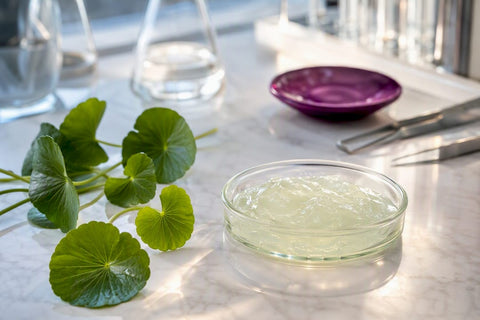
Centella asiatica, known as cica in Korean skincare, is a well-tolerated botanical that soothes irritation, supports barrier repair, and helps wound healing while encouraging collagen synthesis. Peer-reviewed reviews back its anti-inflammatory and antioxidant effects, though researchers still want larger, standardized trials. For most skin types, it’s one of the gentlest actives available.
TL;DR:
- Using around 1% Centella asiatica extract for about three weeks can significantly support skin wound healing and barrier recovery.
- The main active compounds—asiaticoside and madecassoside—help reduce inflammation and promote collagen production through specific cellular signaling pathways.
- Clinical evidence is strongest for wound and burn healing, while anti-aging and scar reduction benefits require larger, standardized trials for confirmation.
- Centella is generally well-tolerated and safe, with patch testing recommended for sensitive skin and caution advised around open wounds or when combining with other actives.
- Choosing products with explicit ingredient names like madecassoside or standardized TECA extracts improves consistency and effectiveness in skin routine applications.
Table of Contents
- What Is Centella Asiatica and Why Do Its Compounds Matter?
- The Skin Benefits Backed by Clinical Research
- How to Use Centella Asiatica: Forms, Concentrations, and Timelines
- Is Centella Asiatica Safe? Side Effects and Interactions
- What the Clinical Research Actually Shows
- Pairing Centella With Retinol, Niacinamide, Vitamin C, and AHAs
- What to Look for on a Centella Product Label
- Where Centella Fits Into a Real K-Beauty Routine
- Try Centella Asiatica Through Lunarashopping’s Curated Routine
- Sources
What Is Centella Asiatica and Why Do Its Compounds Matter?
You’ve probably seen this ingredient listed under three or four different names, and that’s not a marketing trick. Centella asiatica goes by cica, gotu kola, and tiger grass depending on which region or product line you’re reading about. Traditional healers in Southeast Asia and parts of Africa used the plant for wound care long before it turned up in a Korean serum bottle, and that long history is part of why dermatology researchers took a closer look at what’s actually happening at the molecular level.
The answer comes down to four triterpenoid saponins: asiaticoside, madecassoside, asiatic acid, and madecassic acid. These compounds are the working parts of the plant, and each one contributes something slightly different to how your skin responds to it.
- Asiaticoside supports collagen synthesis and has shown wound closure effects in lab and clinical settings.
- Madecassoside carries much of the anti-inflammatory load, calming irritated tissue and reducing redness.
- Asiatic acid contributes antioxidant activity, helping neutralize the oxidative stress that comes from UV exposure and pollution.
- Madecassic acid works alongside asiatic acid to support skin barrier recovery.
Mechanistically, these triterpenoids act on a handful of signaling pathways that dermatology researchers keep coming back to. They dial down NF-κB activity, which is a major driver of the inflammatory cascade behind redness and swelling. They also activate TGF-β/Smad signaling, a pathway your skin uses to ramp up collagen production and speed tissue repair. A clinical review on Centella asiatica’s pharmacological effects lays out this mechanism in detail, tying the plant’s traditional reputation for healing wounds to measurable cellular activity.
None of this makes Centella a miracle ingredient. What it does is give your skin’s own repair processes a nudge, rather than forcing a dramatic change the way a strong acid or retinoid might. That’s precisely why it has become a staple in Korean formulations aimed at reactive or compromised skin.
The Skin Benefits Backed by Clinical Research
Centella’s reputation rests on five overlapping benefits, and the evidence quality varies across them. Here’s how they stack up, starting with the strongest data.
- Wound and burn healing. This is where the clinical evidence is most concrete. Topical formulations rich in madecassoside have improved reepithelialization and reduced inflammatory markers in trials involving burns, diabetic ulcers, and certain dermatitis cases, according to the same pharmacological effects review. Scar outcomes in these studies also tended to be better than in control groups.
- Anti-inflammatory action. Madecassoside and asiaticoside suppress inflammatory signaling in ways that translate to visibly calmer skin. If you deal with flushed cheeks after using a retinoid, or acne that flares into angry, swollen bumps, this is the mechanism doing the quiet work behind a Centella product.
- Antioxidant protection. Asiatic acid helps counter the oxidative stress your skin absorbs from sun exposure and airborne pollutants. Over time, unmanaged oxidative stress breaks down collagen and accelerates visible aging, so this isn’t a cosmetic footnote. It’s part of what keeps skin looking less fatigued.
- Collagen support and anti-aging effects. Through the TGF-β/Smad pathway, Centella nudges fibroblasts to produce more collagen. Clinical data here is promising but still developing. A pharmacological review calling Centella a potential herbal cure-all confirms the mechanistic support while cautioning that cosmetic anti-aging claims need bigger, longer trials before anyone should call this settled science.
- Barrier repair and hydration. In practice, this shows up as less redness after cleansing, less stinging when you apply other products, and skin that holds moisture better throughout the day. It’s the benefit people notice fastest, even before they understand why.
By the Numbers: Clinical formulations using roughly 1% Centella asiatica extract, applied consistently for about three weeks, have shown measurable wound-healing support in trials. That’s a useful benchmark if you’re wondering how long to expect before a Centella product does something noticeable.
What ties these five benefits together is tolerability. Unlike actives that force visible benefits through irritation, such as a strong exfoliating acid, Centella tends to produce its effects without provoking the skin further. That’s an unusual combination in skincare, where potency and gentleness rarely arrive in the same bottle.
How to Use Centella Asiatica: Forms, Concentrations, and Timelines
Not every Centella product is built for the same job, and picking the wrong format is the most common reason people feel underwhelmed by it. Serums and lightweight essences work best for daily preventive use, since they absorb quickly and layer easily under other products. Creams carry more emollient support, making them a better fit if your main concern is dryness or a compromised barrier. Ointments and hydrogel patches show up more often in post-procedure or wound-focused products, where a thicker, occlusive layer helps protect healing skin.
Concentration is where label reading actually pays off. Topical formulations in clinical research span a range from 0.05% up to about 3%, and the research on Centella’s topical concentrations notes that 1% has been the figure most consistently tied to wound-healing support in trials.
- Use a Centella serum after cleansing and toning, before heavier creams or oils.
- Apply Centella-based moisturizers both morning and night if your main goal is barrier support with aqueous cream.
- Reserve higher-concentration ointments or patches for post-procedure recovery, not everyday use.
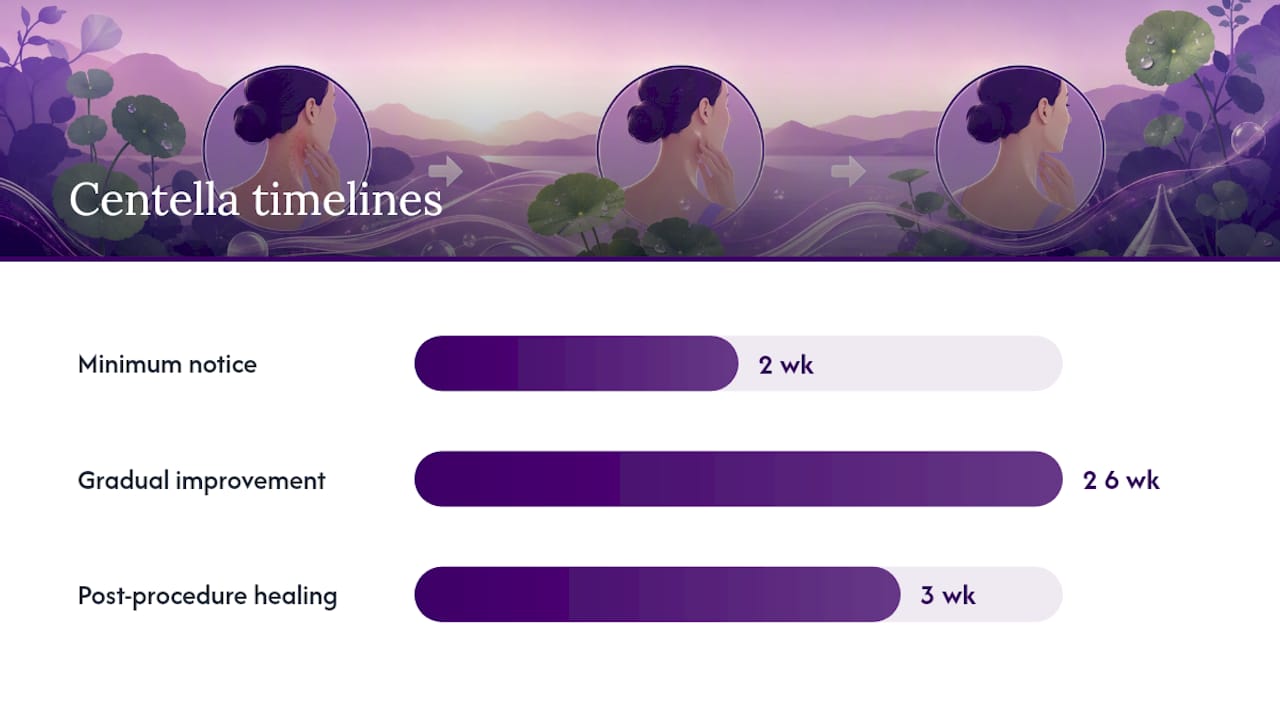
- Give any new Centella product at least two weeks before judging results, since visible barrier improvements build gradually.
Pro Tip: Consistency matters more than potency here. A daily Centella product used for two to six weeks tends to produce more noticeable improvement in redness and hydration than an occasional high-concentration treatment used sporadically.
Timelines depend on what you’re targeting. If you’re using Centella to calm general redness or support your barrier, expect to notice gradual changes within two to six weeks of steady use. If you’re applying it specifically to support healing after a procedure or minor wound, the three-week mark from clinical trials is a more realistic reference point. Either way, patience beats intensity with this ingredient.
Is Centella Asiatica Safe? Side Effects and Interactions
Centella has one of the friendliest safety profiles among active skincare ingredients, which is a big reason dermatology providers recommend it so often for reactive skin. Most people tolerate it well, with side effects limited mostly to rare, mild irritation in those with a specific sensitivity to the plant.
- Patch-test any new Centella product on your inner arm for 24 to 48 hours before applying it to your face.
- Discontinue use if you notice persistent itching, stinging, or a rash that doesn’t settle within a day or two.
- Avoid combining Centella products with fragranced or high-alcohol formulas if your skin is already reactive, since the fragrance or alcohol is more likely to be the irritant than the Centella itself.
- Talk to a dermatology provider before applying Centella to open wounds beyond minor cuts or post-procedure sites your provider has already cleared.
- Check ingredient lists carefully if you’re managing a known plant allergy, since gotu kola sensitivity, while uncommon, does exist.
Dermatology providers frequently recommend Centella specifically because it plays well with stronger actives. A Cleveland Clinic overview of Centella asiatica notes that it’s commonly suggested for sensitive and reactive skin as a calming companion to treatments like retinoids or chemical peels, precisely because it doesn’t add irritation on top of irritation. That said, “well-tolerated” doesn’t mean risk-free for everyone. If you’re on prescription topicals for a diagnosed skin condition, run any new addition past whoever manages that treatment, since layering habits can affect how well a prescription product performs.
What the Clinical Research Actually Shows
The mechanistic story behind Centella is more settled than the clinical outcome story, and that gap matters if you want a realistic picture of what this ingredient can do. Researchers have mapped out several signaling pathways with reasonable confidence: NF-κB suppression drives the anti-inflammatory effect, TGF-β/Smad activation drives collagen stimulation, and MAPK pathway modulation contributes to how skin cells respond to stress and injury. These aren’t speculative claims. They’re documented in the pharmacological effects review that traces triterpenoid activity down to the cellular signaling level.
Where the evidence gets thinner is in large-scale human trials. Wound-healing and dermatologic studies exist, and several show real improvement in reepithelialization and inflammatory markers compared with controls. But sample sizes in many of these trials are small, and the extracts used vary from study to study, which makes it hard to compare results directly or set a single definitive dosing standard.
“The main gap is lack of standardized extracts and dosing,” according to a 2025 review of Centella’s pharmacological perspectives, which calls for further pharmacokinetic studies and larger, better-controlled clinical trials before firmer dermatologic recommendations can be made.
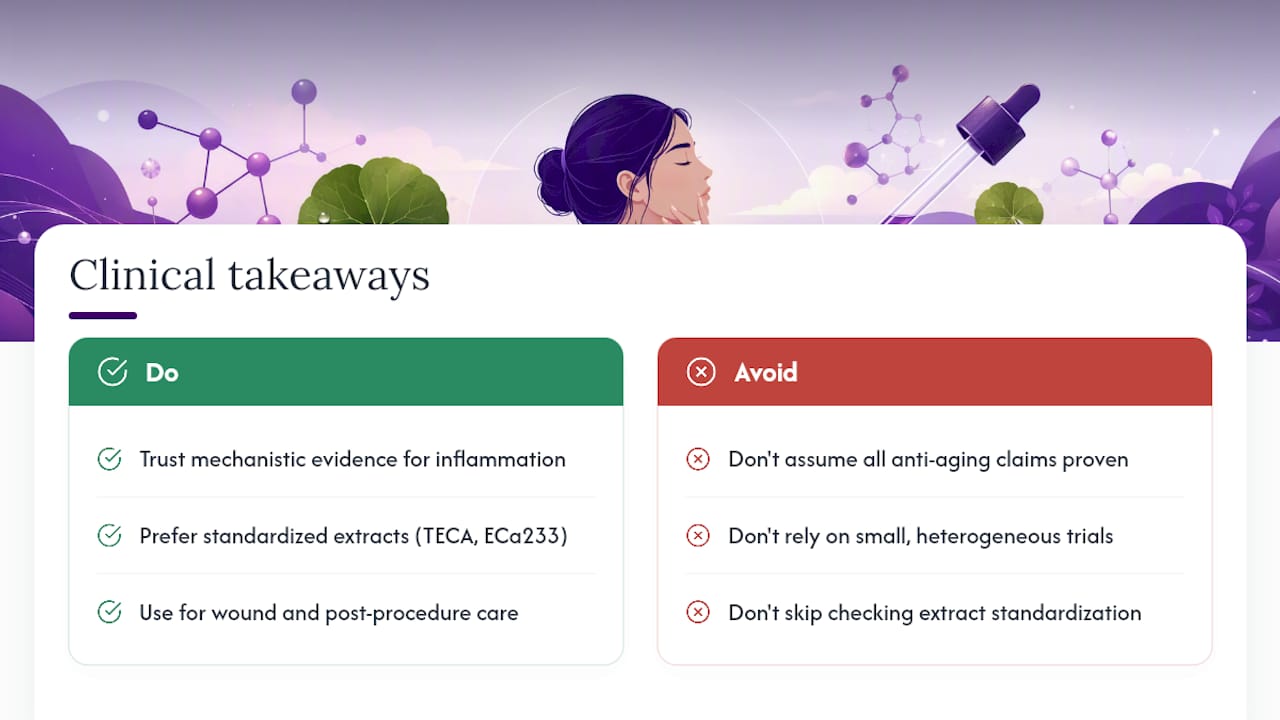
Evidence Snapshot: Clinical contexts with the clearest support are topical wound healing and post-procedural care. Cosmetic claims around anti-aging and scar improvement have solid mechanistic backing but still need longer, larger trials to confirm.
What does this mean if you’re standing in front of a shelf of Centella products? It means you can trust the ingredient to do what the mechanisms suggest: calm inflammation, support barrier repair, and assist wound healing at a biological level. It doesn’t mean every product making an anti-aging claim has trial data specific to that exact formulation behind it. Standardized extracts, sometimes labeled TECA or ECa 233, are the closest thing to a quality benchmark right now, since they at least guarantee a known concentration of the active triterpenoids rather than a vague “Centella asiatica extract” listed low on an ingredient list.
Pairing Centella With Retinol, Niacinamide, Vitamin C, and AHAs
Centella’s biggest practical value might be as a peacekeeper in a routine full of stronger actives. If you use retinol or an AHA exfoliant and deal with the flaking, stinging, or redness that often comes with either, Centella works well layered in to offset that irritation without canceling out the active ingredient’s benefits.
Niacinamide and Centella overlap in the barrier-support department but aren’t redundant. Niacinamide leans more toward oil regulation and brightening, while Centella’s strength is calming inflammation and supporting wound repair. Using both isn’t overkill. It’s coverage for two different mechanisms.
Vitamin C is a slightly different story, since some vitamin C formulations, particularly L-ascorbic acid at higher concentrations, can sting on their own. Applying Centella afterward, once the vitamin C has absorbed, helps offset that sensation without undermining the antioxidant benefit. Consumer-facing dermatology coverage backs this general pairing logic, noting Centella’s compatibility with complementary ingredients like hyaluronic acid, panthenol, and ceramides for post-procedure recovery specifically.
- Morning: vitamin C serum, then a Centella product, then sunscreen.
- Evening: retinol or an AHA, followed by a Centella cream to buffer irritation.
- If your skin is highly reactive, skip layering actives entirely on nights you use a stronger acid, and let Centella carry the routine alone.
- Niacinamide and Centella can be layered together in either the morning or evening without conflict.
If you’re rebuilding a barrier after over-exfoliating or over-treating with retinoids, a related resource on azelaic acid’s effects on skin walks through another gentle option that pairs well in a similar calming role.
What to Look for on a Centella Product Label
A label that lists “Centella asiatica extract” near the top of the ingredient list, or names madecassoside or asiaticoside specifically, tells you more than a vague marketing claim like “cica-infused.” Standardized extracts, often marked TECA, indicate a consistent concentration of active triterpenoids rather than a trace amount added for the label appeal.
- Prioritize products that name madecassoside or asiaticoside directly, or specify a standardized TECA-type extract.
- Look for complementary soothing ingredients like panthenol, ceramides, or centella-derived madecassic acid blends.
- Avoid formulas high on the ingredient list with denatured alcohol or added fragrance if your skin reacts easily.
- Choose thicker ointments or hydrogel formats specifically labeled for post-procedure or wound support, not daily cosmetic serums, if you’re recovering from a treatment like microneedling or laser resurfacing.
- For everyday barrier maintenance, a lighter serum or lotion format is usually the better daily fit.
A Cleveland Clinic guide on Centella asiatica reinforces this distinction between everyday cosmetic use and targeted wound-support formulations, which is worth remembering before you reach for the most intense-sounding product on the shelf.
Where Centella Fits Into a Real K-Beauty Routine
Centella earns its place in Korean skincare not because it’s trendy, but because it solves a specific problem: how do you calm and repair skin without adding another irritant to a routine that might already include retinol, acids, or vitamin C? Standardized extracts matter more than marketing buzzwords here, and readers should be skeptical of “cica” claims that don’t name an actual concentration or active compound. The ingredient works quietly and cumulatively, not instantly, and that’s exactly the kind of active worth building a routine around rather than reaching for once during a flare-up.
— Lunara
Try Centella Asiatica Through Lunarashopping’s Curated Routine
Reading about triterpenoids and TGF-β signaling is one thing. Finding a product with a real, standardized Centella concentration instead of a trace amount buried at the bottom of an ingredient list is another. Online stores specializing in Korean skincare curate products specifically around ingredients like this, so you’re not left guessing which serum actually delivers on the barrier-repair and soothing benefits covered above.
If you’re building a routine around barrier support and calming actives, start with the Morning Face Care Routine Set, which groups compatible products so you’re not layering guesswork on top of guesswork. For a broader look at Centella-forward serums and creams, the full face care collection lets you compare concentrations and formats directly. Pair a Centella serum in the morning with a gentle exfoliating step, like the MIDHA Rice Bran Facial Scrub Foam, a few times a week, and let the Centella product handle daily calming duty in between. If your skin reacts to stronger actives, the Custom Skincare Kit Builder can help you assemble a routine that puts Centella in the right position relative to whatever else you’re using. Start there, and build outward once you know how your skin responds.
Sources
The clinical and dermatological claims in this article draw on peer-reviewed reviews and clinician-facing resources, listed here for anyone who wants to read the primary evidence directly.
- Pharmacological effects of Centella asiatica on skin diseases: Evidence and possible mechanisms
- Clinical studies and topical concentrations of Centella asiatica
- Centella Asiatica: The Most Popular Skin Care Ingredient You’ve Never Heard Of
- Pharmacological review on Centella asiatica: A potential herbal cure-all
This article is general information, not a substitute for advice from a qualified doctor. Consult a qualified healthcare professional about your own circumstances before acting on anything here.