Collagen skincare is defined as the use of topical products and oral supplements designed to support or restore the skin’s collagen supply, the structural protein responsible for firmness, elasticity, and hydration. Your skin’s collagen network is built and maintained by fibroblasts, specialized cells in the dermis that produce collagen types I and III. Starting in your mid-20s, that production slows, and the visible effects accumulate over decades. Understanding what collagen skincare actually does, and what it cannot do, is the clearest path to building a routine that delivers real results.
What does collagen do for your skin?
Collagen is the most abundant protein in the human body, and in the skin it forms a dense fiber network that holds everything firm and supple. Types I and III are the primary collagen types in skin. Type I provides tensile strength, while Type III supports elasticity and flexibility. Together they make up the bulk of the dermis, the deep layer that gives skin its structure.
Fibroblasts produce and maintain this network continuously. When fibroblasts slow down or collagen fibers break down faster than they are replaced, the skin loses its scaffolding. The result is wrinkles, sagging, and dryness. These are not cosmetic inconveniences. They are direct signs of structural protein loss.

UV radiation is the single largest external cause of collagen degradation. Up to 80% of visible skin aging comes from UV exposure, which directly destroys collagen fibers in the dermis. That number explains why dermatologists consistently rank sun protection above every other anti-aging intervention.
Key factors that accelerate collagen loss include:
- UV radiation from daily sun exposure, even on cloudy days
- Oxidative stress from pollution and cigarette smoke
- Glycation caused by high sugar intake, which stiffens collagen fibers
- Natural aging, which reduces fibroblast activity regardless of lifestyle
Each of these factors works differently, but all lead to the same outcome: thinner, less elastic skin over time.
What does research say about collagen supplements for skin?
Oral collagen supplements, specifically bioactive collagen peptides, are the most clinically studied form of collagen skincare. The mechanism is indirect but well established. Ingested collagen peptides are absorbed in the gut and travel through the bloodstream, where they act as signaling molecules that stimulate fibroblasts to increase collagen and extracellular matrix production.
The key word is “bioactive.” Bioactive collagen peptides under 3 kDa differ from native collagen protein in that they function as signaling peptides rather than raw building material. Their small size allows absorption and cellular communication that larger collagen molecules cannot achieve.
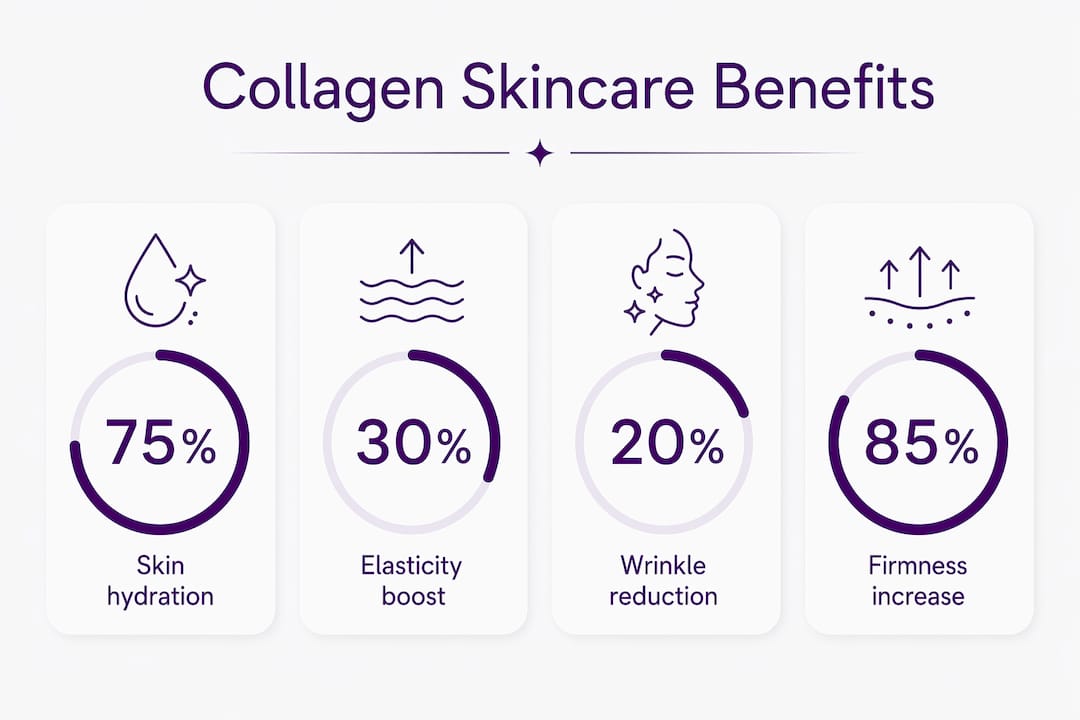
Clinical evidence from 2026 confirms measurable benefits. 12 weeks of daily supplementation with 10g bioactive collagen peptides significantly improved wrinkle count, skin hydration, and elasticity in middle-aged women. The trial also showed dose dependency, meaning results at 10g daily were stronger than at lower doses. That finding matters because many supplements on the market use doses well below the clinically tested threshold.
| Outcome measured | Result after 12 weeks at 10g daily |
|---|---|
| Wrinkle count and length | Significant reduction (p-value confirmed) |
| Skin hydration | Significant improvement |
| Skin elasticity | Measurable improvement |
| Dose dependency | Higher dose produced stronger results |
Hydrolyzed collagen supplements require consistent daily intake over multiple weeks before measurable changes appear. Skipping days resets the signaling process. That is why compliance matters as much as dosage.
Collagen supplements provide modest, gradual improvements in hydration and elasticity. They do not deliver dramatic lifting or wrinkle reversal. Setting that expectation correctly from the start prevents disappointment and keeps you consistent with a routine that genuinely works over time.
Pro Tip: If you start a collagen peptide supplement, photograph your skin under the same lighting every two weeks. Gradual changes are easy to miss day to day, but a side-by-side comparison at 12 weeks often shows clear improvement in texture and hydration.
How effective is topical collagen in skincare products?
Topical collagen is the ingredient you will find most often on product labels, and it is also the most misunderstood. The core limitation is molecular size. Only molecules under approximately 500 Daltons can pass through the skin barrier effectively. Collagen proteins are far larger and cannot penetrate to the dermis when applied topically. They sit on the skin’s surface.
That does not make topical collagen useless. It functions as a humectant and surface moisturizer, drawing water to the outer skin layers and reducing transepidermal water loss. The result is softer, plumper-looking skin. But topical collagen primarily hydrates rather than repairs skin structure. It does not stimulate fibroblasts or rebuild collagen fibers.
For actual collagen synthesis support in topical products, these ingredients are clinically proven to work:
- Retinoids (retinol, retinal, tretinoin): increase cell turnover and directly stimulate fibroblast activity
- Vitamin C: a required cofactor for collagen synthesis; also neutralizes free radicals that degrade existing collagen
- Peptides: short amino acid chains that signal fibroblasts to produce more collagen, similar to the mechanism of oral collagen peptides
- Niacinamide: reduces inflammation and supports the skin barrier, creating conditions where collagen production is less disrupted
Clinical product data supports the hydration and firmness benefits of well-formulated topical products. A 10% phyto-procollagen firming cream led to 81% of users perceiving firmer skin after just one week, and 94% reporting intense hydration after eight weeks. Those results reflect what a well-formulated topical can achieve when it combines collagen-supporting actives with strong humectants.
Pro Tip: When reading a product label, look for retinol, ascorbic acid (vitamin C), or tripeptide-1 in the first half of the ingredient list. Position on the list reflects concentration. A collagen-labeled product with these actives near the top will outperform one that lists collagen first.
What does a balanced collagen skincare routine look like?
A collagen-focused routine works best when it addresses collagen protection, synthesis support, and hydration at the same time. No single product covers all three. The PRETTYSKIN Daily 5-in-1 Collagen Powerful Moisturizer is one example of a product that combines collagen with active moisturizing ingredients for daily use.
A practical daily routine built around collagen health follows this structure:
- Cleanse gently in the morning and evening. Harsh cleansers strip the skin barrier and increase inflammation, which accelerates collagen breakdown.
- Apply a vitamin C serum in the morning. Vitamin C supports collagen synthesis and neutralizes UV-generated free radicals before they damage collagen fibers.
- Use a peptide or collagen-infused moisturizer twice daily. The MEDICUBE Collagen Jelly Face Cream delivers hydration alongside collagen-supporting ingredients in a lightweight formula suited for daily wear.
- Apply broad-spectrum SPF 30 or higher every morning. Daily sunscreen use is the most critical step to prevent collagen loss and visible skin aging. No supplement or serum compensates for unprotected UV exposure.
- Use a retinoid in the evening, starting two to three nights per week. Retinoids are the most clinically validated topical ingredient for stimulating fibroblast activity and increasing collagen production.
- Take a bioactive collagen peptide supplement daily, ideally at 10g per serving, and commit to at least 12 weeks before evaluating results.
- Hydrate consistently. Dehydrated skin accelerates the appearance of fine lines and impairs the skin barrier, making every other step less effective.
Effective collagen skincare routines integrate ingredients that signal collagen production at the cellular level rather than relying on collagen application alone. The 10-step Korean skincare routine offers a structured framework for layering these actives correctly, which matters because applying vitamin C after a retinoid, for example, can reduce the effectiveness of both.
Ingredients like retinoids, vitamin C, and peptides promote fibroblast activity and collagen synthesis more effectively than topical collagen protein. Combining them with daily sun protection and a collagen peptide supplement creates a routine that addresses every stage of the collagen lifecycle.
Key Takeaways
Collagen skincare works best when it combines oral peptide supplementation, collagen-stimulating topical ingredients like retinoids and vitamin C, and daily SPF protection to prevent further collagen degradation.
| Point | Details |
|---|---|
| Topical collagen hydrates, not rebuilds | Collagen molecules are too large to penetrate skin; they moisturize the surface only. |
| Supplements need 12 weeks minimum | Clinical trials show measurable results after 12 weeks at 10g daily of bioactive collagen peptides. |
| Retinoids and vitamin C outperform collagen topicals | These ingredients directly stimulate fibroblast activity and collagen synthesis in the dermis. |
| UV protection is non-negotiable | Up to 80% of visible skin aging comes from UV damage, making daily SPF the highest-impact step. |
| Consistency drives results | Collagen improvements are gradual and require daily commitment across both supplements and topicals. |
What I’ve learned from years of watching collagen trends come and go
The collagen skincare category is one of the most marketed and least understood areas in beauty. I have seen products promise structural skin repair from a topical collagen cream, and I have watched people spend significant money on them expecting results that the science simply does not support.
Here is what I know to be true: collagen supplements, when dosed correctly and taken consistently, do produce real but modest improvements. The clinical data is solid. The results are not dramatic. They look like better hydration, slightly firmer texture, and fewer fine lines after three months. That is worth something. It is not a substitute for a cosmetic procedure, and it should never be marketed as one.
Topical collagen products are not fraudulent. They hydrate well. But if the label leads you to believe the collagen is rebuilding your dermis, that claim is not supported by dermatology. The ingredients doing the real work in those formulas are the retinoids, the peptides, and the antioxidants. Collagen is often the marketing hook, not the active ingredient.
The readers I trust most in this space are the ones who ask for the full ingredient list before buying anything. They know that a product labeled “collagen cream” might contain retinol at a meaningful concentration, which would make it genuinely effective. Or it might contain collagen as the primary active with nothing else to support synthesis, which makes it a moisturizer with a premium price tag.
My honest recommendation: build your routine around sun protection, a retinoid, and vitamin C first. Add a collagen peptide supplement if you want to support the process from the inside. Then choose a moisturizer that fits your skin type. The self-care skincare best practices that hold up over time are always the ones grounded in consistency, not in a single miracle ingredient.
— Lunara
Collagen-supporting skincare from Lunarashopping
Lunarashopping carries a curated selection of face care products built around the ingredients that clinical research supports for collagen health.
The face care collection includes moisturizers, serums, and collagen-infused creams from trusted Korean beauty brands, all selected for their active ingredient profiles rather than label claims alone. Whether you are starting with a daily collagen moisturizer or building a full routine with vitamin C, peptides, and SPF, Lunarashopping’s custom skincare kit builder helps you put together a personalized regimen matched to your skin type and goals. Every product ships with the same commitment to quality and accessibility that defines the Lunarashopping experience.
FAQ
What is collagen skincare, exactly?
Collagen skincare refers to products and supplements designed to support the skin’s collagen supply, the protein responsible for firmness, elasticity, and hydration. It includes topical creams, serums, and oral collagen peptide supplements.
Do collagen supplements actually work for skin?
Clinical trials show that 10g of bioactive collagen peptides taken daily for 12 weeks produces measurable improvements in skin hydration, elasticity, and wrinkle appearance. Results are gradual and modest, not dramatic.
Can topical collagen creams rebuild collagen in the skin?
No. Collagen molecules are too large to penetrate the skin barrier and reach the dermis. Topical collagen functions as a surface moisturizer and humectant, not a collagen-rebuilding agent.
What ingredients actually stimulate collagen production?
Retinoids, vitamin C, and peptides are the most clinically validated topical ingredients for stimulating fibroblast activity and collagen synthesis. These work at the cellular level in ways that topical collagen protein cannot.
How long does it take to see results from collagen skincare?
Oral collagen peptide supplements require at least 12 weeks of consistent daily use before measurable skin improvements appear. Topical retinoids typically show visible texture changes within 8–12 weeks of regular use.