Korean skincare’s gentle, barrier-first approach can genuinely help soothe psoriasis when layered on top of your prescribed medical treatment, not instead of it. Start with three moves: switch to a fragrance-free, low-pH gentle cleanser, apply a ceramide-rich moisturizer consistently, and skip any new active ingredient until your dermatologist signs off. This won’t clear plaques on its own, but it can calm the dryness, scaling, and irritation that make psoriasis harder to live with day to day.
TL;DR:
- Ceramides are the most effective barrier-supporting ingredients for psoriasis, helping reduce dryness and itching when incorporated into moisturizers.
- Hyaluronic acid should be used as a layering product alongside ceramide-rich creams, but it does not replace barrier repair effects.
- Products should be fragrance-free, in airless packaging, and contain a balanced pH to avoid irritating reactive skin, with patch testing recommended before full use.
- A simplified skincare routine with gentle cleansing, ceramide moisturizers, and timely medication application can significantly improve psoriasis management.
- Evidence supports barrier repair and gentle cleansing as valuable adjuncts, while natural extracts like aloe vera and turmeric have limited, inconsistent benefits.
Table of Contents
- What Korean Skincare Ingredients Actually Help Psoriasis?
- Building a Psoriasis-Friendly Korean Skincare Routine
- How Do You Pick Safe K-Beauty Products for Psoriasis?
- Combining Korean Skincare With Prescription Psoriasis Treatment
- What Does the Clinical Evidence Actually Show?
- Why Lunara Takes a Barrier-First View on Psoriasis-Prone Skin
- Curated Starting Points for a Psoriasis-Friendly K-Beauty Routine
- Sources
What Korean Skincare Ingredients Actually Help Psoriasis?
Not every trending K-beauty ingredient earns its place in a psoriasis routine. Some have real barrier science behind them. Others are riding a wave of marketing with thin clinical support, and a few are outright risky for reactive, plaque-prone skin.
Ceramides sit at the top of the list for a reason. Psoriasis-prone skin loses ceramides faster than it can replace them, which weakens the skin barrier and drives up transepidermal water loss. Dermatology reviews point to ceramide-containing moisturizers as a genuine adjunct for reducing dryness and itching in psoriasis. Look for “ceramide NP,” “ceramide AP,” or simply “ceramides” high on the ingredient list.
Hyaluronic acid works differently. It’s a humectant, meaning it pulls water into the skin rather than sealing it in. That makes it a good layering partner underneath a ceramide cream, but a poor substitute for one.
Centella asiatica (often labeled “cica”) has a loyal following in Korean skincare, and early evidence suggests it may help calm inflamed, irritated skin, though trial data specific to psoriasis remains limited. The same systematic review found modest, inconsistent benefits for mugwort, aloe vera, and turmeric. These ingredients aren’t harmful in most formulations, but treat any claims of dramatic results with skepticism.
Ingredients to avoid:
- Added fragrance or “parfum,” a leading trigger for reactive skin
- Essential oil blends (lavender, tea tree, citrus oils), even in “natural” formulas
- High concentrations of denatured alcohol, which strips barrier lipids
- Physical scrubs, brushes, or exfoliating pads on or near plaques
- Snail mucin and other novel actives layered onto already-inflamed skin without a patch test first
Statistic to remember: A systematic review of East Asian natural ingredients found only limited, often non-significant evidence across five relevant trials, a reminder that “natural” doesn’t automatically mean proven.
Building a Psoriasis-Friendly Korean Skincare Routine
Korean layering is famous for its multi-step complexity, but psoriasis-prone skin does better with a stripped-down version: fewer products, applied consistently, in the right order relative to your medication.
Morning routine:
- Cleanse with a fragrance-free, low-pH gel or cream cleanser, using lukewarm water only.
- Apply any prescribed morning topical medication as directed.
- Wait, then follow with a ceramide-rich moisturizer to seal in hydration.
- Finish with a mineral (zinc oxide or titanium dioxide) sunscreen, since some psoriasis medications and phototherapy increase sun sensitivity.
Evening routine:
- Rinse with lukewarm water or use a gentle cleanser if you wore sunscreen or makeup.
- Apply your prescribed topical treatment to active plaques.
- Follow with a thicker occlusive emollient, such as a petrolatum-based balm, over the rest of the body to lock in moisture overnight.
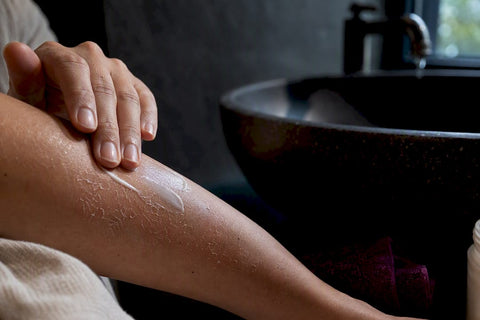
Body care deserves its own attention separate from facial skincare. Thicker creams and ointments outperform lotions for psoriasis because they contain less water and more lipid content. Apply them within a few minutes of stepping out of the shower, while skin is still damp, to trap moisture before it evaporates. For scalp psoriasis, look for medicated scalp treatments or oils formulated for sensitive scalps rather than fragranced hair masks.
Pro Tip: Keep your evening moisturizer in the shower or right next to the towel. The three-minute window after bathing matters more than the product you use.
Weekly, resist the urge to add a physical exfoliator. Mechanical scrubbing can trigger new plaques through the Koebner phenomenon, a well-documented reaction where skin trauma sparks fresh psoriasis lesions. Chemical keratolytics like salicylic acid have a place in some psoriasis regimens, but only under a dermatologist’s guidance.
How Do You Pick Safe K-Beauty Products for Psoriasis?
Reading a Korean skincare label takes a slightly different eye when you have psoriasis. The goal isn’t finding the trendiest formula. It’s screening out anything that could compromise an already-stressed barrier.
Start with the label itself. Words like “fragrance-free,” “ceramide,” “glycerin,” and “hyaluronic acid” signal a formula built for hydration and repair. Be wary of “perfume,” “parfum,” or a long list of botanical extracts you can’t identify, since these often correlate with essential oil blends that irritate reactive skin.
Packaging matters more than most shoppers realize. Airless pump bottles limit air and bacterial exposure compared to open jars, which matters when a product will sit in your bathroom for months. A pH-balanced cleanser, ideally in the 4.5 to 5.5 range, respects the skin’s natural acid mantle better than a high-pH bar soap.
Selection checklist:
- Fragrance-free and dye-free on the label, not just “unscented”
- Short, recognizable ingredient list rather than a crowded formula
- Airless pump or tube packaging over open-jar containers
- No alcohol denat. near the top of the ingredient list
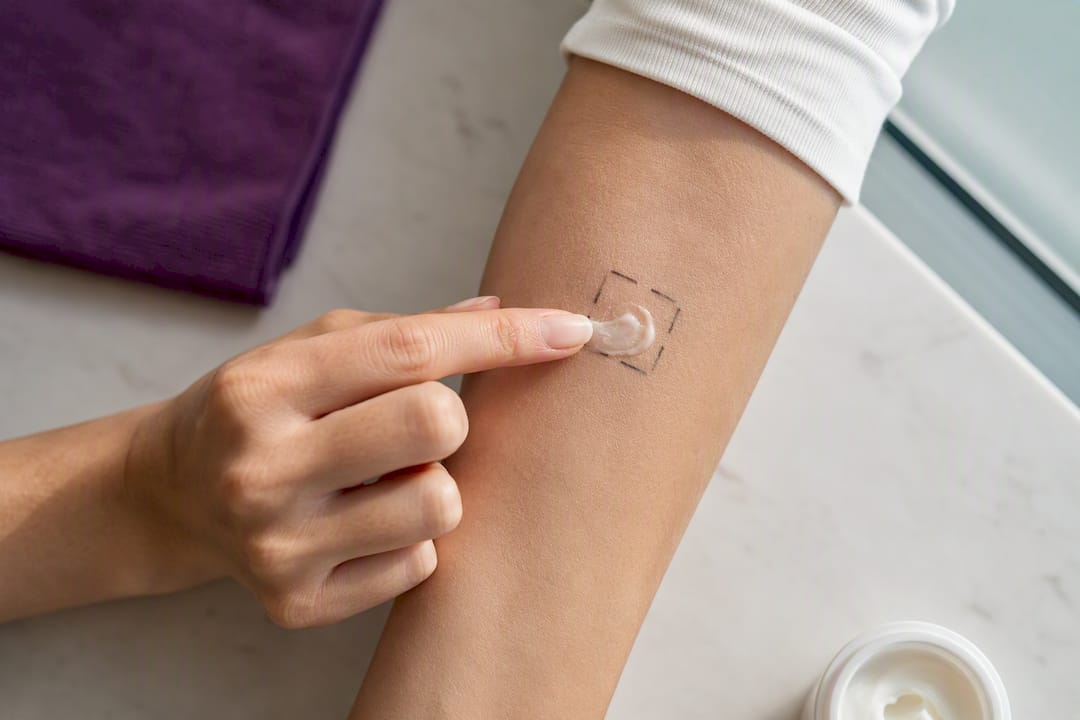
Before applying anything new to visible plaques, patch test it first. Apply a small amount to an unaffected area, like the inner forearm, and wait 48 to 72 hours to check for delayed redness, burning, or itching. If nothing happens, you can introduce it more broadly.
Pro Tip: Patch test one new product at a time, not a whole new routine at once. If irritation shows up later, you’ll know exactly which product caused it.
Save actives like salicylic acid, AHAs, and retinoids for a direct conversation with your dermatologist. These ingredients can help with scale in the right context, but they can also worsen irritation if introduced without guidance.
Combining Korean Skincare With Prescription Psoriasis Treatment
Skincare and medication aren’t competing systems. Used correctly, they work in sequence, and the evidence for that combination is stronger than most people expect.
An 8-week clinical study of adults with plaque psoriasis found that adding a gentle cleansing and moisturizing regimen to standard medical therapy reduced affected body surface area from 9.3% to 5.1% and improved quality-of-life scores (DLQI) from 9.2 down to 2.9. That’s not a replacement for medication. It’s a measurable boost on top of it.
Timing rules that matter:
- Apply topical medications to clean, dry skin, following your prescription’s specific instructions.
- A general rule of thumb is to leave roughly 15 minutes between a moisturizer and a topical steroid or vitamin D analogue, so one doesn’t dilute or block absorption of the other.
- Topical corticosteroids and vitamin D analogues remain the standard medical treatments for psoriasis. Skincare supports the skin around and between treatments, it doesn’t substitute for them.
- If you’re on phototherapy, ask your dermatologist about sunscreen timing on treatment days, since some products can interfere with light penetration.
Watch for red flags that call for a dermatologist visit rather than a new skincare product: signs of infection (increasing warmth, pus, spreading redness), rapidly enlarging plaques, or severe pain and bleeding. Skincare can soothe. It cannot treat an infected or rapidly progressing flare.
What Does the Clinical Evidence Actually Show?
The strongest data on skincare for psoriasis comes from a single well-designed trial, and it’s worth knowing exactly what it did and didn’t measure.
| Evidence source | What it found | Strength of evidence |
|---|---|---|
| 8-week gentle regimen trial | BSA dropped from 9.3% to 5.1%; DLQI improved from 9.2 to 2.9 | Moderate: single multicenter study, used alongside medical therapy |
| Systematic review of East Asian ingredients | Modest, often non-significant benefit from aloe vera and turmeric | Limited: few RCTs, small sample sizes |
| Dermatology barrier reviews | Ceramide moisturizers and pH-balanced cleansers reduce xerosis and pruritus | Expert consensus, supported by mechanism |
The takeaway is straightforward: barrier repair with ceramide moisturizers and gentle cleansing has real, measured support as an adjunct treatment. Many of the specific “natural” ingredients popular in Korean beauty marketing have theoretical promise but thinner proof behind them. Consistency with the basics beats chasing the next trending extract.
Why Lunara Takes a Barrier-First View on Psoriasis-Prone Skin
We built Lunarashopping around Korean skincare because it takes hydration and barrier repair seriously as a category, not an afterthought. When we curate for sensitive and psoriasis-prone skin, we screen labels for fragrance, essential oils, and irritating alcohols before a product ever gets listed.
That screening process leans on the same barrier-first logic dermatology reviews recommend: ceramides, humectants, and gentle, low-pH formulas over trendy actives with thin evidence. We see our role as pointing you toward supportive skincare, not replacing the care plan your dermatologist has already built for you. If you’re changing medicated treatment, that conversation belongs with your clinician first.
— Lunara
Curated Starting Points for a Psoriasis-Friendly K-Beauty Routine
Choosing individual products one by one, while also trying to avoid every irritant on this list, is a lot to manage on your own. That’s the problem a curated set solves: someone has already screened the formulas so you don’t have to cross-reference every ingredient label yourself.
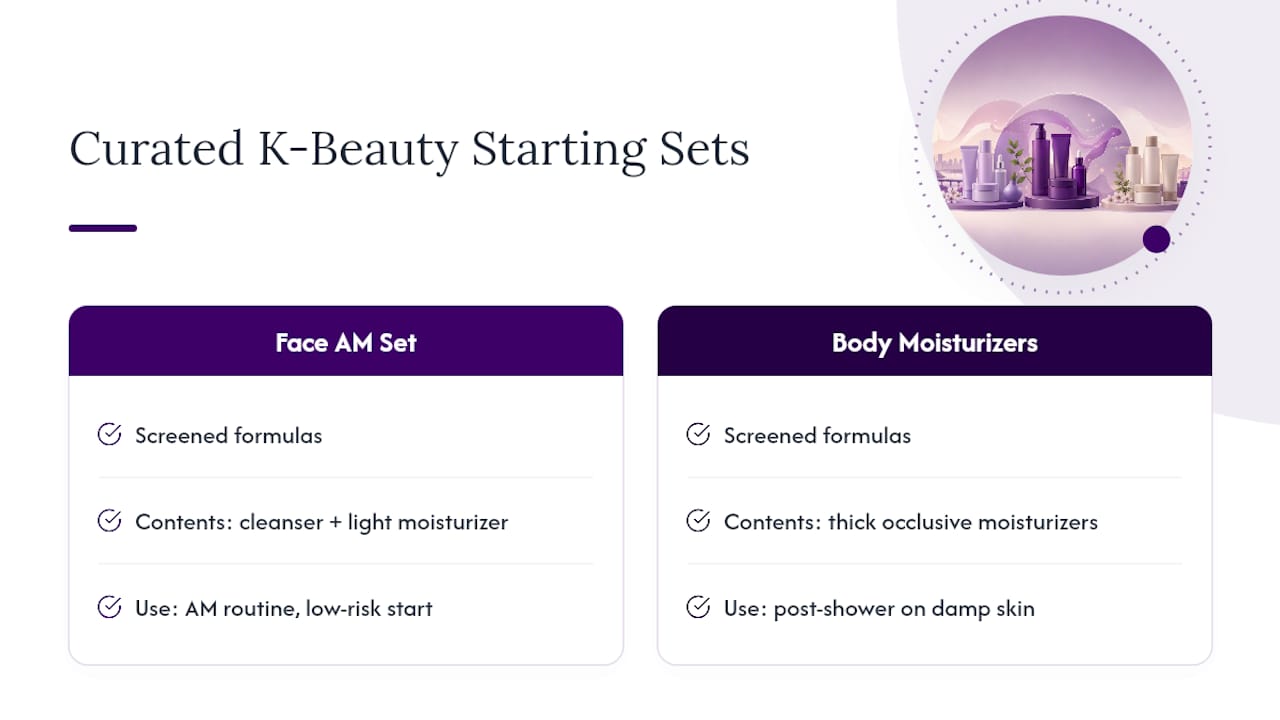
The Morning Face Care Routine Set bundles a gentle cleanser and lightweight, barrier-supportive moisturizer into a single, low-risk starting point for the AM routine outlined above. If body care is a bigger concern, the Body Moisturizers collection focuses on thicker, occlusive formulas designed for post-shower application on damp skin, exactly the window when sealing in moisture matters most.
These are supportive skincare picks, not medical treatments. Keep taking your prescribed medication as directed, and check with your dermatologist before adding anything new to an active flare. Browse the Morning Face Care Routine Set to build your first gentle routine today.
This article is general information, not a substitute for advice from a qualified doctor. Consult a qualified healthcare professional about your own circumstances before acting on anything here.
Sources
- Study of adjuvant sensitive-skin cleansing and moisturizing regimen in plaque psoriasis - PubMed
- Psoriasis and skin barrier dysfunction: the role of gentle cleansers and moisturizers - JDDonline
- Systematic review of natural ingredients used in East Asian skincare for inflammatory skin diseases - PubMed