The most reliable way to avoid fake Korean skincare is a four-step check: inspect the packaging against official brand photos, verify the seller and question any suspiciously low price, scan the QR code or batch number for a match, and stop using anything that causes irritation. If a product fails any of these, document it, contact the seller and the brand, and buy your next order from a source with a verified track record, like Lunarashopping.
TL;DR:
- Authentic packaging uses consistent fonts, clear batch codes, and proper sealing, while counterfeit products often show misaligned logos, spelling errors, and packaging flaws.
- Buying from verified authorized retailers and avoiding suspiciously low prices reduces counterfeit risk, especially when sellers cannot provide invoices or batch verification.
- QR codes should lead to official brand pages, and barcode prefixes like 880 are unreliable indicators of authenticity on their own.
- Fake serums and skincare products are prevalent due to high margins and can contain unsafe ingredients, posing health risks if used regularly.
- Reporting a suspected fake promptly, collecting photo evidence, and purchasing from trusted verified retailers like Lunarashopping help prevent health issues and counterfeit purchases.
Table of Contents
- Fake Korean Skincare: What the Packaging and Label Tell You
- Verifying Sellers, Marketplace Listings, and Suspicious Pricing
- QR Codes, Batch Numbers, and Why Barcodes Don’t Prove Much
- Which K-Beauty Products Get Faked Most, and Why It’s a Health Issue
- You Received a Suspected Fake: Here’s What to Do Next
- How Lunarashopping Verifies What Reaches Your Doorstep
- Our Take: Verification Beats Vigilance
- Shop Verified K-Beauty Without the Guesswork
- Where This Information Comes From
- Sources
Fake Korean Skincare: What the Packaging and Label Tell You
Counterfeiters get the color palette close. They rarely get the details right, and the details are where you catch them.
Start with typography. Authentic Korean beauty packaging uses consistent, crisp fonts, and the brand’s own website almost always has clean product photography you can compare side by side. Pull up the official product page before you accept a delivery, then look at your item under good light. Misaligned logos, slightly wrong shades of a signature color, or a font that looks stretched or pixelated are common tells.
Spelling errors are the fastest giveaway and the one counterfeiters fix last. A single swapped letter in a brand name, like a doubled consonant or a dropped accent mark, often means you’re holding a copycat. Reporting on the “dupe economy” has documented how copycat brands lean on Korean visual cues and wording to pass as the real thing, sometimes without ever claiming to be the actual brand at all.
Physical materials matter just as much as print quality:
- Shrink wrap should be tight, evenly sealed, and free of bubbling or crooked seams.
- Foil stamps and embossing should feel crisp to the touch, not soft or smudged.
- Batch or lot codes should be printed clearly and consistently, not stamped at an angle or in a different ink than the rest of the label.
- Cap and pump mechanisms should feel identical to previous purchases of the same product; a loose or scratchy pump is a warning sign.
- Color tone inside the jar or bottle should match what you remember or what’s shown in verified customer photos, since counterfeit formulas often run slightly off in texture or hue.
Pro Tip: Before you even open the box, photograph the packaging from three angles and compare it against the manufacturer’s current product photos. If anything looks even slightly off, do this before you open the seal. Once the shrink wrap is broken, most sellers will not accept a return.
Verifying Sellers, Marketplace Listings, and Suspicious Pricing
Where you buy matters as much as what you buy. Most Korean skincare brands publish an authorized retailer list on their official site, and checking it takes less than a minute.
- Search the brand’s own website for an “authorized retailers” or “where to buy” page, and cross-check the seller’s name against it before you click purchase.
- Review the seller’s rating history and return policy. A seller with hundreds of five-star reviews but no clear return window, or one that only accepts payment through untraceable methods, deserves a second look.
- Check the seller’s stated location against the product’s origin claims. A listing that claims direct-from-Korea shipping but ships from an unrelated address is worth questioning.
- Look for consistent, original product photography. Sellers who use only stock images pulled from the brand’s marketing (rather than their own photos of stock on hand) may not actually hold inventory.
- Treat a price 40% or more below the standard retail range as a red flag, especially when paired with vague “imported” or “wholesale” language and no proof of sourcing.
- Ask for an invoice or supplier authorization before buying, particularly for a first-time purchase from an unfamiliar marketplace storefront.
Counterfeiting has moved well past luxury labels. Industry reporting shows counterfeit K-beauty has expanded into mass-market and indie brands, which means the popular $12 serum on a crowded marketplace carries real counterfeit risk, not just the $80 luxury cream. A legitimate seller will not hesitate when you ask for a batch number or invoice; a seller who goes quiet or gets defensive has told you everything you need to know.
QR Codes, Batch Numbers, and Why Barcodes Don’t Prove Much
Scan the QR code before you use anything. A working code should route you to the brand’s official site or a matching product page, not a generic landing page or an error message.
A few practical rules make traceability checks worth your time:
- If the QR code fails to scan, redirects somewhere unrelated to the brand, or links to a page in the wrong language for where the product claims to be from, treat it as a red flag.
- Korea’s Ministry of Food and Drug Safety (MFDS) registration numbers appear on many cosmetics sold domestically, but export packaging for the same product can look different or omit certain domestic-only markings, so a missing MFDS number alone doesn’t confirm a fake.
- Barcode prefixes, including the commonly cited “880” range associated with South Korea, are a weak signal on their own. Legitimately exported products can carry different regional barcode prefixes depending on where they were packaged for distribution, so don’t rely on this as your single test.
- When something still feels off after checking the QR code and packaging, contact the brand’s customer service directly with the batch number. Response times vary, but most manufacturers will confirm or deny a batch on request, and it’s worth preserving your packaging in case they ask for a sample.
Labeling consistency, seller transparency, and a direct answer from the brand will tell you more than any single code ever will.
Which K-Beauty Products Get Faked Most, and Why It’s a Health Issue
Serums, ampoules, sheet masks, and sunscreens top the counterfeit target list, largely because they’re high-margin, fast-moving, and easy to reformulate cheaply. Counterfeiters don’t need to fool a lab, just a shopper scrolling fast on a marketplace app.
The scale of the problem is no longer a fringe issue. Fake K-beauty imports have spiked 24-fold in recent tracking, leaving legitimate brands with over 22 billion won in damages, with a majority of seized shipments traced back to manufacturing in China.
That volume matters because counterfeit skincare isn’t just a wasted purchase. It’s a product with an unknown formula sitting on your face. Fake serums have turned up with incorrect preservative levels, substituted active ingredients, or contamination from unsanitary manufacturing conditions. Manufacturers have confirmed real cases: Dongkook Pharmaceutical issued a notice warning that counterfeit versions of its dermacosmetic products were circulating and could carry health risks from unregulated formulation.
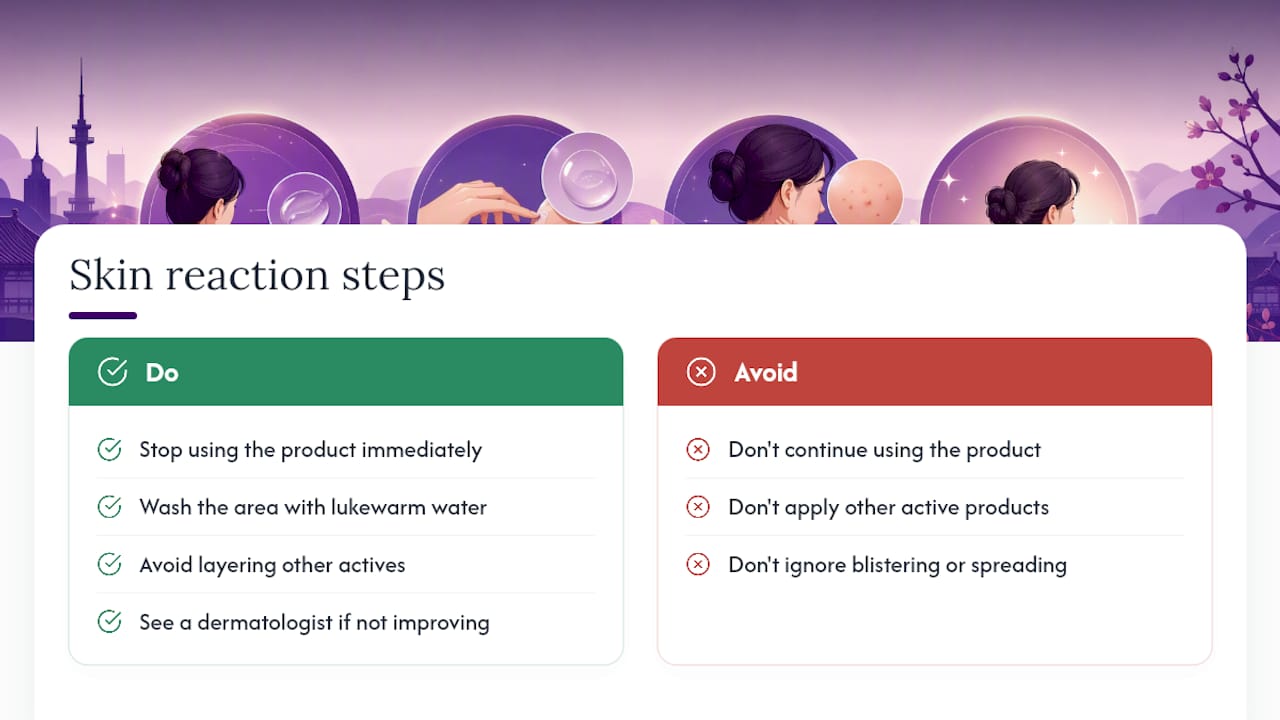
If you experience redness, stinging, swelling, or breakouts after starting a new product, stop using it immediately. Wash the area with lukewarm water, avoid layering other actives on top while your skin settles, and see a dermatologist if symptoms don’t improve within a day or two, or sooner if you notice blistering or spreading irritation.
You Received a Suspected Fake: Here’s What to Do Next
Move quickly, but move in order. Evidence disappears fast once a product gets returned, tossed, or used up.
- Stop using the product immediately. Photograph the packaging, the product itself, the batch code, and your receipt or order confirmation before you touch anything else.
- Contact the seller first, then your payment provider, if a refund isn’t offered. Most credit cards and marketplace payment systems have buyer protection for counterfeit goods, but you’ll need your photo evidence to file a claim.
- Contact the brand directly with your batch number and photos. Many manufacturers want this information for their own enforcement efforts, and some marketplaces require a brand’s confirmation before processing a counterfeit report.
- File a report with the marketplace and, if the item crossed international shipping, consider a customs report. South Korea has expanded cross-border cooperation and reporting infrastructure specifically to help consumers flag counterfeit K-beauty overseas.
Keep a small, sealed sample of the product rather than throwing the whole thing out. Some brands request it for lab testing, and having it on hand speeds up your claim. If you had any physical reaction, keep photos of that too, and see a doctor if symptoms escalate.
How Lunarashopping Verifies What Reaches Your Doorstep
Buying from a retailer that already screens for authenticity removes most of the guesswork covered above. Lunarashopping carries facial care, body care, lip care, eye care, and men’s grooming products from established Korean beauty brands, alongside a smaller set of curated in-house essentials, and every listing is sourced with that verification chain in mind.
What that looks like in practice:
- Product listings are checked against manufacturer packaging and updated when brands change their formulas or box designs.
- Customers who have a question about a specific batch or listing can reach out directly for an authenticity check before or after purchase.
- Return policies are clear and stated upfront, not buried in fine print, so you’re not stuck if something doesn’t match what you expected.
- Curated collections, like the Morning Face Care Routine Set, are built from products already vetted through this process rather than pulled from unverified drop-shipping inventory.
Legitimate retailers can produce invoices, name their suppliers, and answer a batch-number question without hesitation. That responsiveness, more than any badge or seal on a website, is the real test of whether a seller is worth trusting with your skin.
Our Take: Verification Beats Vigilance
Most advice on counterfeit skincare tells you to “be careful” or “trust your gut,” which is close to useless. A checklist does.
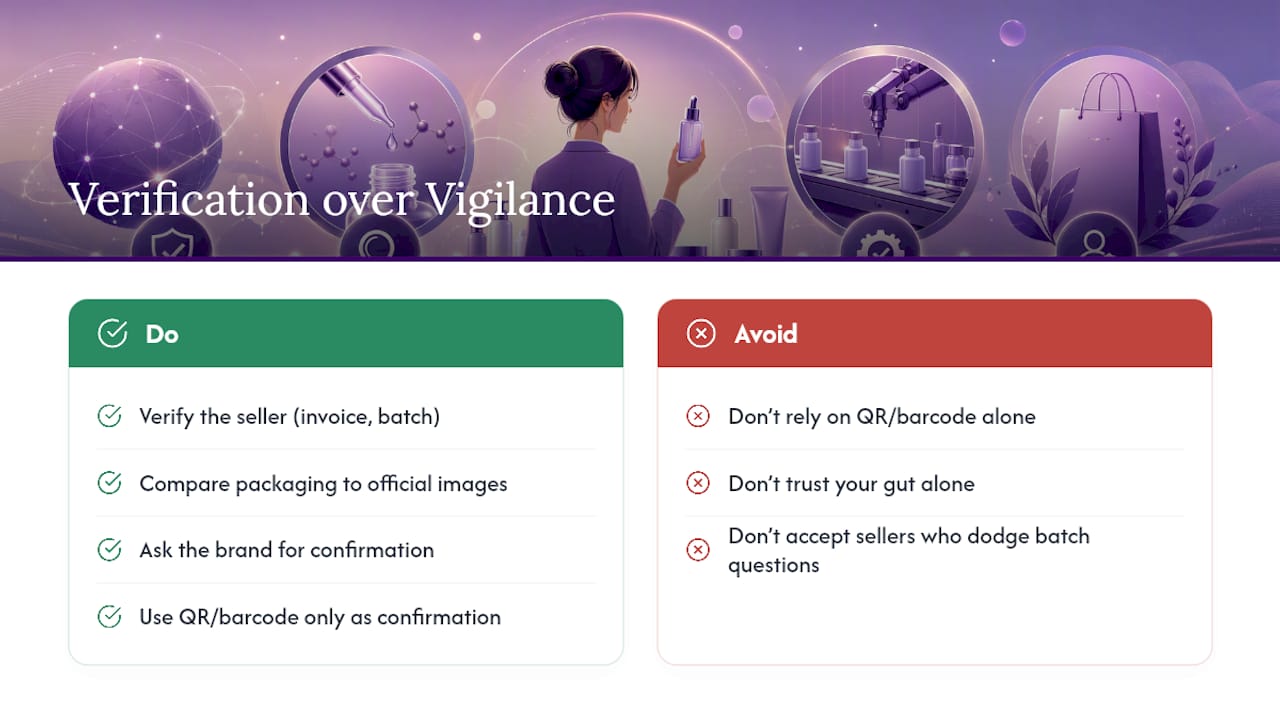
The conventional wisdom oversells barcode checks and QR scans as if they’re foolproof. They’re not. A QR code can be cloned. A barcode prefix can legitimately vary by export market. What actually holds up is the combination: packaging comparison, seller transparency, and a brand’s own confirmation when something looks off. No single test wins on its own.
If we had to rank priorities, seller verification comes first. A seller who can’t produce an invoice or dodges a batch-number question has already told you what you need to know, regardless of how good the packaging looks. Everything else, the QR scan, the shrink wrap inspection, is confirmation, not the primary defense.
— Lunara
Shop Verified K-Beauty Without the Guesswork
Every checklist in this article exists because counterfeit risk is real, but it’s also avoidable the moment you buy from a retailer that’s already done the verification work. Lunarashopping is built around that idea: a curated selection of Korean beauty essentials, sourced and checked so you’re not left comparing fonts and shrink wrap on your kitchen table.
Here’s what that means for you as a customer: listings that match official packaging, a return policy that doesn’t require a legal degree to understand, and a support team you can actually reach if you have a question about a specific product before it ships. Browse the Morning Face Care Routine Set for a ready-made starting point, or explore the full face care collection to build a routine one verified product at a time. If something feels sketchy about a listing elsewhere, that’s the moment to check here instead.
Where This Information Comes From
The counterfeit figures and manufacturer warnings referenced throughout this guide come from direct industry and customs reporting, not marketing claims. The Korea Herald’s coverage of counterfeit import spikes documents the seizure data and financial damages behind the current wave of fakes, while its follow-up reporting on overseas counterfeit expansion tracks how the problem has spread past luxury labels. Dongkook Pharmaceutical’s manufacturer advisory confirms real-world counterfeit cases tied to specific products, and Jing Daily’s analysis of copycat branding explains how non-Korean sellers borrow K-beauty identity to mislead shoppers.
Sources
- Fake K-beauty surges overseas as global popularity soars - The Korea Herald
- Dongkook Pharmaceutical confirms counterfeit distribution and warns of potential side effects - Asiae
- Dupe economy issues and C-beauty misuse of Korean identity - Jing Daily