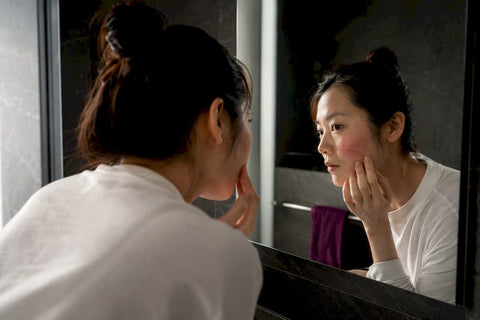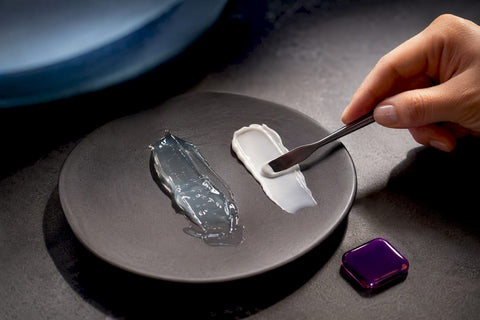
The smartest way to start Korean skincare is a compact 3 to 5 product kit that covers cleansing, hydration, moisturizing, and SPF, nothing more. LunaraShopping’s Complete Face Care Bundle is built around exactly that structure, so you can open the box and start your routine the same day. Give it several weeks before you judge results.
TL;DR:
- The foundation of a Korean skincare routine should include a gentle cleanser, a hydrating serum or essence, a moisturizer suited to skin type, and SPF 30 or higher.
- When choosing products, prioritize formulations tailored to your skin type and avoid those with heavy fragrance, drying alcohols, or aggressive exfoliants for daily use.
- Layer products from thinnest to thickest, applying active ingredients gradually every 2 to 4 weeks while patch-testing new serums to prevent irritation.
- Adjust your routine seasonally by switching to richer creams in winter and lighter moisturizers in summer, while keeping sunscreen year-round.
- Starting with a small, complete kit helps build a consistent routine and reduces confusion or skin reactions, rather than attempting an extensive 10-step regimen from the outset.
Table of Contents
- What’s in a Korean Skincare Starter Kit
- How Do You Choose Products by Skin Type?
- How Do You Layer a Beginner Korean Skincare Routine?
- When Should You Add Active Ingredients?
- How Do You Adjust Your Routine for the Seasons?
- What Should You Budget for a Starter Kit?
- Lunarashopping’s Starter Kits: Which One Fits You?
- Why Lunara Believes in Starting Small
- Sources
- FAQ
What’s in a Korean Skincare Starter Kit
A well-built K-beauty starter kit isn’t a mystery box. Every item has a specific job, and understanding that job helps you shop smarter instead of chasing whatever brand is trending this month.
- Cleanser. A gentle, low-foam formula you can use morning and night without stripping your skin. Double-cleansing (oil cleanser followed by a water-based one) only matters if you’re wearing sunscreen or makeup that needs to come off first.
- Hydrating essence or serum. This is the lightweight layer that gives Korean routines their reputation for glow. Textures are usually thin and watery, made to sink in fast rather than sit on top of skin.
- Moisturizer. Texture should match your skin type, but look for barrier-supporting ingredients like ceramides, glycerin, or squalane regardless of whether you land on a gel or a cream.
- Sunscreen, SPF 30 or higher. This is the step people skip and regret. Reapply every two hours if you’re outdoors, and treat it as the final step of your morning routine, not an afterthought.
- Optional extras. Sheet masks for an occasional hydration boost, a gentle weekly exfoliant, or a makeup remover if you wear heavier coverage.
One more thing worth checking before you buy: fragrance. Scan ingredient lists for “parfum,” since many Korean formulas skew lighter on added fragrance than Western drugstore counterparts. This matters if your skin reacts to scent.
How Do You Choose Products by Skin Type?
There’s no universal “best” Korean skincare brand. What works depends entirely on your skin, and dermatology sources are consistent on this point: identify your skin type first, then shop by formula, not by hype.
- Dry skin: cream cleansers, lotion or cream moisturizers, and serums rich in hyaluronic acid or ceramides.
- Oily skin: gel or foam cleansers, lightweight gel moisturizers, and niacinamide-based serums that help with shine control.
- Combination skin: a balanced gel cream and a cleanser that isn’t overly drying on the cheeks while still managing an oily T-zone.
- Acne-prone skin: noncomedogenic labeling matters here, along with gentle exfoliating acids rather than harsh physical scrubs.
- Sensitive skin: fragrance-free formulas, minimal ingredient lists, and centella or oat-based calming ingredients.
If your budget only stretches to three products, prioritize the cleanser, moisturizer, and sunscreen before anything else. Those three cover the non-negotiable foundation that most dermatology-backed routines are built on, and everything else is an upgrade, not a requirement.
Watch for red flags while shopping online: heavy fragrance near the top of an ingredient list, drying alcohols listed early, or product descriptions that lean on “deep exfoliation” language for daily use. Those are usually signs a product is formulated for occasional use, not your everyday step.
Pro Tip: Before adding anything to your cart, search the product page for “noncomedogenic” and confirm any daytime moisturizer or serum actually lists an SPF number. If it doesn’t, you still need a separate sunscreen.
How Do You Layer a Beginner Korean Skincare Routine?
The order matters as much as the products themselves. Layering thinnest to thickest helps each product absorb properly instead of pilling or sliding off your skin.
Morning routine:
- Cleanse only if your skin feels oily overnight; otherwise a splash of water is enough.
- Apply a hydrating essence or serum while skin is still damp.
- Follow with a pea-sized amount of moisturizer, warmed between your fingers before pressing in.
- Finish with sunscreen, using roughly a nickel-sized amount for your face alone.
Evening routine:
- Remove makeup or sunscreen first if you wore either that day.
- Cleanse with your regular formula.
- Apply any treatment serum, like one containing niacinamide or a gentle acid, if you’re using one.
- Seal everything in with moisturizer.
When you introduce an active ingredient, wait two to three minutes after application before layering the next product on top. This gives thinner formulas time to absorb instead of getting diluted or pushed around by whatever comes next. For a deeper walkthrough of how Korean routines typically expand once you’ve mastered these basics, this step-by-step regimen guide covers the next stage well.
When Should You Add Active Ingredients?
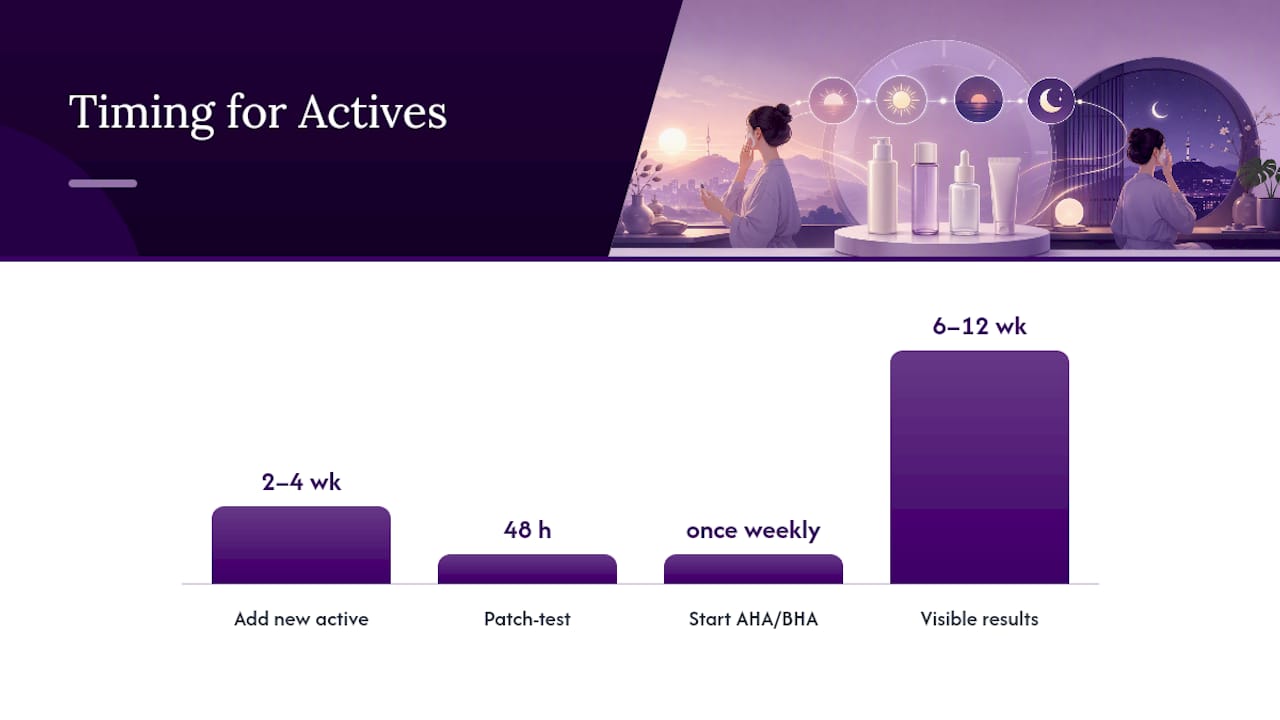
Add one new active every 2 to 4 weeks, never all at once. This single rule prevents most of the irritation beginners run into when they get excited and layer five new serums in the same week.
Common actives you’ll see in K-beauty kits include:
- Niacinamide for tone evenness and oil control, generally well-tolerated by most skin types.
- Hyaluronic acid for hydration, safe for nearly everyone, including sensitive skin.
- AHA/BHA exfoliants for texture and clogged pores, best started once weekly before increasing frequency.
- Retinol for texture and fine lines, typically introduced last and only a few nights a week at first.
Before applying anything new to your face, patch-test on a small area, like behind the ear or the inner forearm, for 48 hours, then test a small patch on your face for a few more days before going all in. If irritation shows up, stop the new product immediately, simplify back to cleanser and moisturizer, and give your skin a few days to calm down. Persistent redness or swelling warrants a dermatologist visit rather than more products.
Patience is the actual active ingredient here. Many skincare actives take 6 to 12 weeks of consistent use before results become visible, and most people who feel like a product “isn’t working” have simply stopped before that window closed.
How Do You Adjust Your Routine for the Seasons?
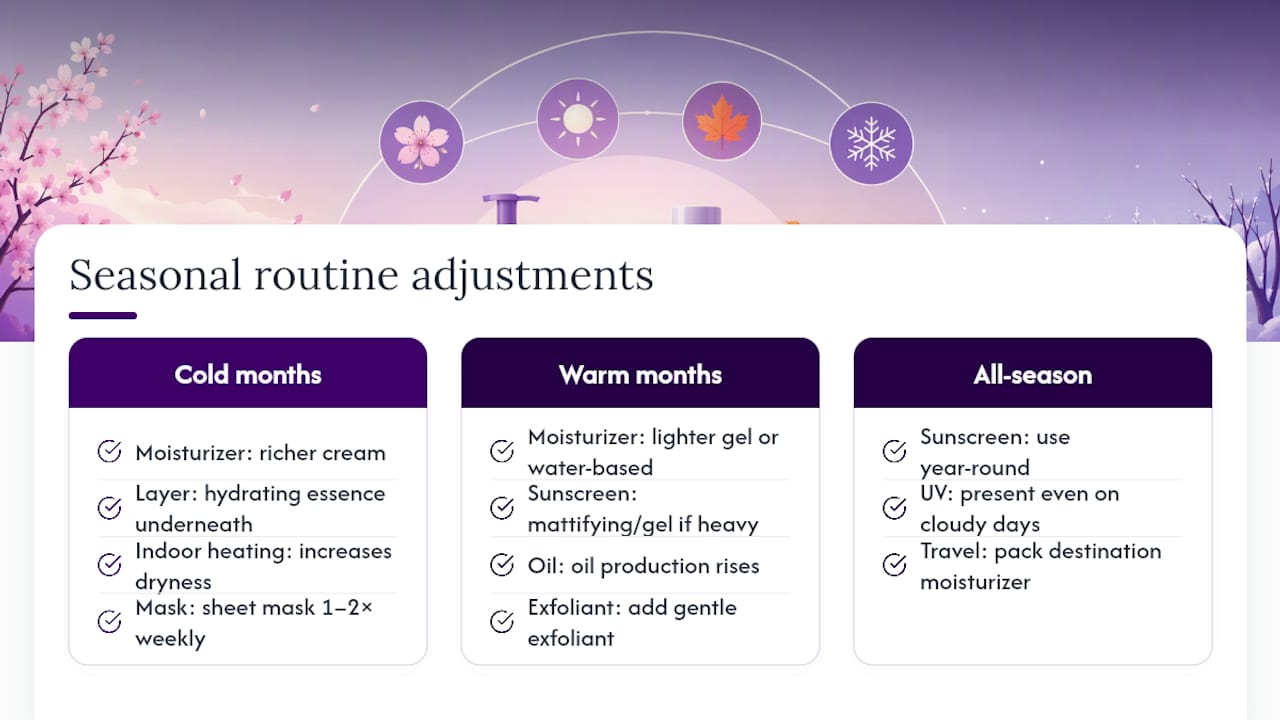
Skin behaves differently depending on humidity, temperature, and how much time you spend indoors under heating or air conditioning, so your kit should flex with the calendar instead of staying static year round.
In colder, drier months, swap your lightweight gel moisturizer for a richer cream and consider layering a hydrating essence underneath it for extra reinforcement. Indoor heating pulls moisture out of the air fast, and skin that felt balanced in October can turn flaky by January. A sheet mask once or twice a week helps bridge that gap without adding a permanent new step.
Warmer, humid months usually call for the opposite adjustment. Switch to a lighter gel or water-based moisturizer, and consider a mattifying or gel-based sunscreen if your usual formula feels heavy under sweat. Oil production tends to rise with humidity, so this is also when a gentle exfoliant earns its place if you skipped it during winter.
Sunscreen stays constant regardless of season. UV exposure doesn’t disappear in winter just because it’s cold outside, and cloudy days still carry meaningful UV levels. If you travel between climates, pack a travel-size version of whichever moisturizer matches your destination rather than assuming your home routine will hold up unchanged.
What Should You Budget for a Starter Kit?
You can build a functional Korean skincare routine at almost any price point, and spending more doesn’t automatically mean better results for your specific skin.
Entry-level (under $40): A basic cleanser, an affordable moisturizer, and a drugstore-tier sunscreen. This covers the three non-negotiables without the extras, and it’s a reasonable place to start if you’re not sure Korean skincare is for you yet.
Mid-range ($40 to $80): This is where most curated starter kits land, bundling a cleanser, hydrating serum, moisturizer, and SPF together at a lower combined cost than buying each separately. It’s the sweet spot for someone who wants the full four-step foundation without piecing it together product by product.
Premium ($80 and up): Kits at this tier often add sheet masks, a second treatment serum, or accessories like a jade roller. Worth it if you already know your skin type and want to layer in extras, but not necessary for your first month.
If you’re deciding where to allocate a limited budget, spend on the moisturizer and sunscreen first. Cleansers are the easiest category to find a solid budget option in, since their job is largely mechanical rather than dependent on expensive active ingredients.
Lunarashopping’s Starter Kits: Which One Fits You?
LunaraShopping built its Complete Face Care Bundle around the exact four-step foundation this guide covers: cleanser, hydrating serum, moisturizer, and sunscreen, packaged together so you’re not hunting for four separate product pages. It’s designed for someone who wants to start today without researching ten different brands first.

If mornings are your priority, or you already have a nighttime routine sorted, the Morning Face Care Routine Set trims the kit down to daytime essentials, cleanser, lightweight moisturizer, and SPF, at a lower price point than the full bundle.
Both kits are built on the same layering logic covered above: cleanse, treat, moisturize, protect. If your skin runs oilier than average, you can swap the included moisturizer for something from the broader face care collection without disrupting the rest of the kit. Sensitive or fragrance-reactive skin should scan ingredient labels the same way you would with any product, and our fragrance-free breakdown explains what to look for. Whichever kit you choose, the goal is to get you into a consistent routine fast, not to sell you more than you need.
Why Lunara Believes in Starting Small
Most beginners fail not because they picked the wrong products, but because they picked too many at once. Ten-step routines look impressive online, but they make it nearly impossible to tell which product is causing an issue when your skin reacts. Lunara favors small, complete kits precisely because they remove that guesswork.
The most common mistake we see: buying a trending serum before securing a decent cleanser and sunscreen. Fix the foundation first. If you want something built specifically around your skin type rather than a general starter set, try the custom skincare kit builder and adjust from there.
— Lunara
Sources
This guide draws on dermatology-backed routine guidance from Geisinger, layering and patch-test protocols from Allure, and Korean product formulation insight from Byrdie. Each source is cited at the specific claim it supports throughout the article.
This article is general information, not a substitute for advice from a qualified doctor. Consult a qualified healthcare professional about your own circumstances before acting on anything here.
- How to build a skincare routine for beginners — Geisinger
- Beginner’s guide to building a skin-care routine — Allure
- The 17 Best Korean Skincare Products of 2026 — Byrdie
FAQ
What Is a Good Starting Korean Skincare Routine for Beginners?
Start with just three steps: a gentle cleanser, a barrier-supporting moisturizer, and SPF 30 or higher during the day. Add a hydrating serum once that foundation feels routine, usually after about a month or more.
What Is the 4-2-4 Rule in Skincare?
Definitions of this rule vary across sources and it isn’t a standardized dermatology term, so treat any specific breakdown you see online with some caution. The safer, well-supported guideline is simpler: introduce one new active every 2 to 4 weeks and expect 6 to 12 weeks before judging results.
What Is the Number One Skincare Product in Korea?
There’s no single product that holds that title universally. Popularity shifts by skin concern and trend cycle, and dermatology sources emphasize matching formulas to your skin type over chasing whatever is currently viral.
Which Brand of Korean Skincare Is Best?
No single brand wins for every skin type or concern. A curated starter kit from a retailer like LunaraShopping simplifies the decision by pairing complementary formulas instead of asking you to compare dozens of brands on your own.
How Long Before I See Results From a Korean Skincare Starter Kit?
Give any new routine several weeks for basic hydration and texture improvements, and up to 12 weeks for active ingredients like retinol or exfoliating acids to show visible change.