A Korean vinegar hair rinse is a mildly acidic, ready-made product you use after shampooing. It brings the scalp and hair surface back toward their natural acidity, helps lift leftover buildup, and leaves hair feeling lighter and shinier. The best-known versions are made with fermented fruit vinegar, often raspberry, and are buffered so they are gentler than the bottle in your kitchen cupboard.
This guide explains what the rinse does, what the science says, how to use it step by step, and how it differs from DIY apple cider vinegar. It also covers who should be cautious, so you can decide if it belongs in your routine.
TL;DR
- A vinegar hair rinse is used after shampoo to help rebalance scalp and hair pH, remove buildup, and add shine. It does not replace washing or conditioning.
- Hair fibers are best preserved in a pH range of 5 to 7. Alkaline products can increase friction and breakage, which is the logic behind an acidic rinse.
- Household vinegar sits around pH 2.5, far more acidic than your scalp. Buffered commercial rinses are the safer choice, and DIY mixes need real dilution.
- Use it once a week to start, on the scalp and mid-lengths, then rinse well with lukewarm water. Skip it if your scalp is broken, freshly shaved, or very irritated.
- Pair it with a gentle shampoo and a conditioner suited to your hair type.
Table of Contents
- What a Korean vinegar hair rinse is
- Why pH matters for hair and scalp
- What a vinegar rinse can and cannot do
- Commercial rinse versus DIY vinegar
- Which vinegar is used: raspberry, apple cider, or rice?
- How to use a vinegar hair rinse step by step
- Who should be careful
- Our perspective at Lunara
- Building a routine around the rinse
- Shop hair and scalp essentials
- How to choose a rinse that suits you
- FAQ
- Sources
What a Korean vinegar hair rinse is
In Korean hair care, the rinse is a distinct step, not a conditioner and not a shampoo. It is a thin, watery liquid, usually 6 to 7 fluid ounces per bottle, made around fermented vinegar and fruit extracts. You apply it after cleansing, leave it on briefly, and rinse it out.
The idea comes from a long-standing practice: acidic rinses to close the hair cuticle and remove the film that shampoo and hard water can leave. Korean brands turned that habit into a tidy, pleasant-smelling product. The vinegar smell is usually softened with fruit fragrance, which is a large part of why these rinses became popular with K-beauty fans.
It belongs to the wider category of scalp care, which treats the scalp as skin rather than as an afterthought. If that approach is new to you, our guide to Korean scalp care and a routine to follow lays out the full sequence.
Why pH matters for hair and scalp
The reasoning behind the rinse is about acidity. Your scalp’s natural pH sits around 5.5, slightly acidic. Many shampoos, and hard water, push the surface in a more alkaline direction.
Research supports why this matters for the hair itself. A 2024 study on pH-induced changes in hair structure found that exposing the hair shaft to different pH levels had specific effects on the cuticle, including lifting at certain pH levels. Hair cuticle structure and protein integrity were best preserved in a range of roughly 5 to 7.

A review of how shampoo pH affects hair adds the mechanism: alkaline pH may increase the negative electrical charge on the fiber surface, which increases friction between fibers and can lead to cuticle damage and breakage. In plain terms, hair that has been exposed to alkaline products can feel rough and tangle more.
An acidic rinse works in the opposite direction. It helps the cuticle lie flatter, which is why hair often looks smoother and reflects more light afterward. We use the same logic in skincare, where low-pH cleansers protect the skin’s natural balance. If you are curious, why Korean cleansers have a low pH explains the idea for your face.
What a vinegar rinse can and cannot do
Set expectations before you buy. Here is what a well-made rinse is designed for, and where its limits are.
What it can help with
- Buildup. Styling products, dry shampoo, silicones, and mineral residue from hard water can leave hair dull and heavy.
- Excess surface oil. Many people with oily scalps like the fresh, clarified finish the rinse leaves.
- Shine and smoothness. A flatter cuticle gives a brighter, smoother finish.
- A cleaner-feeling scalp. The American Academy of Dermatology notes that buildup of products, dead skin, and oil on the scalp can be behind itching and lack of shine, which is why a targeted scalp-cleansing step can make sense when it complements normal washing. See the AAD’s healthy hair tips for the basics it recommends, including choosing products made for your hair type.
What it cannot do
- It does not repair damaged hair. Split ends stay split.
- It does not treat medical scalp conditions such as persistent dandruff, psoriasis, or eczema. If flaking, redness, or itching continues, see a dermatologist.
- It is not a stand-alone cleanser. Think of it as the last step after you have shampooed, not a substitute.
We would rather tell you this plainly. A rinse is a finishing step that can make a good routine work better.
Commercial rinse versus DIY vinegar
Searching for this topic brings up plenty of homemade recipes. They are cheap and easy to find, but there is a real difference between a bottle formulated for hair and a splash of pantry vinegar.
Household vinegar has a pH of about 2.5, according to the dermatology guidance summarized in our research, which is far more acidic than the scalp’s 5.5. Cleveland Clinic’s advice on home remedies cautions that natural does not always mean safer or gentler, and that concentrated acids can irritate. In a separate article on shaving irritation, a dermatologist notes that apple cider vinegar may sting, which is a useful reminder for anyone with irritated or freshly shaved skin near the hairline or nape.
Commercial formulations are generally the safer route because they are pH-buffered and diluted to suit hair and skin. That is the main practical advantage of a Korean-style rinse.
| Ready-made Korean rinse | DIY vinegar mix | |
|---|---|---|
| Acidity | Buffered by the formulator | Varies with your dilution |
| Smell | Usually softened with fruit scent | Strong vinegar smell |
| Consistency | Same every bottle | Depends on measuring |
| Added ingredients | Often includes fruit extracts and soothing agents | Only what you add |
| Cost per use | Higher | Lower |
| Best for | Regular, predictable use | Occasional experiments |
If you do go the DIY route, dilute heavily, keep it away from your eyes, patch test on a small area first, and stop if you feel stinging or tightness. People with sensitive skin or an existing scalp problem should talk to a dermatologist before using any acidic rinse regularly.
Which vinegar is used: raspberry, apple cider, or rice?
Readers often ask whether white vinegar or apple cider vinegar is better, and what rice vinegar does for hair. There is no single winner, because the product matters more than the vinegar type.
- Raspberry vinegar is the signature of the Korean rinse. It is fermented from fruit and typically paired with extracts that give a pleasant scent.
- Apple cider vinegar is the most common choice in Western DIY recipes. It has a milder smell than white vinegar, but it can still sting on irritated skin.
- White vinegar is the harshest and most acidic of the household options. We would avoid it on the scalp.
- Rice vinegar shows up in traditional Asian beauty lore. Whatever the base, the same rule applies: what counts is the final pH and dilution, not the pantry label.
When you choose a ready-made rinse, look for a short, clear description of what it is designed for (scalp clarifying, oil balance, shine) and check the ingredient list for anything you know you react to, such as fragrance.
How to use a vinegar hair rinse step by step
The approach below follows standard dermatology guidance on scalp care and the usage directions most Korean rinses share. Always check your bottle, since each formula differs.
- Shampoo first. Wash with a gentle shampoo suited to your hair type. Rinse thoroughly.
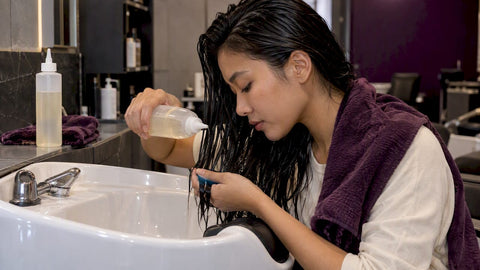
- Apply the rinse. Focus on the scalp and mid-lengths. Apply it directly to the scalp, or into your hands first if your bottle has no spray. Avoid the eyes.
- Massage gently. Use your fingertips, not your nails, for a minute or so.
- Wait briefly. Follow the time on your product. Do not leave it longer than directed.
- Rinse with lukewarm water. Thorough rinsing matters. The AAD’s leave-in conditioner guidance is useful context here, since it also stresses keeping heavier products away from the scalp to avoid buildup.
- Condition the lengths. Apply conditioner mainly from mid-lengths to ends. Rinse again.
Some rinses are designed as leave-in mists. If that is the case, the label will say so. Otherwise, treat it as a rinse-out step.
How often to use it
Start with once a week. If your hair is oily or you use a lot of styling product, you might move to twice a week. If your scalp feels tight, itchy, or dry, cut back. Daily use is not necessary for most people.
Who should be careful
An acidic rinse is not for everyone. Be careful, or ask a professional first, in these situations:
- Irritated, cut, or freshly shaved skin. This includes the nape and hairline after a haircut with a razor. Acids can sting.
- Sensitive skin or known reactions to fragrance or fruit extracts. Patch test behind the ear first.
- Persistent scalp symptoms. Ongoing flaking, redness, or itching is a reason to see a dermatologist rather than add products.
- Color-treated or chemically processed hair. Hair that has been lightened or permed is more fragile. The AAD’s coloring and perming tips are worth reading, and it is wise to ask your colorist whether a rinse suits your treatment before using one.
Vinegar is also sometimes mentioned online for head lice. Medical sources treat that carefully, and we will not suggest it as a cure. If you suspect lice, ask a pharmacist or doctor.
Our perspective at Lunara
We think of a vinegar rinse as a small, sensible step that makes sense for a particular kind of hair day. If your hair feels coated after a week of styling products, or your scalp gets oily by the second day, a rinse can be a satisfying reset. If your main issue is dryness or damage, you will get more from a good shampoo and conditioner pairing than from an acid step.

That is why we look at hair care the way we look at skincare: start with a gentle cleanse, protect what is working, and add a targeted step only when you have a reason. Our approach to curating Korean beauty is about authentic products chosen for quality, gentle formulations, and inclusivity for all skin types, and we apply the same filter to hair. We also believe in buffered, purpose-made formulas over improvised kitchen mixes, because consistency is what keeps a scalp comfortable.
Finally, we want you to leave with a realistic plan, not a long shopping list. One shampoo you tolerate well, one conditioner for your hair type, and, if it suits you, one rinse used weekly is a complete routine for most people.
— Lunara
Building a routine around the rinse
A rinse works best when the steps around it are right. Here is a simple weekly pattern you can adapt.
| Day type | Shampoo | Rinse | Conditioner |
|---|---|---|---|
| Regular wash | Gentle, suited to your hair type | Skip | Mid-lengths to ends |
| Reset wash (weekly) | Gentle, suited to your hair type | Scalp and mid-lengths, then rinse | Mid-lengths to ends |
If your hair is damaged or frizzy, a smoothing shampoo and conditioner pair can do the heavy lifting. Our shop carries Japanese-made options from KRACIE, such as the Ichikami smoothing shampoo and smoothing care conditioner, as well as an extra damage care shampoo. For an easier start, there is also a shampoo and conditioner set.
If you struggle with oiliness on your face as well as your scalp, the same logic applies: balance first, then add actives. Our guide to sebum control in Korea walks through it.
Shop hair and scalp essentials
Ready to build your routine? Browse our hair care collection for shampoos, conditioners, and treatments. If you like a one-bottle approach for travel or the gym, the CIROA 3 in 1 face, body, and hair wash is worth a look. Standard shipping at Lunara is a flat rate from $6.49, so you can add a few items to one order.
How to choose a rinse that suits you
When you compare rinses, use criteria rather than marketing claims.
- Purpose. Is it designed for scalp clarifying, shine, or both?
- Format. Pour-on rinse, spray mist, or shampoo-style product. Pick what you will actually use.
- Fragrance. Fruit scent is pleasant for many people, but a problem for some sensitive scalps.
- Directions. Good labels say how long to leave it on and how often to use it.
- Your hair type. The AAD advises choosing products labeled for your hair type, whether it is curly, straight, coarse, or fine.
And remember that a rinse supports your routine. It does not replace thorough washing and conditioning.
FAQ
Is white vinegar or apple cider vinegar better for a hair rinse?
Neither is ideal straight from the bottle. Household vinegar is around pH 2.5, much more acidic than your scalp, so it must be heavily diluted and patch tested. A buffered, ready-made rinse is the more predictable option.
Is a vinegar rinse safe for color-treated hair?
Often, but not always. Color-treated and chemically processed hair is more fragile, so ask your colorist before using any acidic product. Start with one use, watch how your color and texture respond, and stop if hair feels dry or rough.
How do I make my own vinegar hair rinse?
We suggest a ready-made product instead, because dilution and acidity are easy to get wrong. If you still want to try, use a small amount of vinegar in a large amount of water, keep it away from your eyes, avoid broken skin, and stop if you feel stinging. People with sensitive or irritated scalps should see a dermatologist first.
What is rice vinegar good for in hair care?
It is used in traditional beauty routines in the same way as other vinegars: as a mild acid rinse for shine and buildup. What matters most is the final acidity and dilution, not the type of vinegar. A buffered commercial rinse removes the guesswork.
How often should I use a Korean vinegar hair rinse?
Once a week is a sensible start. You can raise it to twice a week if your hair gets oily or collects styling product, and lower it if your scalp feels dry or tight.
Sources
- Insights into structural and proteomic alterations related to pH-induced changes in hair (PubMed)
- The Shampoo pH can Affect the Hair: Myth or Reality? (PMC)
- Home Remedies for Acne: Do They Work? (Cleveland Clinic)
- 4 Home Remedies To Treat Razor Burn (Cleveland Clinic)
- Tips for healthy hair (American Academy of Dermatology)
- Dermatologists’ top tips for using leave-in conditioner (American Academy of Dermatology)
- Coloring and perming tips for healthier-looking hair (American Academy of Dermatology)