Multi-masking means using more than one mask in a single session, either on different zones of your face or layered in a deliberate order. The Korean approach is built on the same idea as the rest of K-beauty: give each area of skin what it actually needs, and keep the barrier intact. Below you will find how to map your face, which mask types pair well, a step-by-step routine, and the mistakes that turn a relaxing treatment into irritation.
TL;DR
- Multi-masking has two forms: zoning (a different mask on the T-zone and the cheeks) and layering (masks applied one after another for a specific purpose).
- Pair a clarifying wash-off mask on oily areas with a hydrating sheet or hydrogel mask on dry areas. Never stack two exfoliating or active treatments at once.
- Follow the time on the package. Leaving a clay mask until it is fully dry, or a sheet mask until it is dehydrated, can work against your skin.
- Patch test any new mask on your inner arm, and start with once a week.
- Clean, dry skin first, then a moisturizer afterward to finish.
Table of Contents
- What multi-masking actually is
- Map your face before you choose masks
- Mask types and what each one does
- How to multi-mask step by step
- Good pairings and combinations to avoid
- The Korean layering method, and who should skip it
- How often should you multi-mask?
- Where multi-masking fits in your wider routine
- Reading ingredient lists for mask pairing
- Our perspective: simple masking, done consistently
- Build your own multi-mask set
- FAQ
- Sources
What multi-masking actually is
Most of us put one mask over the entire face. The trouble is that a face rarely has one skin condition. The forehead, nose and chin often produce more oil, while the cheeks and the skin around the eyes can feel tight or dry. A single formula tends to be too strong for one area or too weak for another.
Multi-masking solves that mismatch. A Korean beauty retailer’s guide describes it as using two masks at once to address a specific concern or boost the effect of one of them, and notes that it can be done through zoning or layering. In practice:
- Zoning places different masks on different parts of your face at the same time. This is the version most people mean when they search for multi-masking, and it is the best starting point.
- Layering applies masks in sequence, for example a sheet mask followed by a sealing step. It is more advanced and leaves less room for error.
If your skin is combination, zoning is likely the single most useful change you can make to your mask habit. Our Korean skincare routine for combination skin covers the daily routine that surrounds it.
Map your face before you choose masks
Before you open a single package, look at your skin in natural light after cleansing and waiting a few minutes. Note where it feels oily, where it feels tight and where it looks dull or congested.
| Area | Common condition | What to look for in a mask |
|---|---|---|
| Forehead, nose, chin (T-zone) | Excess oil, visible pores, blackheads | Clay-based wash-off masks, gentle clarifying formulas |
| Cheeks | Normal to dry, sometimes sensitive | Hydrating sheet or hydrogel masks, soothing formulas |
| Under-eye and around the mouth | Thin, easily dehydrated skin | Hydrating or soothing masks, nothing abrasive |
| Dull or uneven areas | Rough texture, lackluster tone | A brightening sheet mask, used on its own that day |
These are common patterns, not rules. If your whole face is dry, you do not need zoning at all. You need one good hydrating mask. If you have very reactive skin, keep things simple and do not combine masks until you know how each one behaves alone.
Mask types and what each one does
Knowing the category helps you choose the right pairing. Our guide to matching wash-off and sheet masks to your skin goal goes into more depth. Here is the short version.
Wash-off masks
Creamy or clay textures that you rinse away. They are the usual choice for the T-zone because they help clarify the surface of oilier skin. Rinse them off on time. Dermatologists quoted by Yahoo Health warn that leaving a clay mask on until it is completely dry can draw too much moisture out of your skin.
Sheet masks
Fabric soaked in an essence or serum. They are the classic hydration step for cheeks. Options include collagen, vitamin-focused or propolis formulas. A collagen sheet such as the MEDIHEAL Collagen Essential Mask suits a day when skin feels dry, while the MEDIHEAL Vita Essential Mask or the JM SOLUTION Honey Luminous Royal Propolis Mask fits a day when you want a fresher, more luminous look.
Hydrogel masks
A gel-based alternative to fabric that sits closely on the skin. They are good for cheeks and under-eye areas because they cling well. We explain the format in what a Korean hydrogel mask is and how to use it.
Sleeping and overnight masks
These stay on as the last step of your night routine. They are generally best used on their own rather than combined with other masks, which keeps the number of variables low.
How to multi-mask step by step
This is the zoning routine we suggest for a first attempt. Set aside 15 to 20 minutes.
- Cleanse. Start with clean, dry skin, as experts consistently advise. If you wear sunscreen or makeup, remove it first. A gentle face cleanser is enough. Skip scrubs on mask days.
- Patch test if the mask is new. Apply a small amount to your inner arm first. Allure’s reporting on layered masking recommends a patch test, especially if you have sensitive skin or a history of contact dermatitis.
- Apply the wash-off mask to the T-zone. Use a thin, even layer on forehead, nose and chin. Keep it away from the eye area and the corners of the nose if your skin is sensitive there.
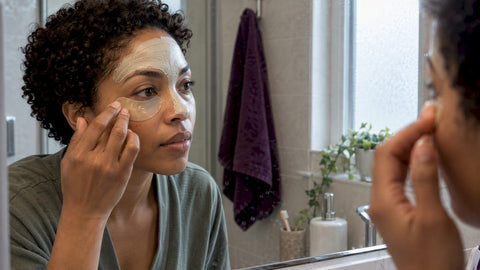
- Apply the hydrating mask to the cheeks. If you use a sheet mask, you can cut it or fold it so it covers cheeks without overlapping the clay area. A hydrogel patch works well here too.
- Set a timer. Use the shortest time on either package. If one says 10 minutes and the other says 20, remove both at 10.
- Remove and rinse. Take off the sheet, then rinse the wash-off mask with lukewarm water. Pat dry.
- Press in any leftover essence. If your sheet mask left essence on your skin, pat it in rather than rinsing it away.
- Finish with a moisturizer. A cream or moisturizer locks in what you just applied. Add sunscreen in the morning.
Good pairings and combinations to avoid
The key rule comes from board-certified dermatologist Dr. Dendy Engelman, who tells Allure to avoid double-duty layering: stacking products with the same outcome, such as several chemical exfoliants at once, raises the risk of barrier damage, irritation and clogged pores.
Pairings that make sense
- Clay or clarifying mask on the T-zone with a hydrating sheet or hydrogel mask on the cheeks.
- A soothing mask on sensitive areas with a more purifying mask on congested ones.
- A hydrating sheet mask as a stand-alone step on days when your skin feels depleted, followed by a rich moisturizer.
Combinations to skip
- Two exfoliating masks, or an exfoliating mask over skin you have already treated with an acid or retinoid that day.
- A heavy occlusive layer over active ingredients, which can trap them and increase irritation.
- Any mask on skin that is already red, peeling, sunburned or broken out in a rash.
The American Academy of Dermatology’s guidance on occupational skin conditions also points to the same logic: facial masking should be restorative, not abrasive, and adding too many active ingredients in one day can lead to contact dermatitis. If you do want several treatments, space them across the week instead of the same evening.
The Korean layering method, and who should skip it
Beyond zoning, you may come across the coating method. According to Allure, it involves applying masks sequentially or on top of one another, and in some Korean spas a rubber modeling mask is used as the final step to create an occlusive seal. The theory is that the seal keeps ingredients against the skin.
It is a spa technique, and it is easy to overdo at home. If you are new to masking, if your skin is sensitive or if you use active ingredients, we recommend mastering zoning first. Dermatologists also caution that prolonged occlusion from sheet masks can lead to irritation or mask-induced dermatitis, particularly on sensitive skin. Layering adds more occlusion, not less.
How often should you multi-mask?
Less often than you may think. Clinical evaluations of facial masks, including formulas with collagen, niacinamide and adenosine, typically show measurable improvements in moisture and texture after four weeks of consistent use, with one to three uses per week common in those settings. That is a useful frame for a home routine:
- Weeks 1 to 2: once a week, one wash-off mask and one hydrating mask, nothing else new.
- Weeks 3 to 4: once or twice a week if your skin is calm, with no stinging, tightness or redness afterward.
- After that: adjust to the season. Many people find a hydrating focus works better in cold, dry months and a clarifying focus helps in humid ones.
More is not better. Longer wear time does not equal better results either. If your skin looks irritated, stop masking for several days and go back to cleanser, moisturizer and sunscreen.
Where multi-masking fits in your wider routine
A mask is a treatment, not a replacement for the basics. The order on a mask night is simple: cleanse, mask, then moisturize. If you follow a longer sequence, our 10-step Korean skincare routine shows where a mask belongs, and the practical Korean skin care regimen guide breaks it into steps you can scale up or down.
If you prefer to mask at night, our Korean night routine puts the barrier first and fits into 10 to 15 minutes. Hydration is the thread that runs through all of it, which is why Korean brands emphasize hydration so heavily.
If your T-zone is the problem area, you may also like our notes on Korean acne care best practices and on using niacinamide in a Korean routine. If you have a mask with niacinamide, treat it as an active when counting what your skin has had that day.

Reading ingredient lists for mask pairing
The label tells you which mask belongs where. A few quick pointers:
- Hydrators such as hyaluronic acid, glycerin and panthenol suit cheeks and dry patches.
- Clay and gentle clarifying ingredients suit oilier zones. Keep them to the time on the package.
- Collagen in sheet masks is a moisturizing ingredient on the surface. If you are curious about the ingredient in general, this overview of types of collagen explains how the types differ, though a topical mask works on the skin’s surface rather than like a supplement.
- Exfoliating acids and enzymes count as actives. Use one per session, and on its own.
If an ingredient list is long and you are unsure, pick the simpler formula and test it alone first.
Our perspective: simple masking, done consistently
At Lunara, we choose Korean products for effective, gentle formulas that work for different skin types, and our view on multi-masking follows from that. The technique is valuable because it respects the fact that skin is not uniform. It stops being valuable when it becomes a competition to apply as many products as possible.

We suggest two masks, two zones, one clear purpose. Pick a clarifying formula for the area that needs it and a hydrating one for the rest. Keep the time short, finish with moisturizer and watch how your skin responds over a month rather than a single evening. If something stings, stop. Skin that feels comfortable afterward is the signal that the pairing worked.
For shoppers who like variety, single-use sheet masks make it easy to test different formulas without committing to a large jar. That lets you learn what your skin prefers at its own pace.
— Lunara
Build your own multi-mask set
You do not need a big shelf. A starter set could include one clarifying wash-off mask, one hydrating sheet or hydrogel mask and a good moisturizer. You can browse our full range of Korean face masks, or explore all face care products to round out your cleanser, toner and cream. Standard shipping starts from $6.49. Get It Now and give your T-zone and cheeks the separate attention they ask for.
FAQ
Can you multi-mask every day?
We do not recommend it. Clinical masking studies commonly involve one to three uses per week, and more frequent use gives you more chances of irritation without proof of added benefit. Start with once a week and increase only if your skin stays calm.
Is multi-masking good for sensitive skin?
It can be, but go slowly. Use one soothing or hydrating mask on its own first, patch test anything new on your inner arm, and avoid combining exfoliating or active masks. If you have a history of contact dermatitis or a skin condition such as eczema or rosacea, ask your dermatologist before adding new masks.
Do I put the wash-off mask or the sheet mask on first?
If you are zoning, you apply both at roughly the same time, each on its own area. If you are layering, a wash-off mask generally goes first and is rinsed away, with a hydrating mask afterward, but keep this to simple pairings and avoid stacking actives.
How long should each mask stay on?
Follow the time printed on each package, and use the shorter one if they differ. Dermatologists warn against leaving clay masks until they are completely dry, and prolonged sheet mask wear can lead to irritation, especially on sensitive skin.
Sources
- What Is the Coating Method? Korean Skin-Care Masking Trend, Allure
- Yes, You Can Leave a Sheet Mask on for Too Long, Yahoo Health
- Skin improvement effects of facial masks with collagen, niacinamide and adenosine, earticle
- Preventing and treating occupationally induced dermatologic conditions, American Academy of Dermatology
- What is multi-masking and how to do it correctly, VeryLoveBeauty