
Mixing skincare actives the Korean way is defined as a strategic layering and timing method that separates conflicting ingredients, sequences products by texture and pH, and uses hydrating layers to boost absorption and protect the skin barrier. This approach, known in dermatology as active ingredient sequencing, draws from the K-beauty philosophy of consistent hydration and barrier health rather than aggressive treatment. The core actives involved include vitamin C, retinoids, AHAs, BHAs, niacinamide, and hyaluronic acid. Getting their order and timing right determines whether your routine delivers results or causes irritation.
What are skincare actives and why do they matter in k-beauty?
Skincare actives are ingredients with a measurable, targeted effect on skin biology. They differ from base ingredients like emollients or occlusives, which primarily protect or soften. In the Korean skincare regimen, actives are treated as precision tools, each assigned a specific role, time of day, and position in the layering sequence.
The main categories of K-beauty active ingredients are:
- Antioxidants: Vitamin C (L-ascorbic acid) neutralizes free radicals and brightens hyperpigmentation. It works best in the morning when UV exposure is highest.
- Exfoliants (keratolytics): AHAs like glycolic acid and lactic acid resurface the skin. BHAs like salicylic acid penetrate pores and reduce sebum. Both are reserved for evening use.
- Retinoids: Vitamin A derivatives including retinol and retinal accelerate cell turnover and stimulate collagen. They are photosensitive and belong in nighttime routines.
- Hydrators: Hyaluronic acid is a humectant that draws moisture into the skin. It is compatible with all actives and applied on slightly damp skin to maximize hydration.
- Barrier supporters: Niacinamide (vitamin B3) reduces inflammation, controls sebum, and strengthens the skin barrier. It is safe at concentrations up to 10% for daily AM and PM use.
The reason correct mixing matters is chemical interaction. Some actives destabilize each other. Others compete for the same skin receptors. Layering them without a plan reduces their efficacy and raises your risk of redness, peeling, and barrier damage. The Korean approach solves this by assigning each active a defined role and time slot rather than piling everything on at once.
How do you layer korean skincare actives correctly?
The Korean skincare routine organizes actives by time of day and product texture. Thinner, water-based products go first. Richer, oil-based products go last. This sequence ensures each active reaches the skin at the right depth and does not block what follows.
Morning Routine Order:
- Double cleanse (oil cleanser first, then a gentle water-based cleanser). Double cleansing removes sunscreen residue and prepares the skin to absorb actives without interference.
- Hydrating toner. Apply in thin layers to damp skin. The 7-skin method, which involves applying a lightweight toner up to seven times in succession, improves moisture retention and primes the skin for actives.
- Vitamin C serum. Apply after toner while skin is still slightly damp. Vitamin C is unstable in sunlight, so morning is its only effective window.
- Essence or hydrating serum with hyaluronic acid.
- Moisturizer to seal hydration.
- SPF 30 or higher sunscreen. This step is non-negotiable. Vitamin C and sunscreen work synergistically to protect against UV-induced oxidative damage.
Evening Routine Order:
- Double cleanse to remove SPF and makeup thoroughly.
- Hydrating toner, 1–3 layers depending on your skin’s needs that night.
- Targeted active: either a retinoid OR an exfoliant (AHA or BHA), never both on the same night. Retinoids used 1–3 nights per week; AHAs 1–2 times; BHAs 2–3 times on separate evenings.
- Niacinamide serum if using retinoids that night. It calms the inflammation retinoids can trigger.
- Moisturizer, ideally with ceramides to reinforce the barrier.
- Facial oil as the final seal on dry or combination skin.
Pro Tip: Apply your retinoid after moisturizer rather than before if your skin is new to it. This “buffering” technique slows absorption slightly and cuts down on peeling without reducing long-term results.
Which actives can be combined and which must be separated?
This is the most practical question in any Korean skincare regimen, and the answer depends on both chemistry and timing.
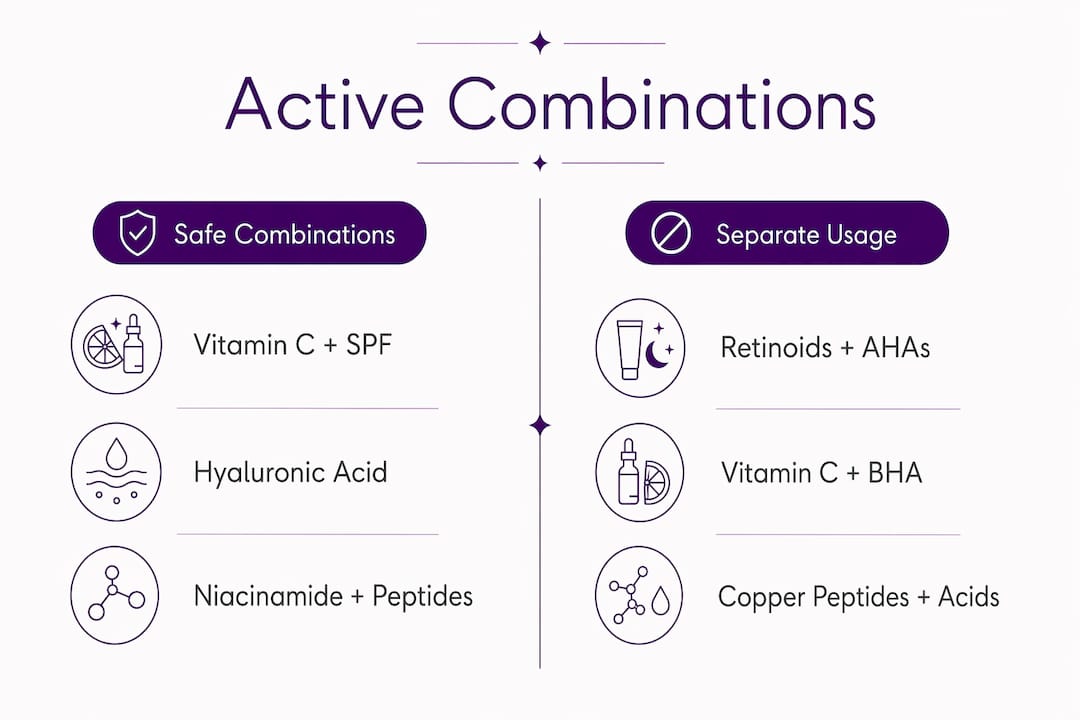
| Active Pairing | Safe to Combine? | Notes |
|---|---|---|
| Vitamin C + Sunscreen (AM) | Yes | Synergistic UV protection; apply vitamin C first |
| Niacinamide + Retinoids (PM) | Yes | Niacinamide reduces irritation and strengthens barrier during retinoid use |
| Hyaluronic Acid + Any Active | Yes | Universal hydrator; apply after any water-based active |
| Retinoids + AHAs/BHAs (same night) | No | Combining these raises irritation risk significantly; alternate nights |
| Vitamin C + AHAs (same AM) | Use caution | Both are acidic; layering can cause stinging and redness on sensitive skin |
| Niacinamide + Vitamin C | Yes | The old myth that these cancel each other out is not supported by current evidence |
The most important rule is the retinoid and exfoliant separation. Using retinol and glycolic acid on the same night compounds cell turnover and pH disruption. The result is a compromised barrier, not faster results. Alternating them across the week, for example retinol on Monday and Thursday, BHA on Tuesday and Friday, gives each active its own space to work.
Hyaluronic acid is the one ingredient that belongs in every routine, every night. It does not interact negatively with any active. Hydrating layers also improve the penetration and efficacy of subsequent vitamin C and anti-aging actives in Korean beauty rituals, according to dermatologist-backed guidance.
What mistakes do people make when blending skincare ingredients?
The most common error is overuse. More product applied more often does not accelerate results. It damages the skin barrier, which then requires weeks of recovery before actives can work effectively again.
Watch for these specific mistakes:
- Over-exfoliating: Using AHAs and BHAs more than their recommended frequency strips the acid mantle. Washing more than twice daily and overusing exfoliants both harm barrier function and can trigger increased oil production as a stress response.
- Stacking conflicting acids: Applying glycolic acid toner, then a BHA serum, then a vitamin C serum in one session is a common layering error. Each of these lowers skin pH and increases photosensitivity. Use one exfoliant per session.
- Skipping moisturizer after actives: Retinoids and AHAs are drying by nature. Skipping the moisturizer step leaves the barrier exposed and amplifies irritation.
- Introducing too many actives at once: Adding vitamin C, retinol, and a new AHA in the same week makes it impossible to identify what is causing a reaction. Introduce one new active every two weeks.
- Ignoring signs of barrier damage: Tightness, stinging from water, and sudden sensitivity to products you have used before are signals to pause actives entirely for 5–7 days and focus on ceramide-rich moisturizers.
Pro Tip: When building tolerance to retinoids, start with retinol 0.025% or 0.05% once a week for the first month before increasing frequency. Jumping to higher concentrations too fast is the leading cause of retinoid-related barrier damage.
How do you customize active layering for your skin type?
The traditional 10-step Korean skincare routine is aspirational, not prescriptive. Most people practice a personalized 3–5 step approach with core essentials plus targeted actives. Your skin type determines which actives you prioritize and how often you use them.
| Skin Type | Recommended Actives | Frequency Notes |
|---|---|---|
| Oily / Acne-Prone | BHA (salicylic acid), niacinamide, lightweight hyaluronic acid | BHA 2–3x/week; niacinamide daily; skip heavy oils |
| Dry / Dehydrated | Lactic acid (gentle AHA), hyaluronic acid, retinol | Lactic acid 1x/week; prioritize ceramide moisturizers |
| Sensitive | Niacinamide, polyglutamic acid, low-dose retinol | Retinol 1x/week max; avoid high-strength AHAs |
| Combination | BHA on T-zone, vitamin C, niacinamide | Spot-apply BHA; use lightweight hydrators |
| Hyperpigmented | Vitamin C (AM), niacinamide, AHA (PM) | Consistent SPF is mandatory; AHA 2x/week |
For oily skin layering, the priority is BHA for pore clarity and niacinamide for sebum regulation, with lightweight gel-based hydrators rather than heavy creams. For dry skin, lactic acid is a gentler keratolytic than glycolic acid and doubles as a humectant, making it the smarter exfoliant choice.
The K-beauty philosophy here is flexibility. Korean skincare is a mindset that prioritizes consistent hydration, sun protection, and barrier health over rigid step counts. You adapt the framework to your skin, not the other way around.
Key takeaways
Effective active ingredient sequencing in Korean skincare depends on separating conflicting actives by time of day, supporting the barrier with hydrators, and building tolerance gradually rather than maximizing product count.
| Point | Details |
|---|---|
| Separate actives by time of day | Use vitamin C and SPF in the AM; reserve retinoids and exfoliants for separate PM sessions. |
| Never combine retinoids and AHAs/BHAs | Alternating them on different nights prevents barrier damage and irritation. |
| Hyaluronic acid works with everything | Apply it after any active on damp skin to lock in hydration and support absorption. |
| Niacinamide buffers retinoid irritation | Layering niacinamide with retinoids calms inflammation and strengthens the skin barrier. |
| Customize by skin type, not step count | A 3–5 step routine with the right actives outperforms a 10-step routine used incorrectly. |
Why i think most people overcomplicate active mixing
The most persistent myth I see is that more actives equal faster results. It does not. The skin barrier has a finite capacity to handle chemical stimulation. When you exceed it, you spend more time recovering than progressing.
What actually works is boring by comparison: one exfoliant, one retinoid, one antioxidant, and consistent hydration. The Korean approach gets this right because it treats hydration as the foundation, not an afterthought. Hydrating layers do not just add moisture. They improve the penetration of every active that follows.
My personal schedule is vitamin C every morning, niacinamide twice daily, retinol on Monday and Thursday evenings, and a BHA on Wednesday. That is it. Glass skin, the dewy, poreless finish that defines K-beauty, is achieved through maximizing hydration and barrier repair, often with 4–5 core steps rather than an excessive product count. The experts agree. The full 10-step routine is not a daily requirement. It is a special-occasion treatment.
Start with the basics. Add one active at a time. Give each one four to six weeks before judging results. Your skin will tell you what it needs if you stop overwhelming it with too many signals at once.
— Lunara
Build your korean active routine with Lunarashopping
Ready to put these layering principles into practice? Lunarashopping has curated the products to make it straightforward.
The Korean Glass Skin Routine Bundle brings together the core steps for hydration-first active layering in one kit, covering cleansing, toning, vitamin C, and barrier-sealing moisturizer. If you want to build a routine around your specific skin type and active schedule, the custom skincare kit builder lets you select morning and evening products that work together rather than against each other. Both options are sourced from trusted Korean beauty brands and Lunarashopping’s own in-house line, so you know every product in your routine is formulated to layer cleanly.
FAQ
What does “mix skincare actives the korean way” mean?
It refers to the K-beauty method of layering active ingredients in a specific order and timing sequence, separating conflicting actives like retinoids and AHAs across different nights while using hydrating layers to boost absorption and protect the skin barrier.
Can you use vitamin c and niacinamide together?
Yes. The claim that vitamin C and niacinamide cancel each other out is not supported by current dermatological evidence. Both can be used in the same routine, though applying vitamin C first and niacinamide after is the standard sequence.
How often should you use retinol in a korean skincare regimen?
Retinol is recommended 1–3 nights per week, always on evenings when you are not using an AHA or BHA. This frequency prevents barrier damage while still delivering cell turnover and anti-aging benefits.
Is the 10-step korean skincare routine necessary?
No. The 10-step routine is aspirational. Most people follow a personalized 3–5 step approach with targeted actives. Consistent hydration and SPF are the non-negotiable steps; everything else is adapted to your skin type and concerns.
What is the safest active for beginners to start with?
Niacinamide is the most beginner-friendly K-beauty active. It is safe at up to 10% concentration, suitable for daily AM and PM use, and compatible with every other active in a Korean skincare routine.