Retinal (retinaldehyde) works faster and hits harder than retinol, but retinol remains the gentler, more forgiving option to start with for most people. If you’re dealing with visible aging alone, retinol builds tolerance with less drama. If acne and aging show up together, retinal’s added antibacterial edge makes it worth a closer look, provided your skin can handle the stronger irritation potential.
Here’s the practical breakdown:
- Retinal is one conversion step closer to active retinoic acid, so it acts faster but can irritate skin more easily during the first few weeks.
- Retinol has a longer track record for sensitive and beginner skin, with more affordable, widely available formulations.
- If you have acne-prone, aging skin, retinal’s antibacterial activity against acne-causing bacteria gives it a real edge.
- Your next move: pick a well-formulated product, whichever ingredient you choose, and introduce it slowly.
Key Takeaways
Retinal converts faster into active retinoic acid and produces visible results sooner, while retinol offers a gentler, more adjustable path for building tolerance.
| Point | Details |
|---|---|
| Speed of results | Retinol typically takes 8 to 12 weeks; retinal often shows changes in 4 to 8 weeks. |
| Irritation trade-off | Retinal’s extra potency means a rougher adjustment period than most retinol formulas. |
| Best for acne-plus-aging | Retinal’s antibacterial action against acne-causing bacteria suits combination concerns. |
| Formulation matters most | Stable, well-packaged products often outperform potency claims alone. |
| Lunarashopping options | PRETTYSKIN Ginseng Retinol Multi Cream suits beginners; DERMATORY Retinal Spicule Cream suits tolerant, acne-prone skin. |
Table of Contents
- Retinol vs Retinal: Comparing Potency, Speed, and Tolerance
- How Retinol and Retinal Actually Work on Your Skin
- Which Ingredient Fits Your Skin Goals
- How to Start Retinol or Retinal Without Wrecking Your Barrier
- What Side Effects to Expect From Retinal vs Retinol
- Finding the Right Formula on Lunarashopping
- Sources
Retinol vs Retinal: Comparing Potency, Speed, and Tolerance
The decision between retinol and retinaldehyde comes down to four factors: how strong the ingredient is, how fast you’ll see results, how much irritation you can tolerate, and what skin concern you’re actually treating.
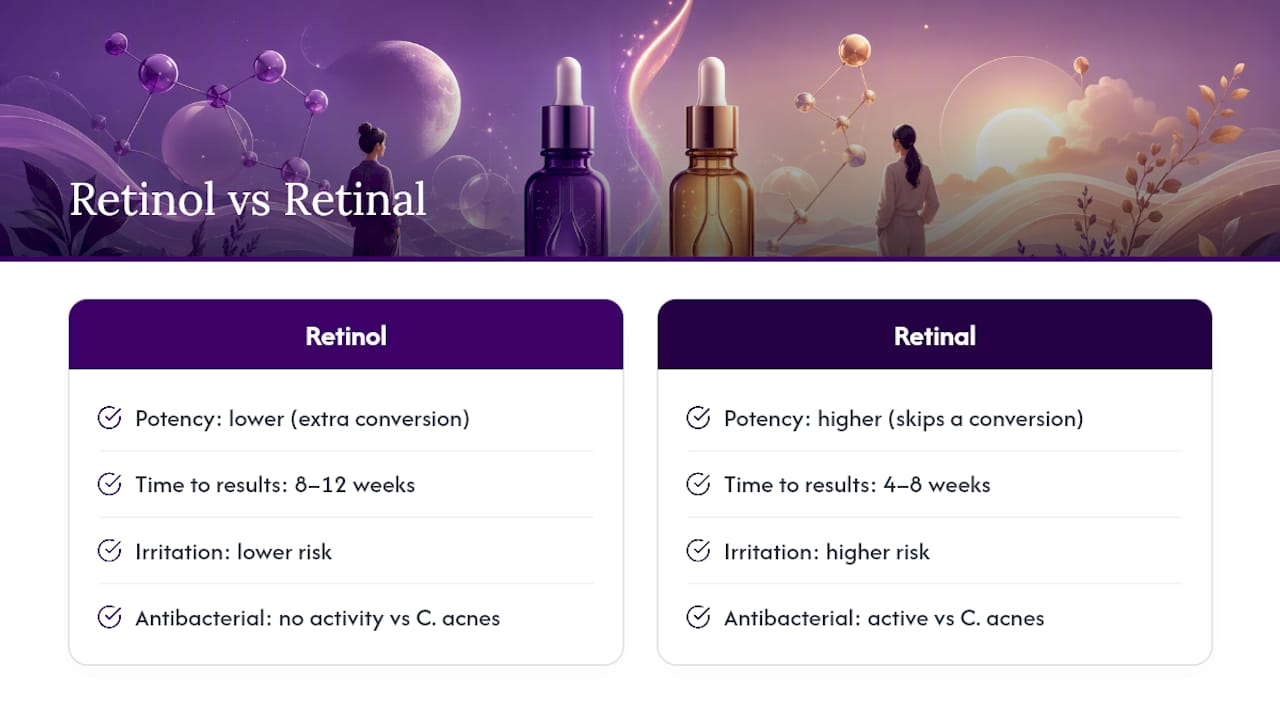
Potency favors retinal. Your skin converts retinyl esters to retinol, then retinol to retinaldehyde, and finally retinaldehyde to retinoic acid, the form your cell receptors actually use. Retinal skips one of those conversion steps compared to retinol, which is why it tends to act faster and stronger on the skin.
Time to visible results splits clearly along that same line. Clinical data on topical retinoids shows retinol typically needs 8 to 12 weeks of consistent use before you notice changes in texture and fine lines. Retinal can show results in 4 to 8 weeks, roughly half the wait.
Irritation risk runs opposite to potency. Retinal’s extra strength means more redness, flaking, and stinging during the adjustment period, while retinol tends to be more forgiving on first contact.
Unique advantage: retinal also shows antibacterial activity against Cutibacterium acnes, the bacteria linked to breakouts, giving it a dual benefit that plain retinol doesn’t offer.
Direct, matched-dose clinical trials comparing the two head-to-head are still limited, so treat “10 times stronger” claims as a description of chemistry, not a guaranteed outcome.
How Retinol and Retinal Actually Work on Your Skin
Your skin doesn’t use retinol or retinal directly. It converts each into retinoic acid, the molecule that actually binds to your skin cell receptors and drives collagen production, cell turnover, and pore refinement. Here’s the conversion ladder your skin runs every time you apply a vitamin A derivative:
- Retinyl esters convert to retinol first (the slowest, gentlest starting point).
- Retinol converts to retinaldehyde (this is the step retinal skips).
- Retinaldehyde converts to retinoic acid, the active form your cells respond to.
Retinal enters your skin already one rung up that ladder, which is the entire basis for the “retinal works faster” claim. But conversion speed is a mechanism, not a promise. A 2% retinol serum wrapped in an unstable, poorly preserved base can underperform a well-engineered 0.05% retinal product, and vice versa.
Research on retinoid formulation and delivery confirms this directly: vehicle, encapsulation technology, and packaging often matter more than which letter follows “retin” on the label. Opaque, airless packaging protects both ingredients from the light and oxygen exposure that degrade them before they ever reach your skin. That’s why two products with identical percentages on paper can behave completely differently on your face.
Which Ingredient Fits Your Skin Goals
Your skin type and primary concern should drive this choice more than potency alone.
Choose retinal if:
- You’re managing acne and visible aging at the same time. The antibacterial action against acne-causing bacteria makes it genuinely useful for adults facing both issues at once.
- You want faster feedback and your skin has already tolerated other actives without much fuss.
Choose retinol if:
- You’re new to retinoids entirely. Retinol comes in a much wider range of concentrations, so you can start at 0.01% or 0.025% and step up over months.
- Budget matters. Well-formulated retinol options are generally more accessible than specialty retinal products.
- Your skin leans reactive, dry, or easily flushed.
Pump the brakes if you’re pregnant or breastfeeding, since retinoids aren’t recommended during either. The same caution applies if you have active rosacea, eczema, or a compromised barrier. In those cases, talk to a dermatologist before adding any vitamin A derivative, and consider calming, barrier-first alternatives for reactive skin in the meantime.
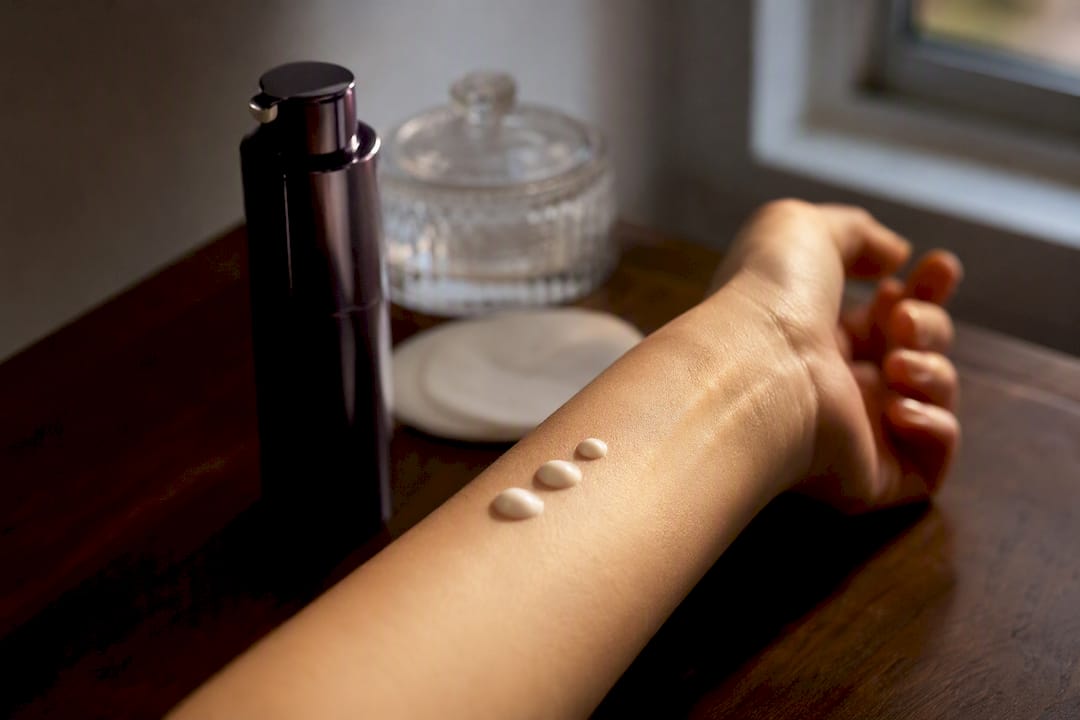
Pro Tip: Patch test any new retinoid on your inner arm for two nights before applying it to your face. It won’t predict every reaction, but it catches the obvious ones before they show up where everyone can see them.
How to Start Retinol or Retinal Without Wrecking Your Barrier
Whichever ingredient you pick, the ramp-up process matters more than the ingredient itself. Rushing frequency is the single most common reason people quit retinoids after one bad week.
- Start at 1 to 2 nights a week. Apply a pea-sized amount to fully dry skin, and give your face 20 to 30 minutes before adding moisturizer if you’re buffering.
- Buffer if you’re sensitive. Apply moisturizer first, then your retinoid on top, or mix a small amount of retinoid directly into your moisturizer to dilute the initial contact.
- Build gradually. Move to every other night after two to three weeks of no significant irritation, then nightly once your skin tolerates that pace.
- Layer supportive ingredients. Look for glycerin, ceramides, and squalane in your moisturizer. These reinforce your skin barrier while retinoids do their work.
- Skip conflicting actives at first. Hold off on high-strength AHAs/BHAs, benzoyl peroxide, and high-dose vitamin C at night while you’re still ramping up. Fundamentals like barrier support and routine sequencing make this transition far smoother.
- Wear broad-spectrum SPF 30+ every single day. Retinoids increase photosensitivity, and this step is non-negotiable regardless of which ingredient you use.
Dermatology guidance consistently backs this slow, barrier-first approach over jumping straight to nightly use. If you develop persistent dermatitis, severe irritation that doesn’t calm down after a few days off, or you’re pregnant or breastfeeding, stop and check with a dermatologist rather than pushing through.
Pro Tip: If your skin gets flaky, that’s often normal cell turnover, not necessarily a sign to quit. Persistent burning or swelling is different and means you should scale back frequency immediately.
What Side Effects to Expect From Retinal vs Retinol
Retinal’s extra potency comes with a steeper side effect profile, especially in the first few weeks. Expect more pronounced redness, tightness, and peeling than you’d typically see with retinol at an equivalent starting frequency. Retinaldehyde tends to be stronger and faster acting, and that strength is exactly what drives the harsher initial adjustment for many users.
Some people also report a distinct stinging sensation with retinal that feels different from the dryness typically associated with retinol, particularly on first application. This tends to fade as your skin builds tolerance, usually within two to four weeks of consistent, low-frequency use.
Retinol’s side effects skew milder but aren’t absent: dryness, mild flaking, and occasional purging (temporary breakouts as cell turnover speeds up) are common in the first month. Because retinol comes in such a wide concentration range, you have more room to dial back if irritation shows up.
Both ingredients increase sun sensitivity, so sunburn risk rises with either one if you skip daily SPF. Neither should be combined carelessly with other strong exfoliating acids, especially while your skin is still adjusting. If you notice swelling, blistering, or irritation that doesn’t improve after reducing frequency, that’s your cue to pause and get a professional opinion rather than switching products on your own.
Finding the Right Formula on Lunarashopping
Once you know which ingredient fits your skin, the product itself decides whether that choice actually pays off. Lunarashopping curates both retinol and retinal formulas built around supportive ingredients and stable packaging, not just a percentage on the label.
If you’re new to retinoids or lean sensitive, the PRETTYSKIN Ginseng Retinol Multi Cream pairs retinol with ginseng and hydrating support, giving your skin a cushion while it adjusts. It’s a practical entry point for the 1 to 2 nights a week ramp-up described above.
If your skin has already built some tolerance, or you’re managing acne alongside early aging concerns, the DERMATORY Retinal Spicule Wrinkle & Neck Cream delivers retinal’s faster timeline in a formula designed for both the face and neck.
When you’re comparing product pages, look for three things: a clearly stated concentration, a fragrance-free base to limit unnecessary irritation, and packaging that limits air and light exposure. Formulation and stable packaging protect the active ingredient from breaking down before it reaches your skin, which matters more than the number on the front of the bottle.
Pair whichever cream you choose with daily sunscreen from a complete morning routine set, or browse the full face care collection to build out the rest of your regimen.
Why We Stock Both Retinol and Retinal
Lunarashopping carries both ingredients because no single vitamin A derivative fits every skin type or goal. Our curation focuses on formulation quality and tolerability, not just percentage claims. Check individual product pages for concentration details, and reach out to customer support if you need help matching a formula to your skin’s specific needs.
— Lunara
Sources
- Clinical outcomes for topical retinoids (PMC article)
- DermApproved blog: retinal vs retinol
- Verywell Health: Retinaldehyde overview