If you’re in your 30s, your skin needs three things every day: hydration, barrier support, and daily SPF, with a low-dose retinoid or bakuchiol added slowly at night. Morning calls for gentle cleansing, an antioxidant like Vitamin C, a hydrating essence, a ceramide moisturizer, and sunscreen. At night, double cleanse if you wore makeup, hydrate first, layer in your active a few nights a week, then seal everything with a richer, ceramide-based cream. Protecting and repairing the skin barrier matters more right now than chasing aggressive treatments.
TL;DR:
- Using a low-pH cleanser and ceramide moisturizer in the morning enhances barrier protection and prevents excessive lipid loss.
- Introducing retinol or bakuchiol gradually over several months minimizes irritation and allows the skin to build tolerance safely.
- Reapplying SPF every two hours and using physical protection like hats and sunglasses are key to maintaining sun defense during outdoor activities.
- Exfoliate once or twice a week with gentle acids or scrubs, avoiding overdoing it to prevent barrier damage and increased sensitivity.
- Prioritizing hydration and barrier support over aggressive treatments yields more consistent, long-term anti-aging results for skin in the 30s.
Table of Contents
- What Does a Korean Skincare Routine for Your 30s Actually Look Like?
- Which Korean Ingredients Matter Most for Skin in Your 30s?
- How Do You Introduce Retinol Safely in Your 30s?
- Why Does Layering Order Matter So Much in K-Beauty?
- What Should You Do When a Product Irritates Your Skin?
- Which Routine Template Fits Your Schedule?
- Why LunaraShopping Recommends a Barrier-First Approach for 30s Skin
- How Should You Reapply Sunscreen and Protect Skin During the Day?
- How Often Should You Exfoliate in Your 30s?
- Why Does Eye Area Care Matter More in Your 30s?
- How Do Diet and Lifestyle Fit Into a Korean Skincare Approach?
- Which Korean Products Work Best for Skin in Your 30s?
- Editor’s Perspective: Consistency Beats Aggressive Fixes
- How LunaraShopping Can Help You Build a Barrier-First Routine
- Sources
- FAQ
What Does a Korean Skincare Routine for Your 30s Actually Look Like?
Your skin in your 30s is not the same skin you had at 25, even if it looks nearly identical in the mirror. Cell turnover has already started slowing, oil production is dipping slightly, and the visible effects of sun exposure from your 20s are beginning to surface as faint lines and uneven tone. A Korean skincare routine for your 30s works because it treats the barrier as the priority, not an afterthought, and builds anti-aging actives around that foundation rather than in place of it.
The morning sequence
- Low-pH gel or cream cleanser. Skip foaming cleansers with high pH; they strip lipids you cannot afford to lose. A cleanser in the 5.0 to 6.0 range respects your skin’s natural acid mantle.
- Antioxidant serum. A stable Vitamin C derivative (ascorbyl glucoside or sodium ascorbyl phosphate tend to be gentler than pure L-ascorbic acid) helps neutralize daytime environmental stress and works best applied in the morning, separate from nighttime retinoid use, since combining unstable forms of Vitamin C with retinoids can cause irritation and reduce effectiveness of both.
- Hydrating essence or serum. This is where Korean formulas differ most from Western routines. Essences deliver hyaluronic acid, fermented extracts, or humectant blends before your moisturizer, giving skin a hydration base to build on.
- Ceramide moisturizer. Look for a cream that lists ceramides (NP, AP, EOP) near the top of the ingredient list.
- Broad-spectrum SPF 30 or higher. Non-negotiable, rain or shine, every single day.
The evening sequence
- Oil cleanser (only if you wore sunscreen or makeup), followed by a low-pH water-based cleanser.
- Hydrating essence, the same step as morning, to prep skin before actives.
- Targeted active two to three nights a week to start: a low-dose retinol, retinal, or bakuchiol if you prefer a gentler option.
- Ceramide-rich night cream, slightly heavier than your day formula, to lock in moisture while you sleep.
Choosing your routine length
Not everyone has time for eight steps every night, and that’s fine. Match the routine to your schedule, not to what looks impressive on social media.
- Minimalist (3-step): Cleanse, moisturize, SPF in the morning; cleanse, treat, moisturize at night. Good for travel days or when you’re simply exhausted.
- Balanced (5-step): Cleanse, essence, serum, moisturizer, SPF. This covers the core prevention bases without demanding a 20-minute ritual.
- Full layering (8-step): Oil cleanse, water cleanse, toner, essence, serum or ampoule, sheet mask (a few times weekly), moisturizer, sleeping pack. This is the version worth doing two or three nights a week, not every single night.
Adjusting for your skin type
Dry skin benefits from layering multiple hydrating essences before a heavier ceramide cream, and can usually tolerate retinol better once the barrier is well hydrated. Oily and combination skin should look for gel-based moisturizers and lighter essences, but still needs the ceramide step. Skipping moisturizer because your skin feels oily is one of the most common mistakes in your 30s, since dehydrated oily skin overproduces sebum to compensate. Sensitive or acne-prone skin should introduce actives more cautiously and lean on centella-based formulas to calm reactivity before adding retinoids at all.
Which Korean Ingredients Matter Most for Skin in Your 30s?
Reading a Korean skincare label can feel like decoding a chemistry exam, but a handful of ingredient categories do most of the heavy lifting for skin in this decade.
Ceramides and barrier lipids rebuild the lipid matrix that keeps moisture in and irritants out. Look for “ceramide NP,” “ceramide AP,” or “ceramide EOP” on ingredient lists, often paired with cholesterol and fatty acids in a ratio that mimics your skin’s own structure.
Humectants and hydrators pull water into the skin and hold it there. Hyaluronic acid remains the workhorse, but Korean formulas frequently add tremella mushroom extract (sometimes called “snow mushroom”) and glycerin, which layer well under heavier creams without causing pilling.
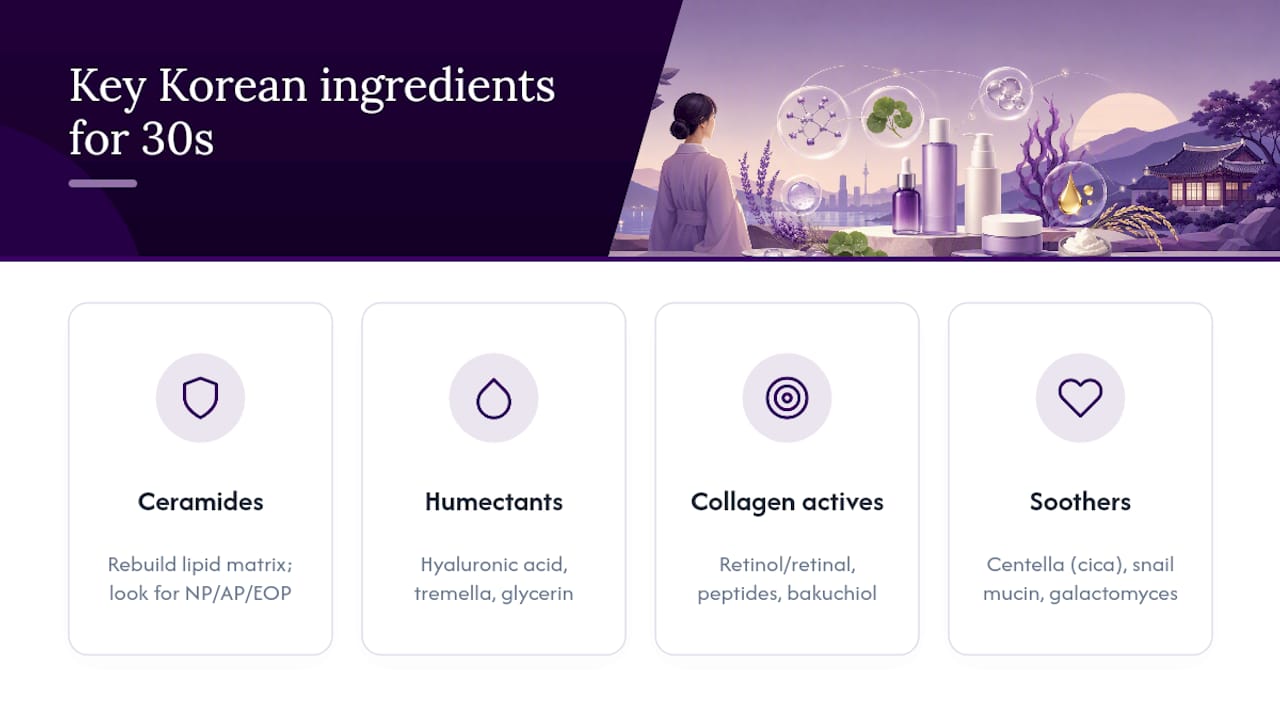
Collagen-supporting and firming actives are where anti-aging Korean skincare earns its reputation. Retinol and retinal address fine lines and texture directly, peptides signal skin to produce more collagen with a gentler tolerability profile, and bakuchiol offers a plant-derived alternative for anyone who reacts poorly to retinoids or is pregnant. A peptide ampoule can be a useful bridge for skin that isn’t ready for retinol yet.
Soothers and fermented extracts calm the inflammation that actives can trigger. Centella asiatica, often labeled “cica,” is one of the most consistently recommended anti-inflammatory ingredients in Korean formulations, and dermatologists specifically point to it for reactive or aging skin that needs calming alongside active ingredients. Snail mucin and galactomyces ferment filtrate work similarly, softening skin while supporting barrier repair.
Ingredient snapshot: A multi-pathway approach combining retinoids or peptides with barrier lipids, antioxidants, and daily SPF produces more consistent anti-aging results with less irritation than relying on one high-concentration active alone.
A few pairings deserve caution. Avoid layering a fresh retinol application directly under a strong exfoliating acid the same night; the combination frequently causes redness and flaking that has nothing to do with either ingredient failing on its own. If you’re pregnant or breastfeeding, skip retinol and retinal entirely and reach for bakuchiol or peptide-based serums instead, since those categories don’t carry the same contraindication.
How Do You Introduce Retinol Safely in Your 30s?
Start low and go slowly. A Seoul-based clinical approach recommends beginning retinoid use in the late 20s to early 30s specifically because gradual introduction prevents the deeper structural changes that show up later, and gives skin time to build tolerance without a punishing adjustment period.
- Week 1 to 2: Apply a low-concentration retinol (0.01% to 0.03%) once or twice a week, at night only.
- Week 3 to 6: If skin tolerates it well (no persistent redness, flaking, or stinging), increase to three nights a week.
- Month 2 to 3: Move to every other night if your barrier feels stable.
- Month 4 onward: Nightly use becomes realistic for most people, though many find three to five nights a week is the sustainable long-term rhythm.
Buffering makes this transition far more comfortable. The technique dermatology-adjacent guidance recommends is straightforward: apply a hydrating essence first, wait about 60 seconds, then apply the retinoid, and finish with a ceramide-rich moisturizer. This essence-first sequencing cushions the retinoid’s contact with skin while barely affecting how well it works.
Watch for the difference between expected mild dryness and a signal to pause. Persistent burning, visible cracking, or redness that doesn’t fade by morning means back off frequency, not push through it.
Pro Tip: If retinol has irritated you in the past, try bakuchiol two to three nights a week for a month before reattempting retinol. Building baseline tolerance with a gentler active often makes the eventual retinol transition much smoother.
Pregnant or breastfeeding readers should use bakuchiol or peptide serums instead of retinoids, full stop. Anyone with rosacea, eczema, or a compromised barrier should talk to a dermatologist before starting any retinoid, and increase concentration only after several weeks of stable, irritation-free use.
Why Does Layering Order Matter So Much in K-Beauty?
The thin-to-thick rule exists because heavier products create a physical barrier that blocks thinner, active-rich formulas from penetrating. Apply your thinnest, most watery products first (toners, essences), then move to serums and ampoules, and finish with creams and oils. Skip this order and your $40 serum mostly sits on top of your moisturizer doing very little.
pH sensitivity is where things get technical, but the practical rule is simple: apply Vitamin C in the morning and retinoids at night, and don’t try to combine them in the same application. Vitamin C needs a low pH (around 3.5) to stay stable and effective, while many exfoliating acids and retinoids perform differently at different pH ranges. Layering them together can destabilize both and irritate skin for no real benefit, which is exactly why morning and evening separation is the standard recommendation.
- Essences go on damp skin right after cleansing, before anything else.
- Ampoules and concentrated serums come next, targeting specific concerns like dullness or fine lines.
- Sleeping masks or overnight packs go last, sealing in every layer beneath them.
- If a product pills or balls up when you pat in the next layer, wait an extra 30 to 60 seconds before applying, or you’re using too many actives in one sitting.
Three or four active-focused steps a night is plenty. Piling on six serums does not multiply results. It usually just overwhelms the barrier you’re trying to protect.
What Should You Do When a Product Irritates Your Skin?
Purging and irritation look similar but need opposite responses. Purging happens when an active (usually a retinoid or exfoliating acid) speeds up cell turnover and brings existing congestion to the surface faster, typically appearing as small breakouts in areas you already broke out before, and it resolves within four to six weeks. Irritation shows up as redness, burning, or breakouts in new areas you’ve never had problems before, and it gets worse with continued use rather than better.
If you suspect irritation rather than purging, act immediately:
- Stop the suspected product entirely for at least a week.
- Simplify to a routine built around ceramides, centella, and plain humectants like hyaluronic acid.
- Skip all exfoliation, physical or chemical, for one to two weeks minimum.
- Avoid introducing anything new until redness and sensitivity fully resolve.
Pro Tip: Keep a one-week gap between introducing any new active and adding another. If your skin reacts, you’ll know exactly which product caused it instead of guessing among three new serums.
Once skin calms down, reintroduce the suspected product at half the previous frequency, patch testing on your inner arm for 48 hours before your face if you’re genuinely unsure. Revisit your pH-sensitive pairings too. A surprising number of “irritation” cases are actually just Vitamin C and retinol fighting for the same nightly slot.
Which Routine Template Fits Your Schedule?
Templates work better than vague advice, so here are three ready-to-use versions organized by how much time you actually have.
- 3-step minimalist (AM): Low-pH cleanser, ceramide moisturizer with built-in SPF, done in under three minutes.
- 3-step minimalist (PM): Cleanser, hydrating serum, night cream.
- 5-step balanced (AM): Cleanser, Vitamin C serum, hydrating essence, ceramide moisturizer, SPF.
- 5-step balanced (PM): Double cleanse, essence, targeted active (retinol or bakuchiol), ceramide night cream.
- 8-step full layering (PM, two to three nights weekly): Oil cleanse, water cleanse, toner, essence, ampoule, sheet mask, moisturizer, sleeping pack.
If you’re starting actives for the first time, a one-week plan removes the guesswork. Days one and four, apply a low-dose retinol or bakuchiol at night using the buffering method. Days two, three, five, six, and seven, stick to your hydrating essence and ceramide moisturizer without any active. By week three, most people can comfortably move to three nights a week. Hydration improvements tend to show up within days to weeks, while texture and radiance changes generally take 4 to 8 weeks of consistent use, with firmness changes taking longer to become visible.
Why LunaraShopping Recommends a Barrier-First Approach for 30s Skin
Editorial coverage from outlets like Allure consistently points to hydration and barrier support as the highest-impact habits for skin heading into its later 30s and beyond, with targeted actives playing a supporting role rather than the lead. That framing lines up with what dermatology-adjacent guidance shows about combining retinoids or peptides with barrier lipids and antioxidants, a strategy that produces steadier results with less irritation than chasing one aggressive ingredient at high concentration.
Lunarashopping curates its face care selection around that same logic, prioritizing formulas that pair active ingredients with ceramides and soothing extracts rather than isolating potency at the expense of tolerability. For readers building or rebuilding a routine, the 10-step Korean skincare guide breaks the full layering sequence down further.
How Should You Reapply Sunscreen and Protect Skin During the Day?
One morning application of SPF does not cover you through an eight-hour workday, especially if you’re near windows, commuting, or spending any time outdoors. Sunscreen degrades with UV exposure and rubs off with sweat, touch, and fabric contact, so reapplication genuinely matters, not just as a suggestion tucked into the fine print.
Reapply every two hours during direct sun exposure, and at minimum once around midday if you’re mostly indoors but near windows, since UVA rays penetrate glass. A setting powder-SPF hybrid or a cushion compact with SPF makes reapplication realistic over makeup, since most people won’t wipe off their base and start over midday.
Beyond sunscreen itself, a few habits compound the protection. Wide-brimmed hats and UV-blocking sunglasses reduce cumulative exposure on the areas most prone to visible aging, your eye area and cheekbones. Seeking shade between 10 a.m. and 4 p.m., when UV intensity peaks, cuts exposure without any extra product. Antioxidant serums applied in the morning add a secondary layer of defense against the free radical damage that sunscreen alone doesn’t fully neutralize.
If your foundation or moisturizer already contains SPF, don’t assume that covers you for the whole day. Reapplication rules still apply, and layering a physical SPF stick or mist over makeup remains the easiest fix for the midday gap most routines miss entirely.
How Often Should You Exfoliate in Your 30s?
Skin in your 30s still benefits from exfoliation, but less frequently and more gently than skin in its 20s tends to need. Once or twice a week is typically enough for most skin types, whether you’re using a chemical exfoliant (AHA or BHA) or a gentle physical scrub.
Over-exfoliating is one of the fastest ways to compromise the barrier you’re working to strengthen elsewhere in your routine. Signs you’ve overdone it includes persistent tightness, visible flaking that wasn’t there before, and increased sensitivity to products that never used to bother you. If any of those show up, drop back to once a week or take a full week off entirely.
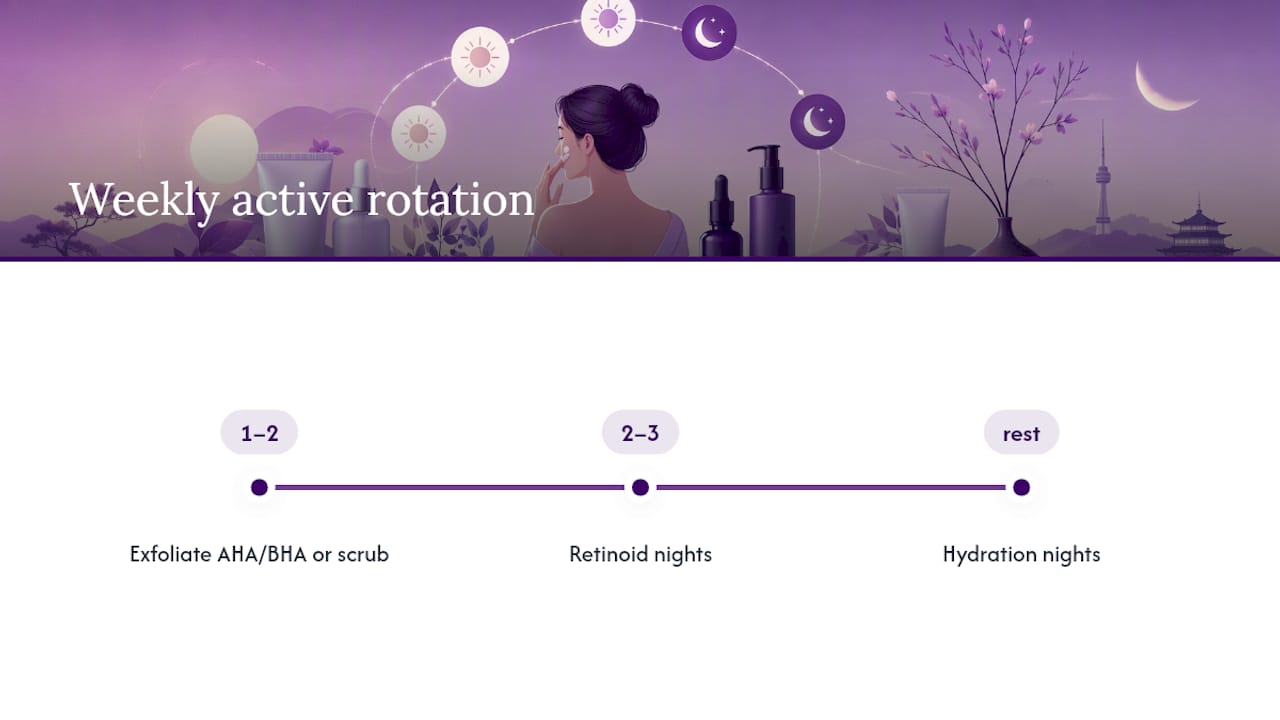
Timing matters as much as frequency. Chemical exfoliants work best at night, separate from your retinoid nights, since combining two potent actives in the same session multiplies irritation risk without multiplying benefit. A simple split, exfoliate one or two nights, retinoid two or three nights, hydration-only nights filling the rest, keeps your skin working through actives without overwhelming it.
Physical scrubs deserve gentler treatment than most people give them. Look for finely milled formulas rather than anything with jagged or uneven particles, and never scrub over active breakouts or irritated patches. A gentle exfoliating scrub used once weekly can round out a chemical exfoliation routine without doubling up on intensity.
Why Does Eye Area Care Matter More in Your 30s?
The skin around your eyes is thinner than anywhere else on your face, with far fewer oil glands and almost no fat cushioning underneath. That combination makes it the first place fine lines, dryness, and dullness tend to show up, often years before the rest of your face shows comparable changes.
A dedicated eye cream isn’t just marketing. Formulas made specifically for the eye area tend to use lower concentrations of actives and richer emollient bases than your regular moisturizer, since this skin can’t tolerate the same intensity without irritation or excess puffiness. Peptides and caffeine are common in eye-specific formulas for firmness and reducing morning puffiness, while hyaluronic acid and ceramides handle the hydration side.
Application technique matters here more than almost anywhere else on your face. Use your ring finger, which naturally applies the lightest pressure, and pat the product in gently rather than rubbing or tugging. Apply from the inner corner outward along the orbital bone, staying just above the actual lash line to avoid product migrating into your eyes throughout the day.
If you’re already using retinol on the rest of your face, most formulas are too strong for direct eye application unless specifically labeled as eye-safe. A dedicated eye cream, applied both morning and night, fills that gap without risking irritation in skin that simply can’t handle the same active load as your cheeks or forehead.
How Do Diet and Lifestyle Fit Into a Korean Skincare Approach?
Korean skincare philosophy has never treated topical products as the whole story. Hydration from the inside matters as much as hydration applied topically, and adequate water intake shows up in skin plumpness and texture in ways no serum fully replicates on its own.
Diet plays a genuine role in how your skin ages through your 30s. Diets higher in antioxidant-rich foods, think leafy greens, berries, and fermented foods like kimchi, support the same free radical defense your Vitamin C serum is working on topically. Fermented ingredients show up constantly in Korean skincare formulas (galactomyces, bifida, rice ferment) partly because fermented foods have long been a dietary staple, and the philosophy simply extended that logic to topical products.
Sleep deserves more credit than it usually gets. Collagen production and skin repair happen predominantly during deep sleep, which means consistently cutting sleep short undermines your nighttime routine’s effectiveness before it even gets a chance to work. Chronic stress raises cortisol, which has been linked to accelerated collagen breakdown and increased sensitivity, both of which make your barrier-repair efforts fight an uphill battle.
None of this replaces a solid topical routine, but it explains why two people using identical products can see different results. Sleep, hydration, and diet act as a multiplier on whatever you’re already applying at your sink each morning and night.
Which Korean Products Work Best for Skin in Your 30s?
Formulation matters more than brand name at this stage, but a few product categories consistently deliver for skin navigating early prevention and mild concerns like dullness or uneven tone.
Ceramide-rich moisturizers should anchor your routine regardless of skin type. Look specifically at face creams and moisturizers that list ceramides among the first several ingredients rather than buried near the bottom of a long list. Hydrating toners and essence-based mists work well as a hydration layer before serums, and toners and mists formulated with centella or fermented extracts double as calming steps on nights you’re also using an active.
Sheet masks deserve a regular spot rather than an occasional treat. Used once or twice a week, a hydrating or brightening sheet mask gives skin a concentrated dose of humectants that a regular moisturizer can’t match in a single application. Propolis and collagen-focused masks in particular tend to leave skin visibly plumper the next morning, which makes them a useful reset before a big event or simply after a stretch of poor sleep.
For anyone specifically managing sensitivity alongside anti-aging goals, gentle formulas built around soothing actives tend to outperform harsher, higher-concentration products over the long run, mostly because you’ll actually keep using them.
Editor’s Perspective: Consistency Beats Aggressive Fixes
Your 30s are the best decade to build consistency, not the decade to panic into aggressive treatments. Skin responds to steady, boring habits far better than to sporadic intensity, and the data on multi-pathway approaches backs that up clearly. The non-negotiable baseline is simple: daily SPF, applied and reapplied, plus one low-dose nighttime active used consistently. That combination outperforms an expensive serum used twice a month every single time. Skip the 12-step overhaul and just show up for the simple version, nightly, for the next six months.
— Lunara
How LunaraShopping Can Help You Build a Barrier-First Routine
A curated selection of Korean skincare products follows the same barrier-first logic this routine is built on, prioritizing formulas that include ceramides near the top of the ingredient list. Standard shipping fees apply, facilitating trial of individual products without committing to complete sets.

Start with the face care collection if you’re assembling a routine piece by piece, or head to ceramic-focused moisturizers if your barrier needs the most attention right now. If you want the full sequencing explained step by step before you buy anything, the 10-step routine guide walks through exactly how these categories fit together. Shop the Lunarashopping store today and build a routine around what your skin actually needs this decade, not what looked good on someone else’s shelf.
Sources
- PMC review on topical antioxidants and skin
- What is Cica? The K-Beauty ingredient dermatologists actually recommend | Jane Yoo, MD
- Best Korean skin care for mature skin — Allure (2026)
FAQ
What Skincare Should a 30-Year-Old Use?
A 30-year-old should use a gentle low-pH cleanser, a hydrating essence or serum, a ceramide-rich moisturizer, and daily SPF as the core morning routine, adding a low-dose retinol or bakuchiol at night a few times a week. Barrier support and consistent sun protection matter more at this stage than aggressive actives.
What Is the Best Korean Skincare for People in Their 40s?
Korean skincare for 40s skin follows the same barrier-first logic as the 30s but typically layers in richer moisturizers and slightly higher retinoid concentrations once tolerance is established, alongside continued centella and ceramide use for reactivity. The core principles, hydration, protection, and gradual active introduction, carry through Korean skincare for 40s and beyond routines with adjustments for increased dryness and sensitivity, including menopause Korean skincare approaches that emphasize extra barrier lipids as hormonal changes reduce natural oil production.
What Is Korea’s Number One Skincare Priority?
Hydration and barrier protection consistently rank as the top priorities in Korean skincare philosophy, ahead of any single hero ingredient or brand. Editorial coverage from outlets like Allure reinforces that hydration-first, gentle-layering formulas suit a wide range of skin concerns, including mature and sensitive skin.
Is Korean Skincare Good for Mature Skin?
Yes, Korean skincare’s emphasis on hydration, barrier repair, and gentle layering makes it particularly well-suited for mature skin, which tends to be thinner and more reactive than younger skin. The multi-pathway approach common in Korean formulations, pairing actives with soothing and hydrating ingredients, produces steadier results with less irritation than single-ingredient, high-concentration strategies.
How Long Does It Take to See Results From a New Routine?
Hydration improvements often appear within days to a couple of weeks, while texture and radiance changes typically take 4 to 8 weeks of consistent use. Measurable firmness or collagen-related changes usually take 3 to 6 months, which is why sticking with a simple routine matters more than switching products every few weeks.