If your skin flushes, stings, or reacts to most actives, start with a PHA. If your skin tolerates exfoliation well and you want faster results on texture or pigmentation, an AHA will get you there quicker. Both acids remove dead surface cells, but they differ sharply in how deep they penetrate and how much irritation they risk. Patch test either one, and never skip daytime sunscreen.
TL;DR:
- PHA is gentler than AHA because its larger molecules penetrate skin more slowly, reducing irritation especially for reactive or sensitive skin types.
- AHAs work faster on rough texture and pigmentation but require a lower pH, increasing the risk of stinging, while PHAs offer similar anti-aging benefits with less discomfort.
- Sensitive or rosacea-prone skin should start with PHA, while resilient skin can incorporate AHA more frequently, gradually increasing concentration over time.
- Always patch test new acids, start with low concentrations, and avoid layering retinoids or strong exfoliants until your skin develops tolerance, plus wear sunscreen daily.
- Routine customization, including patch testing and slow introduction, outweighs product strength, and stability in your routine is key for long-term results.
Table of Contents
- PHA vs AHA: What Each Acid Actually Is
- Why Does PHA Feel Gentler Than AHA?
- Which Skin Types and Concerns Suit Each Acid?
- How Do You Introduce Acids Without Overdoing It?
- What Do Sample Routines Look Like in Practice?
- Our Take on Starting Gentle First
- Ready to Build Your Acid Routine?
- Sources
- FAQ
PHA vs AHA: What Each Acid Actually Is
AHA stands for alpha hydroxy acid, a family of water-soluble acids derived from fruit, milk, or sugarcane. The most common ones you’ll see on ingredient lists are glycolic acid, lactic acid, mandelic acid, malic acid, and citric acid. PHA stands for polyhydroxy acid, a newer generation of exfoliants that work on the same principle but with a gentler touch. Gluconolactone and lactobionic acid are the two you’ll encounter most often.
Both acid families show up in similar product formats, which is part of why people confuse them:
- Toners and essences (typically low to moderate concentration)
- Leave-on serums and lightweight lotions
- Pre-soaked exfoliating pads
- Rinse-off masks meant for weekly use
Concentration matters more than the label’s marketing copy. A 5% PHA toner and a 5% AHA toner will feel and perform very differently on your skin, which comes down to the chemistry underneath. A guide on AHA skincare basics breaks down starter concentrations if you want a deeper primer before shopping.
Why Does PHA Feel Gentler Than AHA?
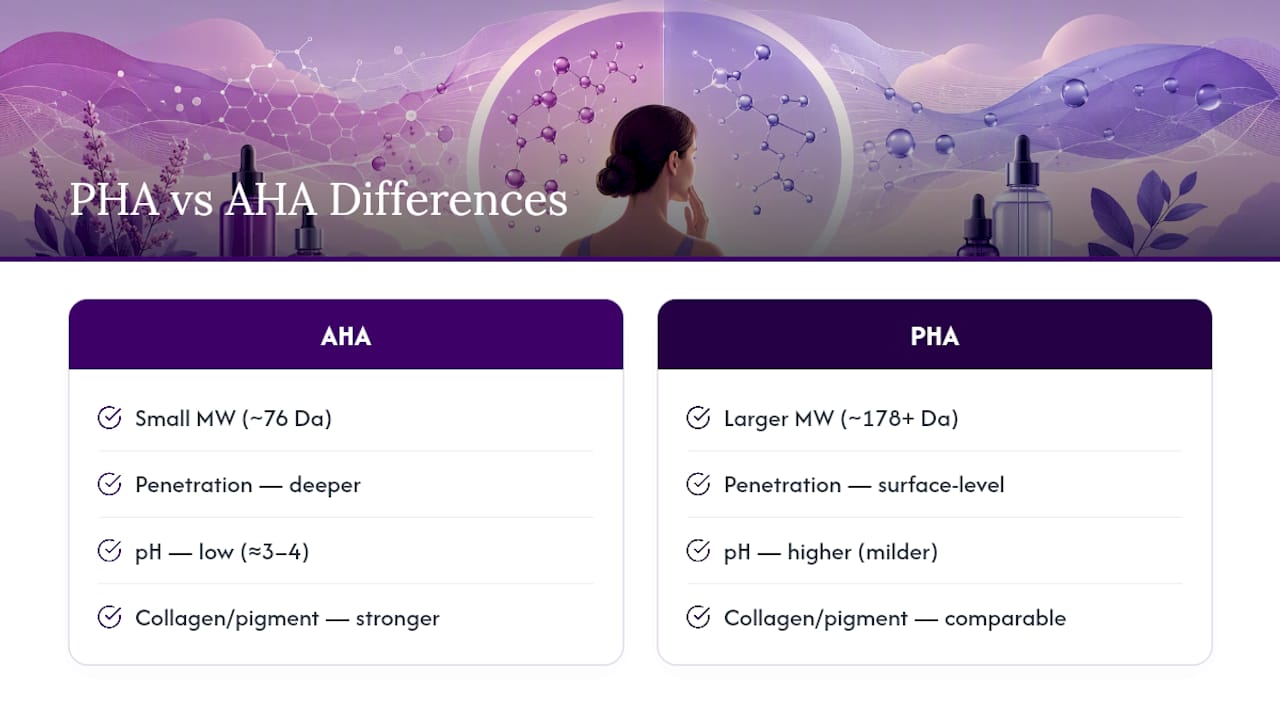
Molecular size is the whole story here. Glycolic acid, the smallest and most aggressive AHA, has a molecular weight around 76 Daltons, small enough to slip past the skin’s outer barrier quickly. Gluconolactone, a common PHA, weighs in at roughly 178 Daltons or more. That larger structure moves slower and stays closer to the surface, which is why PHAs are often described as working on the skin rather than into it.
A comparative clinical review found that PHAs deliver anti-aging benefits comparable to AHAs while causing noticeably less stinging and irritation, especially in people with reactive or compromised skin barriers.
pH plays a role too. AHAs need a lower pH, typically between 3 and 4, to stay active, and that acidity is part of what triggers the tingling sensation and occasional redness. PHAs function at a slightly higher pH, which softens the sensory experience without eliminating the exfoliating effect.
The tradeoff runs both directions. AHAs penetrate deeper and have stronger evidence behind their ability to stimulate collagen and fade pigmentation, but that same depth raises photosensitivity risk. PHAs bring humectant and antioxidant properties to the table, drawing in moisture while they exfoliate, so your skin barrier isn’t left worse off after use.
Which Skin Types and Concerns Suit Each Acid?
Match the acid to your skin’s current state, not just your end goal.
- Resilient, non-sensitive skin with texture or pigmentation concerns: AHAs, particularly glycolic acid, work faster on rough texture, dullness, and dark spots.
- Skin that tolerates actives but wants a milder AHA: Lactic acid is larger and gentler than glycolic, while still delivering visible resurfacing.
- Sensitive, rosacea-prone, or eczema-prone skin: PHAs exfoliate with far less risk of triggering flares.
- Post-procedure or pregnancy-cautious routines: PHAs are generally the safer starting point, though you should always confirm with your provider first.
One clarification worth making: BHA (salicylic acid) and its cousin LHA are oil-soluble acids that work inside pores, which makes them a separate decision axis entirely, mainly relevant for blackheads and clogged pores rather than surface texture. Don’t lump BHA into the PHA vs AHA choice; it solves a different problem.
A simple heuristic: if your skin reacts to fragrance or new products often, start with PHA. If your skin routinely handles retinoids or vitamin C without a fuss, an AHA is worth trying.
How Do You Introduce Acids Without Overdoing It?
Ease in slowly, regardless of which acid you pick.
- Patch test first. Apply a small amount behind your ear or on your inner forearm for two nights before using it on your face.
- Start low and slow. A conservative starting point is an AHA a few nights per week at a lower concentration, or a PHA daily or every other night, depending on strength. These are starting frameworks, not rigid rules; adjust based on how your skin responds.
- Know the difference between tingling and irritation. Mild, brief tingling on application is expected. Sustained burning, visible redness lasting hours, or peeling skin means you’ve gone too far, too fast.
- Space out actives. Don’t layer acids and retinoids on the same night when you’re starting out. Alternate nights until your skin builds tolerance.
- Wear sunscreen every single morning. The FDA’s guidance on AHA-containing cosmetics specifically flags increased sun sensitivity as a risk, and that caution applies to daily AHA users especially.
Pro Tip: If you’ve recently had a facial treatment, laser session, or even a bad windburn, skip acids entirely for a few days and lean on plain moisturizer and SPF until your barrier settles.
Avoid stacking multiple acids or combining acids with strong retinoids in the same routine unless your skin has months of proven tolerance. If redness or flaking persists beyond a week of reduced use, it’s worth checking in with a dermatologist rather than troubleshooting alone.
What Do Sample Routines Look Like in Practice?
Routines built around your skin’s actual tolerance beat routines built around what influencers use.
- Sensitive routine: A daily low-percentage PHA toner or serum, morning SPF, and a barrier-supporting moisturizer. No AHA until your skin has stayed calm for at least a month.
- Balanced routine: AHA on 2 to 3 nights weekly, alternating with a PHA or a plain hydrating serum on off nights, so your barrier gets recovery time.
- Advanced routine: A phased approach that increases AHA concentration gradually, paired with close monitoring for irritation and a dedicated barrier repair step (think ceramide-rich moisturizer) built into the week.
If irritation shows up at any stage, drop back to the sensitive routine for two weeks before trying again. If you’ve been consistent for six to eight weeks and see no improvement in texture or tone, that’s your signal to consider a slightly higher concentration or a different acid family, not to add more products on top. For guidance on layering order once your acid step is settled, A piece on Korean skincare routine sequencing covers where tools and treatments fit around your actives.
Our Take on Starting Gentle First
Most skincare content treats AHA and PHA as interchangeable exfoliants with different names, and that framing does readers a disservice. Experience in curating Korean skincare shows that formulation quality and gradual introduction matter more than chasing the strongest active on the shelf. Skin barriers don’t reward speed; they reward consistency.
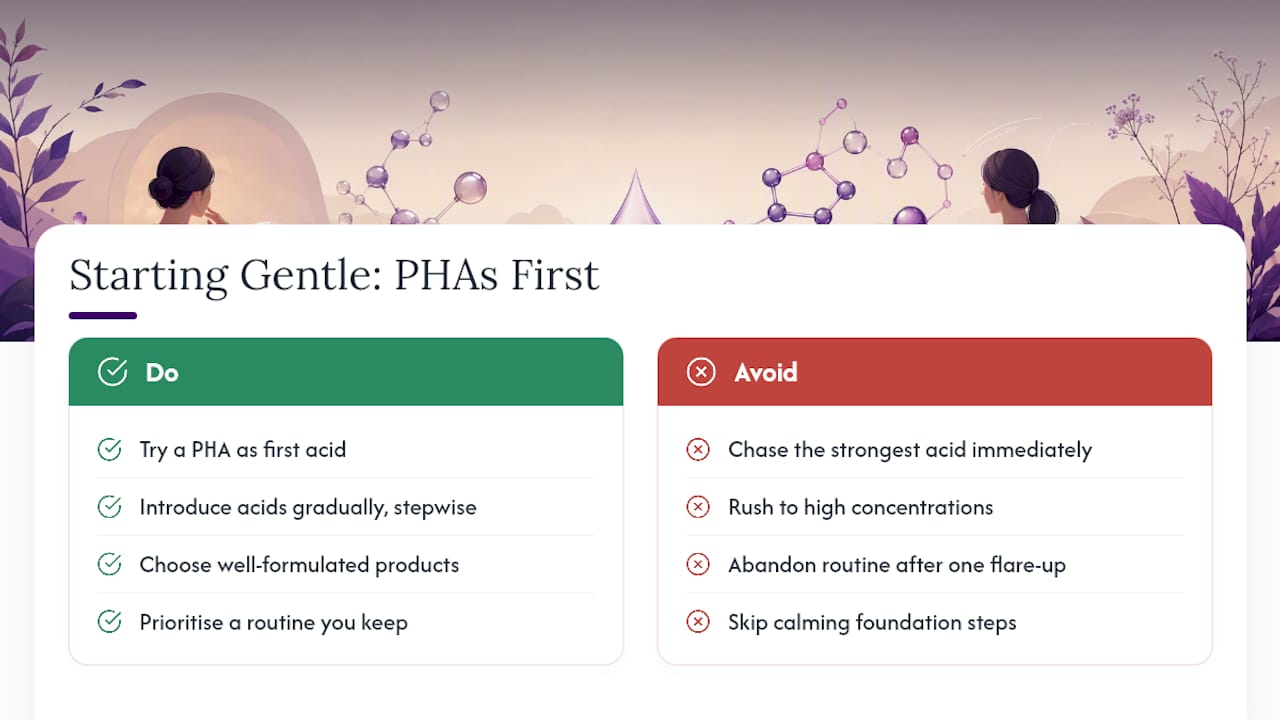
Our editorial stance leans toward recommending PHAs as the safer entry point for most people, not because AHAs are inferior, but because a routine you can actually stick to for months beats a stronger acid you abandon after one bad flare-up…
Sensitive or rosacea-prone readers exploring this further may find our guide to calming Korean skincare routines useful for building a foundation before introducing any acid.
— Lunara
Ready to Build Your Acid Routine?
Lunarashopping stocks gentle PHA and conservative-strength AHA formulas alongside the moisturizers and sunscreens you need to use them safely, all curated from trusted Korean skincare brands instead of scattered across a dozen different retailers. That curation is the advantage: every product in our face care collection is chosen for effective, gentle formulation rather than sheer potency, so you’re not guessing which strength is safe to start with.

If you’d rather skip the trial and error, our morning routine set pairs a gentle exfoliating step with sunscreen and hydration in one curated kit. Pairing a chemical exfoliant with better sleep hygiene also helps reduce nighttime friction on treated skin, which is why some customers add a silk pillowcase from our partners at Bella Lu to their routine. Browse the collection, pick a starting concentration that matches your skin’s current tolerance, and check out with flat rate shipping starting at a low fixed rate.
Sources
For deeper reading, the FDA’s AHA labeling guidance covers consumer warnings in detail. The PMC review on chemical exfoliants and the American Academy of Dermatology offer additional clinical context on safe acid use.
- Alpha hydroxy acids (AHAs) — FDA
- Alpha hydroxy acids in dermatology — PMC
- Comparative clinical study / review on hydroxy acids — PubMed
FAQ
What Should You Not Mix With PHA?
Avoid combining PHA with strong retinoids, high-percentage AHAs, or physical scrubs in the same routine until your skin has proven tolerance, since stacking exfoliants raises the risk of over-exfoliation even with a gentle acid like PHA.
Does PHA Get Rid of Blackheads?
PHA works on the skin’s surface and offers mild, gentle exfoliation, but it isn’t formulated to penetrate pores the way an oil-soluble BHA like salicylic acid does, so it’s not the go-to acid for blackhead-specific concerns.
Is PHA Better Than Glycolic Acid?
Neither is universally better. PHA causes less stinging and irritation and suits sensitive skin, while glycolic acid penetrates deeper and works faster on texture and pigmentation for skin that tolerates it well.
Can You Mix AHA and PHA?
You can alternate them on different nights once your skin shows it handles exfoliation well, but combining both in the same session, especially early on, increases irritation risk without adding meaningful benefit.