The best Korean in-flight skincare routine does most of its work before you board. You build up your moisture barrier at home, pack a small kit that fits the TSA liquids rule, and use only hands-free, low-effort steps in the air: a mist, an under-eye patch or a sheet mask. This guide shows you how to do that, step by step, for a short domestic hop or a long-haul flight.
TL;DR
- Cabin air is extremely dry. The CDC Yellow Book cites humidity on aircraft of roughly 5-20%, with some studies noting levels as low as 2%.
- Prepare before you fly: a hydrating serum and a richer moisturizer shore up your barrier, so you don’t need a complicated routine at 35,000 feet.
- Keep it hands-free in the air: facial mist, eye patches or one sheet mask, plus water. Skip the lavatory face wash.
- Carry-on liquids, gels and creams must be 3.4 oz (100 ml) or less each and fit in one quart-sized bag. Sheet masks are not liquids.
- Moisturize again after landing and give your skin a calm, simple night.
Table of Contents
- Why airplane air is hard on your skin
- The Korean approach: preserve first, maintain second
- Before you board: the pre-flight routine
- What to pack: a TSA-friendly K-beauty kit
- In the air: hands-free and simple
- A sample routine for a long-haul flight
- Short flights and day trips
- After you land
- Our perspective: keep it small and keep it gentle
- Build your travel kit with Lunara
- FAQ
- Sources
Why airplane air is hard on your skin
At sea level, indoor air typically feels comfortable. In a pressurized cabin, the air is far drier. The CDC’s Yellow Book for travelers and clinicians puts typical aircraft humidity at 5-20%, and some studies have recorded as little as 2%. For comparison, most people feel comfortable in a home that sits well above that range.
Dry air pulls water out of the outer layer of your skin. That is transepidermal water loss, and it is why skin can feel tight, look dull, or show fine lines more clearly after a flight. If your skin barrier is already stressed, you may also notice redness, flaking or stinging. A Women’s Health piece with dermatologists describes the same sensation: parched, tight skin mid-flight is not your imagination, and low-humidity cabin air is a likely reason.
Three things follow from this:
- Hydration and barrier support matter more than any active ingredient.
- Anything that irritates or dries your skin on a normal day will feel worse in the air.
- The less you touch your face, the better.
The Korean approach: preserve first, maintain second
Korean skincare is built around layers of hydration and a healthy barrier rather than one strong product. That philosophy suits flying well. If you want the background, our guide on why Korean brands emphasize hydration explains the thinking in more detail.
Dermatologists quoted by Women’s Health describe the most effective approach as preparation rather than mid-air effort: build up moisture with hydrating serums and richer moisturizers before you board, then keep the rest simple. That is the “pre-flight preservation” idea, and it is what we recommend too.
In practice, the routine has three phases:
| Phase | Goal | What you do |
|---|---|---|
| Before boarding | Reinforce the barrier | Gentle cleanse, hydrating toner or essence, serum, moisturizer, SPF in the morning |
| In the air | Add moisture without touching your face | Mist, eye patches or one sheet mask, water |
| After landing | Replace what the cabin took | Gentle cleanse, hydrating layers, richer cream at night |
Before you board: the pre-flight routine
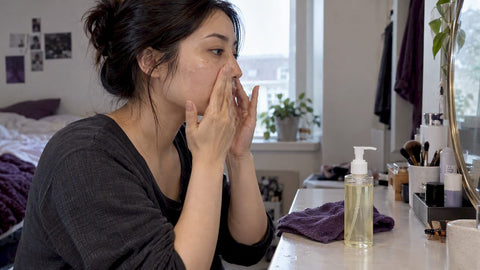
Start your routine at home or at your hotel, not at the gate. Allow the layers to settle for a few minutes before you leave for the airport, so you don’t leave the house with a sticky face.
Step 1: Cleanse gently
Use a low-pH cleanser that doesn’t leave your face squeaky. A tight feeling after washing is the opposite of what you want before a dry flight. Our face cleansers collection includes gel and foaming options for different skin types.
Step 2: Layer hydration
Apply a hydrating toner or essence, then a serum with humectants such as hyaluronic acid or glycerin. Pat it in rather than rubbing. If you have time, repeat a thin layer of toner once more. This layering is the heart of K-beauty hydration. For a fuller walk-through, see our 10 step Korean skincare routine guide.
Step 3: Seal with moisturizer
Choose a cream a little richer than your usual daytime moisturizer. Its job is to slow water loss for the next several hours. Browse face creams and moisturizers if you want a cushiony texture for travel days.
Step 4: SPF if you’re flying in daylight
Window seats get sun exposure at altitude. If you fly during the day, wear your usual broad-spectrum sunscreen. Apply it as the last step, and keep it consistent with what you already use at home.
What to skip before flying
This is not the day to try a new product or a strong exfoliating acid. Anything that can sting or peel is a bad idea before several hours of dry air. If your skin tends to react, our guide to Korean skincare for dry skin and the one on dehydrated skin cover how to rebuild the barrier first. If you are acne-prone, keep it equally simple and see our Korean acne care best practices.
What to pack: a TSA-friendly K-beauty kit
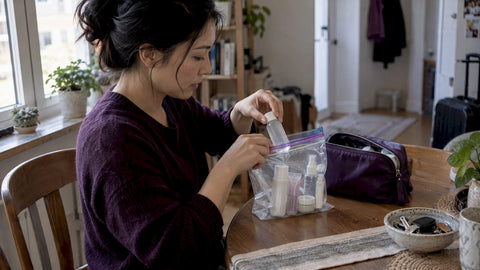
In the US, the TSA’s 3-1-1 rule lets you bring liquids, aerosols, gels, creams and pastes through the checkpoint in a quart-sized bag, as long as each item is 3.4 ounces or less. Anything larger goes in checked baggage. This applies to hand luggage on flights departing from US airports. Rules elsewhere can differ, so check the airport’s guidance if you are connecting abroad.
Skincare mostly counts as liquids, gels or creams. That means your serum, moisturizer, mist and cleanser all go in that one bag. Here is a practical way to build it.
The kit
- A mini mist (about 2 oz or less). It is the easiest in-flight step. Our guide to types of Korean facial mists explains which formula suits which skin type.
- Your moisturizer, decanted. A small travel jar or tube works. If the product is already under 3.4 oz, you can carry it as is.
- Eye patches. Hydrating hydrogel or fabric patches are hands-free, and our article what is a Korean eye patch covers how they work.
- One or two sheet masks. According to Reader’s Digest’s TSA rundown, sheet masks are not treated as liquids or gels, so the 3-1-1 rule does not apply to them in the same way. Keep them in your personal item for easy reach.
- A lip balm you already trust. Lips and the skin around your nose feel the dryness first.
- Hand cream. Not a face product, but dry hands tend to find your face.
Decanting tips
- Use clean, leakproof containers and label them. Some travelers find 1 oz (30 ml) containers enough for a short trip.
- Put the whole kit in a clear zip-top bag before you reach the checkpoint, not at it.
- Cabin pressure can push product out of loosely sealed bottles. Fill containers about three quarters full and keep them upright in the bag.
- Store everything away from heat. Our guide on how to store Korean skincare products has the basics.
If you want to build a custom travel set rather than hunt for minis one by one, our custom skincare kit builder can help you assemble a combination around your routine. The skincare accessories collection is a useful place to look for small travel extras.
In the air: hands-free and simple
Once you are seated, resist the urge to run a full routine. Here is what is worth doing.
Skip the lavatory wash
Washing your face in a cramped lavatory is rarely worth it. Some travel guides, including this one on a minimal Korean routine for long-haul flights, recommend finishing the full routine at home and keeping the cabin portion to mist and patches. Our view is the same. If your hands feel unclean, use hand sanitizer or wash your hands first, then touch your face only when necessary.
Reach for hands-free products
Vogue’s in-flight skincare guide notes that experts suggest touching your face less on a plane and favoring options like sheet masks, under-eye patches and mists. That fits the Korean toolkit well:
- Eye patches go on first. They sit still, you can relax, and they take about 15 to 20 minutes depending on the product directions.
- A sheet mask works well on a long overnight flight, once the cabin has settled. Follow the time on the package, and don’t leave it on until it dries out, because a dry mask can pull moisture back from your skin.
- A mist can be used every couple of hours. Close your eyes, hold the bottle at arm’s length and spray lightly. Follow with a gentle press of your palms if your hands are clean.
- Lip balm and hand cream whenever the tightness returns.
Drink water
What you put on your face is only half of it. AFAR’s guide to caring for skin while flying quotes a licensed esthetician who calls flying extremely dehydrating. Its experts recommend drinking water steadily and limiting alcohol and very salty snacks. A common rule of thumb in travel advice is about eight ounces for every hour of flight. If you have a medical condition that limits how much fluid you should drink, ask your doctor before following any general guideline.

A note on sheet masks in the cabin
A sheet mask is not a miracle, and some dermatologists are skeptical of in-flight routines in general. The NBC Select guide to in-flight skin care collects dermatologist tips on drinking water, moisturizing and keeping the routine simple. A mask is best treated as a comfortable extra on top of a good pre-flight routine, not a replacement for one.
If you want an easy place to start, our face masks collection includes single-sheet options such as the MEDIHEAL Collagen Essential Mask and the MEDIHEAL Vita Essential Mask. Single sheets are slim, so they fit a personal item without any trouble.
A sample routine for a long-haul flight
Here is how the pieces fit together for a 10-hour overnight flight departing in the evening.
At home, about 45 minutes before you leave
- Cleanse with a gentle gel or foam.
- Apply toner or essence, patting it in. Repeat once if your skin is very dry.
- Apply a hydrating serum.
- Apply a rich moisturizer.
- Skip makeup, or keep it light.
After takeoff, once the cabin lights dim
- Wash your hands or use sanitizer.
- Apply eye patches and relax for the time on the package.
- Apply a sheet mask if you want one, then press any leftover essence into your neck and hands.
- Add a thin layer of moisturizer on top to seal it in.
Midway, when you wake up
- Mist your face lightly.
- Reapply lip balm and hand cream.
- Drink a full glass of water.
Before landing
- Mist once more, then add a little moisturizer to the driest areas.
- Hold off on makeup until you’ve landed and washed your face.
Short flights and day trips
For a flight of two or three hours, you can drop the sheet mask. Do the pre-flight routine, carry a mist and lip balm, and drink water. That is enough for most skin types.
After you land
Your skin may still feel dry and slightly dull for a day. The fix is gentle:
- Cleanse with a mild cleanser as soon as you reach your hotel or home.
- Use hydrating layers, then a moisturizer, morning and night.
- Avoid strong exfoliants, retinoids and peels for a day or two if your skin feels sensitive.
- Stick to a simple evening routine. Our Korean night routine in 10 to 15 minutes is built for that.
If you notice persistent redness, rashes or a flare of a skin condition after flying, see a board-certified dermatologist rather than adding products.
Our perspective: keep it small and keep it gentle

We see the same mistake every travel season: people pack too many products, try something new on the plane, and arrive with irritated skin. Our curated range of Korean products is chosen for gentle, effective formulas that suit different skin types, and that principle matters even more at altitude.
Our advice is to pick three or four products you already know your skin tolerates. Choose a hydrator, a moisturizer, a mist, and one extra such as eye patches or a sheet mask. Test any new item at home a few days before the trip. If you’re not sure where to begin, start with the products that support the barrier rather than anything marketed as a quick fix. A calm, consistent routine travels best.
— Lunara
Build your travel kit with Lunara
If you’re ready to put a travel kit together, start with our face toners and mists, face creams and moisturizers and face masks. You can also see everything in one place under all face care products. We also offer Korean Hydration Essentials for a simple hydration-focused start. Standard shipping is a flat rate from $6.49, so you can order ahead of your trip. Shop Lunara now.
FAQ
How do I keep my skin hydrated on an airplane?
Prepare before boarding with a hydrating serum and a richer moisturizer, then drink water throughout the flight. In the air, use a mist, under-eye patches or a sheet mask so you don’t have to rub your face. Moisturize again after landing.
Can I bring skincare on a plane?
Yes. In your carry-on, each liquid, gel or cream must be 3.4 oz (100 ml) or less, and all of them must fit in one quart-sized clear bag, according to the TSA. Larger sizes go in checked baggage. Sheet masks are generally treated differently from liquids, but check the TSA’s current guidance before you travel.
What is the best face mask for a long flight?
A single-use sheet mask is the easiest, since it is slim and mess-free. Pick a hydrating one you have already tried at home. Use it once the cabin is calm and remove it when the package says so, not when it has dried.
Should I wash my face on the plane?
Usually no. Lavatories are cramped, and a full routine there is hard to do well. Finish your cleanse and moisturizer at home, then rely on mist and patches in the air, and cleanse properly when you land.
Should I wear sunscreen on a plane?
If you fly during the day, especially in a window seat, wearing your usual sunscreen as the last step of your morning routine is a sensible habit. For skin concerns or a history of sun sensitivity, ask your dermatologist what they recommend for you.
Sources
- CDC Yellow Book: Air Travel
- Women’s Health: Are In-Flight Skincare Routines A Bunch Of BS? Dermatologists Weigh In
- TSA: Remember the 3-1-1 liquids rule
- Reader’s Digest: TSA and skin-care products
- Vogue: In-Flight Skincare 101
- AFAR: The Best Ways to Care for Your Skin While Flying
- NBC Select: The best guide to in-flight skin care, according to experts
- The Ultimate Guide to a TSA-Approved Minimal Korean Skincare Routine for Long-Haul Flights