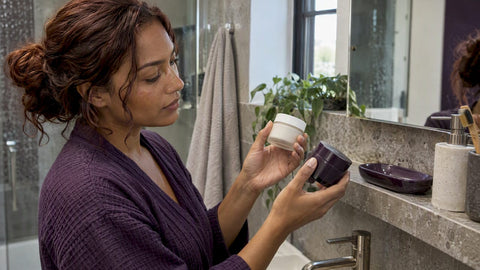
Mugwort is a soothing botanical used in Korean skincare to calm redness, support the skin barrier and keep irritated, blemish-prone skin comfortable. The research is encouraging but early. Most of it comes from lab work and small studies, so mugwort works best as a gentle supporting ingredient in your routine, not as a treatment.
Below, we go through what the science says, what it does not say, who should be careful, and how to fit mugwort into a routine without overloading your skin.
TL;DR
- Mugwort (Artemisia) is used for its calming, anti-inflammatory and antimicrobial properties, mostly in essences, masks and creams for sensitive or reactive skin.
- A review of 32 papers found reduced inflammation, antimicrobial potential and photoprotective effects, but the authors say more human studies are needed.
- It is not a proven acne treatment. It may help with breakout-related redness and irritation inside a gentle routine.
- Patch-test first. Mugwort belongs to a plant family that can trigger allergic contact dermatitis, and the NCCIH advises against using it during pregnancy.
Table of Contents
- What mugwort is and why K-beauty uses it
- The main mugwort skincare benefits
- How strong is the evidence, really?
- Does a mugwort mask help with acne?
- Who should avoid mugwort or patch-test first
- What not to mix with mugwort skincare
- Does mugwort affect hormones?
- How to use mugwort in your routine
- Our perspective on mugwort
- Shop soothing K-beauty at Lunara
- FAQ
- Sources
What mugwort is and why K-beauty uses it
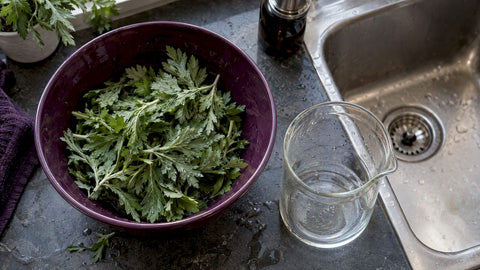
Mugwort is a group of plants in the Artemisia genus. In Korea, the plant has long been part of food and traditional remedies. In skincare, you will see it on ingredient lists as Artemisia princeps leaf extract, Artemisia vulgaris extract, Artemisia annua extract or, more casually, “mugwort” or “ssuk”.
The reason it keeps showing up in essences, sheet masks and lightweight creams is simple. Shoppers with sensitive skin want ingredients that feel calming rather than aggressive, and mugwort has a reputation for exactly that. It sits in the same family of “soothing” botanicals as centella asiatica, which we cover in our guide to how centella calms sensitive, reactive skin, and heartleaf, which we look at in our piece on heartleaf benefits.
A caution about the word “mugwort”: it is also sold as a herbal supplement and tea. This article is about mugwort applied to skin in cosmetic products. Findings on swallowing it do not automatically apply to a face essence, and the reverse is true too.
The main mugwort skincare benefits
Here is what researchers have actually reported, ranked roughly from best supported to least.
Calming inflammation and irritation
This is the benefit with the most behind it. A systematic review of 32 papers on topical mugwort derivatives, published in the Journal of Investigative Dermatology, reported reduced inflammation and dermatitis, antimicrobial potential and photoprotective effects. The same review notes that more human models and longer-term evidence are needed before firm conclusions can be drawn.
In plain terms: the signals are consistent, and the research field is still young.
Supporting the skin barrier
Your skin barrier is the outer layer that holds in water and keeps irritants out. Researchers at Kyushu University and the Sunstar Group found that Artemisia princeps extract increased the expression of filaggrin and loricrin, two proteins essential for maintaining that barrier. Their work tied this to activation of the AHR/OVOL1 pathway, which governs how skin cells produce those proteins.
This was a laboratory study. It tells us why mugwort may help a compromised barrier, not that every mugwort cream will repair one. If barrier health is your main concern, a mugwort product works best alongside a solid moisturizer. Our article on why moisturizer matters for healthy, hydrated skin explains the basics.
Hydration
A 2020 human trial on cosmetics containing Artemisia annua extract, as described by SkinSort’s ingredient analysis, showed increased stratum corneum hydration and reduced transepidermal water loss over four weeks. Less water loss means the skin holds moisture better, which is why mugwort essences often feel comforting on tight, dry or stressed skin.
The same source notes that published research on mugwort in finished products tends to cluster around a 1% concentration, and that an artemisinin-free Artemisia oil did well at 1% in a small human trial on sensitive and acne-prone skin. Treat that as a guide to what has been studied, since most brands do not disclose the exact percentage in their formulas.
Antimicrobial and antioxidant activity
Lab studies show mugwort can limit the growth of certain bacteria. A 2021 Korean study found that most tested mugwort tea products inhibited acne-associated bacteria, including P. acnes, S. aureus and S. epidermidis. That is test-tube evidence on tea products, not on a leave-on cosmetic worn on a real face. It is a reason to be interested, not a promise of clearer skin.
How strong is the evidence, really?
Honestly, modest. The table summarizes where each claim stands.
| Claimed benefit | What was studied | Strength of evidence |
|---|---|---|
| Calming irritation and redness | Review of 32 papers on topical mugwort | Consistent signals, more human data needed |
| Skin barrier support | Lab study on Artemisia princeps extract | Early, mechanistic |
| Hydration | Small human trial on Artemisia annua cosmetics (four weeks) | Promising, small |
| Antibacterial action | Lab tests on bacteria | Not shown in real-world acne treatment |
| General health uses | Not established for topical use | NCCIH says there is not enough evidence to judge safety or usefulness for any health condition |
One dermatology commentary on mugwort essence makes the same point: most benefits come from lab or small pilot studies, not large double-blind trials. It suggests viewing mugwort as a gentle, supportive ingredient for hydration and irritation relief rather than a replacement for evidence-backed medical treatments. We agree with that framing.
Does a mugwort mask help with acne?
It can help with the redness and irritation that come with breakouts, but it is not a proven acne treatment. The antibacterial results above are lab findings. Nothing in the research we reviewed shows that mugwort clears acne in people.
What a mugwort mask may do is take the edge off a flared, sensitive complexion. That matters because breakout-prone skin is often over-treated. The American Academy of Dermatology advises keeping the rest of your routine gentle when using over-the-counter acne medicines, because most acne products can lead to dryness. A soothing mask or essence fits that approach.
If you have persistent, painful or scarring acne, see a board-certified dermatologist. Mugwort is a comfort step, not a substitute for prescription care. For a broader look at gentle blemish care, read our guide to Korean acne care best practices.

Who should avoid mugwort or patch-test first
Soothing does not mean risk-free. Mugwort comes from the Compositae (daisy) family, and that family is a known source of contact allergy.
- Allergic reactions. A study in the Journal of the American Academy of Dermatology patch-tested healthy volunteers and found a positive reaction rate of 1.8% to mugwort. A published case report describes allergic contact dermatitis from cosmetics containing mugwort and other botanical extracts, relating the allergy to sesquiterpene lactones found in Compositae plants.
- Known plant allergies. If you react to ragweed, chrysanthemum, daisies or similar plants, talk to an allergist or dermatologist before trying mugwort products.
- Pregnancy and breastfeeding. The NCCIH says mugwort should not be used during pregnancy, and that its safety while breastfeeding is not well established. That guidance covers mugwort in general. If you are pregnant or nursing, ask your obstetrician or midwife before using any mugwort product, including skincare.
- Common side effect. WebMD lists contact dermatitis, including itching and rash, as the most common reported side effect when mugwort is applied to skin, and notes the reaction can vary with the amount and the product.
How to patch-test
- Apply a small amount of the product to the inside of your forearm or behind the ear.
- Leave it for 24 hours without washing the area, if comfortable.
- Repeat for a few days. Redness, itching, swelling or bumps mean you should stop.
- If a reaction is more than mild, see a dermatologist.
What not to mix with mugwort skincare
There is no documented dangerous interaction between mugwort and a specific ingredient. The practical risk is overloading skin that you are trying to calm. The AAD notes that exfoliating while using prescription retinoids, retinol products or benzoyl peroxide may worsen dryness or cause breakouts. It also says mechanical exfoliation can be too irritating for dry, sensitive or acne-prone skin, and that over-exfoliating can leave skin red and irritated.
Applied to a mugwort routine, that means:
- Skip scrubs and strong acids on the same night as a calming mask if your skin is already red or stinging.
- Introduce one new product at a time, so you can tell what caused a reaction.
- Use retinol and benzoyl peroxide on separate nights from exfoliating products, and follow your dermatologist’s advice if they prescribed them.
- Keep the base simple: gentle cleanser, hydrating step, moisturizer, sunscreen in the morning.
Mugwort is not a sunscreen. The photoprotective effects in the review are lab-level findings, so daily SPF stays non-negotiable.
Does mugwort affect hormones?
People often ask this because mugwort has a long history in traditional medicine, including uses connected to menstruation. Those uses involve swallowing it as a tea or supplement. We did not find research showing that mugwort in a face essence, mask or cream changes hormone levels. What the evidence does show is a precaution: the NCCIH advises against mugwort during pregnancy, and that is the main reason to ask your doctor first if pregnancy, nursing or a hormone-sensitive condition applies to you.
How to use mugwort in your routine
Mugwort shows up in several formats. Each has a different job.
Essences and toners
A watery essence is the easiest entry point. Apply after cleansing, pressing it into damp skin with clean hands. This is the step where hydration and calming benefits are most noticeable for sensitive skin. Browse face toners and mists to find lightweight options in this category.
Sheet masks and wash-off masks
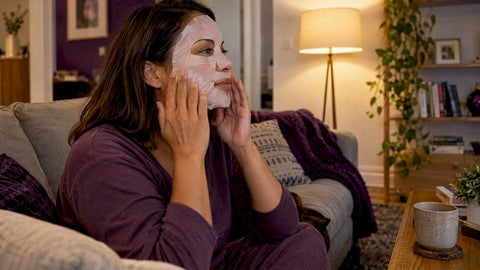
Masks deliver a short, concentrated dose and are useful when skin looks flushed after sun, wind or a harsh treatment. Use one to three times a week, and do not leave a sheet mask on longer than the label says, because once it dries it can pull moisture back out. Our face masks collection covers sheet and pack formats.
Creams and moisturizers
A mugwort cream gives longer contact time and doubles as your barrier-sealing step. Look for it alongside humectants and ceramides. See our face creams and moisturizers if you prefer fewer steps.
A simple evening routine
- Cleanse gently.
- Apply a mugwort essence or mask (not both on the first week).
- Add a hydrating serum if your skin feels tight.
- Seal with a moisturizer.
Korean routines lean heavily on layered hydration, and we explain the reasoning in why Korean brands emphasize hydration. If your barrier is the concern, our five-step beta glucan routine pairs well with a soothing botanical step.
Reading the label
- Look for Artemisia princeps, Artemisia vulgaris or Artemisia annua in the ingredient list. Higher on the list generally means a larger share of the formula.
- Fragrance and essential oils in the same formula can irritate sensitive skin, so a short ingredient list is a safer bet.
- A product with “mugwort” in its name may contain only a small amount. The name does not tell you the concentration.
- Skin that is reactive deserves extra care: introduce the product on a few nights per week first.
Our perspective on mugwort
We curate Korean skincare for people who want products that are effective and gentle, for every skin type. Mugwort fits that brief as a supporting player. It makes sense for shoppers whose skin feels reactive, tight or flushed and who want a calming step without a heavy active.

We would not call it a miracle ingredient, and we would be wary of anyone who does. The best-supported claims are the modest ones: soothing, hydration, barrier support. The evidence is still maturing, and a small percentage of people react to it. A good routine rests on the basics: cleansing without stripping, hydrating, moisturizing and wearing sunscreen every day.
Our advice is to choose one mugwort product, patch-test it, and give it a few weeks before judging. If your skin looks calmer and feels more comfortable, keep it. If not, nothing is lost, and many other soothing ingredients can do the job.
— Lunara
Shop soothing K-beauty at Lunara
If you want to build a calming routine, start with our face care collection, where you can filter toners, cleansers, masks and creams from Korean beauty brands. Our morning face care routine set is a simple place to begin if you want fewer decisions. Standard flat-rate shipping starts from $6.49, and you can see the full range on lunarashopping.com.
FAQ
Is mugwort good for your skin?
For many people, yes, particularly for sensitive or irritated skin. Research points to calming, hydrating and barrier-supporting effects, though most of it is early-stage. A small share of people are allergic, so patch-test before applying it to your face.
Who should avoid mugwort?
Anyone who has had a reaction to mugwort or related plants in the daisy family should skip it. The NCCIH says mugwort should not be used during pregnancy, and safety while breastfeeding is not well established. If you are pregnant or nursing, check with your doctor first.
What does mugwort do to hormones?
The hormone-related uses of mugwort involve taking it as a tea or supplement. We found no evidence that mugwort in a topical skincare product alters hormones. If you are pregnant, nursing or managing a hormone-related condition, ask your doctor before using it.
Does a mugwort mask help with acne?
It may calm the redness and irritation around breakouts, but it is not proven to treat acne. Lab studies show antibacterial activity, which has not been confirmed in people. Persistent acne needs a dermatologist’s guidance.
What should you not mix with mugwort skincare?
There is no specific banned pairing, but avoid stacking harsh exfoliants, scrubs, retinol or benzoyl peroxide on the same night as a calming mugwort step. The AAD warns that over-exfoliating can leave skin red and irritated. Introduce new products one at a time.
Sources
- Efficacy of topical mugworts in cosmetics, Journal of Investigative Dermatology
- Mugwort: Usefulness and Safety, NCCIH
- Antioxidant Artemisia princeps Extract Enhances the Skin Barrier, PMC
- Artemisia ingredient analysis, SkinSort
- Science behind mugwort essence, Boston Derm Advocate
- Mugwort tea products and acne bacteria, Korea Citation Index
- Patch test of mugwort in healthy controls, JAAD
- Allergic contact dermatitis caused by crude drug extracts
- Mugwort overview and side effects, WebMD
- How to safely exfoliate at home, American Academy of Dermatology
- Think that DIY acne trick is helping?, American Academy of Dermatology