An at-home Korean facial is a slow, layered routine you do once a week or so: cleanse, gently exfoliate, treat with a mask, massage, then hydrate and protect. You need about 45 to 60 minutes, a handful of product types and no special equipment. It will not match a clinic procedure, but it can leave skin cleaner, more hydrated and calmer when you keep it gentle and consistent.
This guide walks through each step in order, explains what each product type does, and shows how to adjust the routine for sensitive, oily, combination or rosacea-prone skin.
TL;DR
- A Korean facial at home follows six stages: double cleanse, gentle exfoliation, toner or essence, sheet mask, face massage, then moisturizer (plus sunscreen in the morning).
- Do it once a week. Exfoliate no more than that, and less often if your skin is sensitive or darker-toned.
- Patch test every new product on your inner elbow before it goes on your face.
- Expect a temporary glow, better hydration and a softer feel. Massage tools may help contour and elasticity over weeks, but a home facial cannot replace clinical procedures.
- Skip the heavy fragrance and “natural” shortcuts: neither guarantees a product is safe for you.
Table of Contents
- What an at-home Korean facial is (and what it is not)
- Before you start: patch test and set up
- The at-home Korean facial, step by step
- Adjust the facial for your skin type
- Make it a spa evening
- After the facial: aftercare and how long results last
- Our perspective
- Build your facial kit
- FAQ
- Sources
What an at-home Korean facial is (and what it is not)
The Korean facial most people picture in a salon is a long, multi-step treatment: deep cleansing, exfoliation, masking, massage and hydration, often lasting well over an hour. The at-home version borrows the same logic. Each stage prepares the skin for the next, and the finish is always moisture and protection rather than anything aggressive.
It is also worth separating it from the clinic treatments that show up under the same search, such as injectables, ultrasound lifting or thread lifts. Those are medical procedures performed by licensed professionals. A home facial is skincare, not a procedure.
Realistic benefits:
- Cleaner pores and a smoother surface from thorough cleansing and light exfoliation.
- Better hydration from water-based toners, essences and masks sealed in with a moisturizer.
- Less puffiness and a relaxed look from massage, which Korean beauty routines use to support circulation. Byrdie notes that consistency matters and that the visible effects are temporary.
- A routine you can actually keep, which matters more for skin health than any single treatment.
If you want the daily foundation first, our 10-step Korean skincare routine covers the everyday sequence this facial builds on.
Before you start: patch test and set up
New products are the most common reason a home facial goes wrong. Cleveland Clinic points out that a “natural” or “organic” label does not make a product automatically safe, since people can react to oils and minerals too. The same source notes that inner-elbow skin is very sensitive, similar to facial skin, which makes it a good place for a patch test.
How to patch test:
- Apply a small amount of the new product to your inner elbow.
- Leave it as directed and watch the area over the next day or two.
- Skip the product if you see redness, itching, burning or swelling.
Then set up your space:
- Tie your hair back and use a clean headband.
- Wash your hands and have a clean towel ready.
- Lay out your products in order, so you are not hunting for a bottle with a mask on your face.
- Keep water lukewarm. Hot water strips skin and adds to redness.
If you have a diagnosed skin condition or use prescription treatments, ask your dermatologist before adding exfoliants or masks.
The at-home Korean facial, step by step
Step 1: Double cleanse (5 to 8 minutes)
Start with an oil or balm cleanser to dissolve sunscreen, sebum and makeup, massaging it onto dry skin. Rinse, then follow with a gentle water-based cleanser to remove what remains. The goal is clean skin that does not feel tight afterward.
We go deeper on technique and timing in our Korean double cleansing guide. If you are shopping for the second step, browse our face cleansers and scrubs.
Step 2: Exfoliate gently (2 to 3 minutes, once a week at most)
Exfoliation clears dead surface cells and helps the products that follow absorb better. It is also the step where most people overdo it.
The American Academy of Dermatology says exfoliation should match your skin type: sensitive skin may do better with a washcloth or a mild chemical exfoliator, while thicker or oilier skin may tolerate stronger options. The same AAD page warns that over-exfoliating can leave skin red and irritated, and that people with darker skin tones should avoid aggressive exfoliation because of the risk of post-inflammatory hyperpigmentation.
Practical rules:
- Use light pressure and small circles, never scrubbing.
- Choose one exfoliant per session: a foaming scrub, a soft cloth or a mild acid, not all three.
- Stop if skin stings, turns pink or feels tight.
A rice-bran foaming scrub is a mild option for a weekly session. Our MIDHA Rice Bran Facial Scrub Foam is one example.
Step 3: Tone and mist (1 to 2 minutes)
Korean toners are not astringents. They are hydrating, often watery layers that rebalance skin after cleansing and prepare it for what follows. Pat a few drops into your skin with clean hands, and repeat once or twice if your skin is dry. Choose alcohol-light, fragrance-free formulas if your skin is reactive. See our range of face toners and mists.
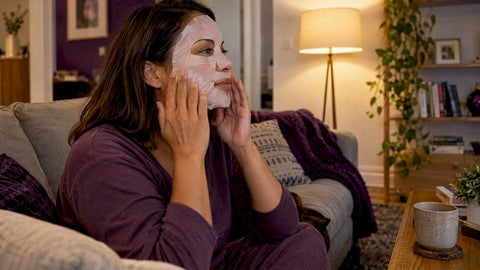
Step 4: Sheet mask (15 to 20 minutes)
This is the centerpiece of the facial. A sheet mask holds a concentrated essence against your skin, so the time under the mask is when your skin takes in the most hydration. Pick a mask for your main concern:
- Dull or dry skin: collagen- or hyaluronic-based masks for moisture. The MEDIHEAL Collagen Essential Mask is a single-sheet option.
- Tired, uneven-looking skin: vitamin-based masks. The MEDIHEAL Vita Essential Mask fits here.
- Reactive skin: soothing masks with simple ingredient lists, tested on your elbow first.
Follow the time on the package. Leaving a sheet on until it dries out can pull moisture back out of your skin. Remove it, then press any leftover essence into your face and neck rather than rinsing it away. You can compare more in our face masks collection.
Step 5: Massage (5 to 10 minutes)
While skin is slippery from essence, use your fingertips, a gua sha stone or a facial roller. Work upward and outward: from the center of the chin along the jaw, from the nose across the cheekbones, and from the brows to the hairline.

The evidence is encouraging but modest. In a trial reported by Dermatology Times, using gua sha or rollers five times a week for eight weeks improved contour with both tools, muscle tone with gua sha and elasticity with rollers. That is a daily-habit result, not a one-off facial result, so treat a weekly massage as a relaxing bonus and a daily two-minute session as the real routine.
Use enough slip (essence, a light oil or cream) so tools glide without tugging. Our Korean face massage method guide has the movements in detail, and you can find tools in our skin care accessories.
Step 6: Moisturize and protect (2 minutes)
The AAD’s order for applying products is simple: cleanse, apply any treatment, then moisturizer and/or sunscreen. Following a facial, a cream locks in the hydration you just added. Look for ceramides, panthenol or squalane for barrier support, in a texture that suits your skin: gel-cream for oily skin, a richer cream for dry skin. Browse face creams and moisturizers.
If you do the facial in the morning, finish with sunscreen. The AAD recommends broad-spectrum, water-resistant sunscreen of SPF 30 or higher every day. Evening is usually the better time: skin is fresher from exfoliation, and you do not need to go straight into sun exposure. Our Korean night routine shows how to wrap up a facial in 10 to 15 minutes on regular nights.
Adjust the facial for your skin type
Korean facials have a reputation for “glass skin”, but your starting point matters more than the trend. Adjust the same six steps like this.
| Skin type | Exfoliation | Mask choice | Moisturizer |
|---|---|---|---|
| Dry | Soft cloth or very mild exfoliant, every 1 to 2 weeks | Hydrating or collagen sheet | Rich cream with ceramides |
| Oily or acne-prone | Mild exfoliant weekly, no scrubbing over active breakouts | Light hydrating or clarifying sheet | Gel-cream, non-greasy |
| Combination | Gentle exfoliant, focus on the T-zone | Hydrating sheet | Light lotion, richer cream on dry areas |
| Sensitive | Washcloth only, or skip | Simple, fragrance-free sheet | Plain barrier cream |
| Darker skin tones | Very gentle, infrequent | Hydrating or brightening sheet | Barrier cream |
A few notes behind the table:
- Combination skin: treat zones differently rather than the whole face the same. Our combination skin routine explains how.
- Acne-prone skin: keep the facial soothing, not scrubbing. See our Korean acne care best practices.
- Rosacea-prone skin: dermatologists recommend fragrance-free products and testing before applying to the face. Skip exfoliation and massage unless your dermatologist agrees, and read our calm guide to rosacea-prone Korean skincare.
- Fragrance sensitivity: our guide to fragrance-free skincare for sensitive skin shows how to read labels.
If you are unsure whether exfoliation suits you, the AAD’s advice is to ask a dermatologist.
Make it a spa evening
The facial works best when the whole evening is slow. A warm bath or shower beforehand softens skin, and a calm setting makes the massage step more effective as a break from the day. If you like this ritual approach, our Korean spa at home guide covers soaking and contrast rinsing, and our Korean body care routine extends the same care below the neck. Do not forget lips: a quick treatment from our lip moisturizers and masks fits neatly after the sheet mask.
After the facial: aftercare and how long results last
A freshly exfoliated, masked face is more exposed than usual, so keep the next 24 hours simple:
- Use only cleanser, moisturizer and sunscreen.
- Do not add strong actives such as retinoids or acids on the same night unless your routine already includes them.
- Drink water and sleep well. That is plain good sense, not a hack.
Supporting your skin from the inside is a separate topic. If you are curious about antioxidants, you can read about glutathione benefits for skin and aging alongside your topical routine, and talk to a clinician before starting any supplement.
How long do results last? The glow from hydration and gentle exfoliation typically fades within days as the surface renews, which is why the routine is weekly. Massage effects are temporary unless you do them consistently, as the research above suggests. Lasting changes such as deeper wrinkles, scarring or loosened skin need professional treatment from a board-certified dermatologist, and a home facial is not a substitute.
Our perspective
We see two mistakes again and again among new K-beauty fans: buying a dozen products at once, and treating a facial like an intensive repair job. In our view, a good at-home facial is the opposite: it is gentle, repeatable and built on a few well-chosen products. We curate our selection for effective, gentle formulations and for inclusivity across skin types, so a first-time shopper can start small, patch test, and add products as the skin responds.
If you only buy three things for your first facial, make them a gentle cleanser, a hydrating sheet mask and a moisturizer you like using. Everything else is optional. If your skin reacts, stop, simplify and ask a dermatologist. Calm skin is always the goal, and glow follows from it.
— Lunara
Build your facial kit
We stock Korean skincare from brands such as COSRX, Beauty of Joseon, ANUA, MEDICUBE and more, organized by step so you can assemble a facial in one order. Start with the all face care products collection, try our Custom Skincare Kit Builder, or pick up the Morning Face Care Routine Set for the daily basics. Standard shipping is a flat rate from $6.49 at Lunarashopping.
FAQ
What are the benefits of a Korean facial treatment at home?
A home Korean facial deep-cleans, gently exfoliates and loads the skin with hydration, leaving it softer and brighter-looking. A massage step may reduce puffiness and, when done regularly, support contour and elasticity. The effects are temporary, so the benefit comes from repeating the routine.
How often should I do an at-home Korean facial?
Once a week suits most skin. Exfoliation is the limiting factor: the AAD warns that overdoing it causes redness and irritation. If your skin is sensitive or you are prone to dark marks, space facials further apart or skip the exfoliation step.
Can I do a Korean facial with sensitive or rosacea-prone skin?
Yes, in a stripped-down form: gentle cleanse, fragrance-free hydrating mask and a barrier cream, with no scrubbing or tools. Patch test everything first and check with your dermatologist about masks and massage if you have rosacea.
What is the difference between a glass skin routine and a Korean facial?
Glass skin is a goal: smooth, hydrated, light-reflecting skin. A Korean facial is one way to work toward it, alongside a daily routine of cleansing, hydrating and sunscreen. A weekly facial helps, but daily habits do most of the work.
Sources
- Cleveland Clinic: Am I Allergic to My Skin Care Products?
- AAD: How to safely exfoliate at home
- AAD: Should I apply my skin care products in a certain order?
- AAD: 10 skin care secrets for healthier-looking skin
- AAD: 7 rosacea skin care tips dermatologists recommend
- Dermatology Times: At-home facial massage methods and skin elasticity, tone and contour
- Byrdie: 11 Korean Beauty Secrets You Should Know